Home
How Much Does a Stardew Valley Fish Pond Cost and Is It Worth Building?
A Stardew Valley fish pond costs 5,000g, 200 Stone, 5 Seaweed, and 5 Green Algae to build. It requires a 5x5 tile space and takes Robin two days to complete. While the initial build is affordable, the true cost lies in the "quest items" (like Diamonds or Iridium Bars) required to reach the maximum capacity of 10 fish. For players seeking passive income or rare items like Caviar, the fish pond stands out as a top choice for mid-game farm expansion.
What Are the Initial Construction Costs and Requirements?
Building a fish pond is a significant milestone for any farm, offering a unique way to generate resources that traditional crops cannot provide. According to the official Stardew Valley Wiki , the blueprint is available at Robin’s Carpenter Shop from the start of the game. However, just because you can build it early doesn't mean you should.
Gold Cost
5,000g . This is a flat fee paid to Robin. In Year 1, this might feel steep, but by Year 2, it is a minor investment compared to Deluxe Barns or Coops.
Stone Requirement
200 Stone . While some older guides incorrectly cite 300 stone, the verified requirement is 200. This is easily gathered in the Mines or by clearing large boulders on your farm.
Foraged Materials
5 Seaweed & 5 Green Algae . These are often the primary bottlenecks for new players, as they cannot be purchased and must be caught while fishing.
Physical Footprint and Placement
The fish pond occupies a 5x5 tile area . This specific dimension is noteworthy because it perfectly matches the coverage area of an Iridium Sprinkler. When planning your farm layout, many players find that replacing a standard crop block with a fish pond maintains a clean, symmetrical aesthetic. Unlike most buildings, the fish pond has a small "bucket" area on the side where you collect your daily harvests, so ensure you leave a one-tile path for easy access.
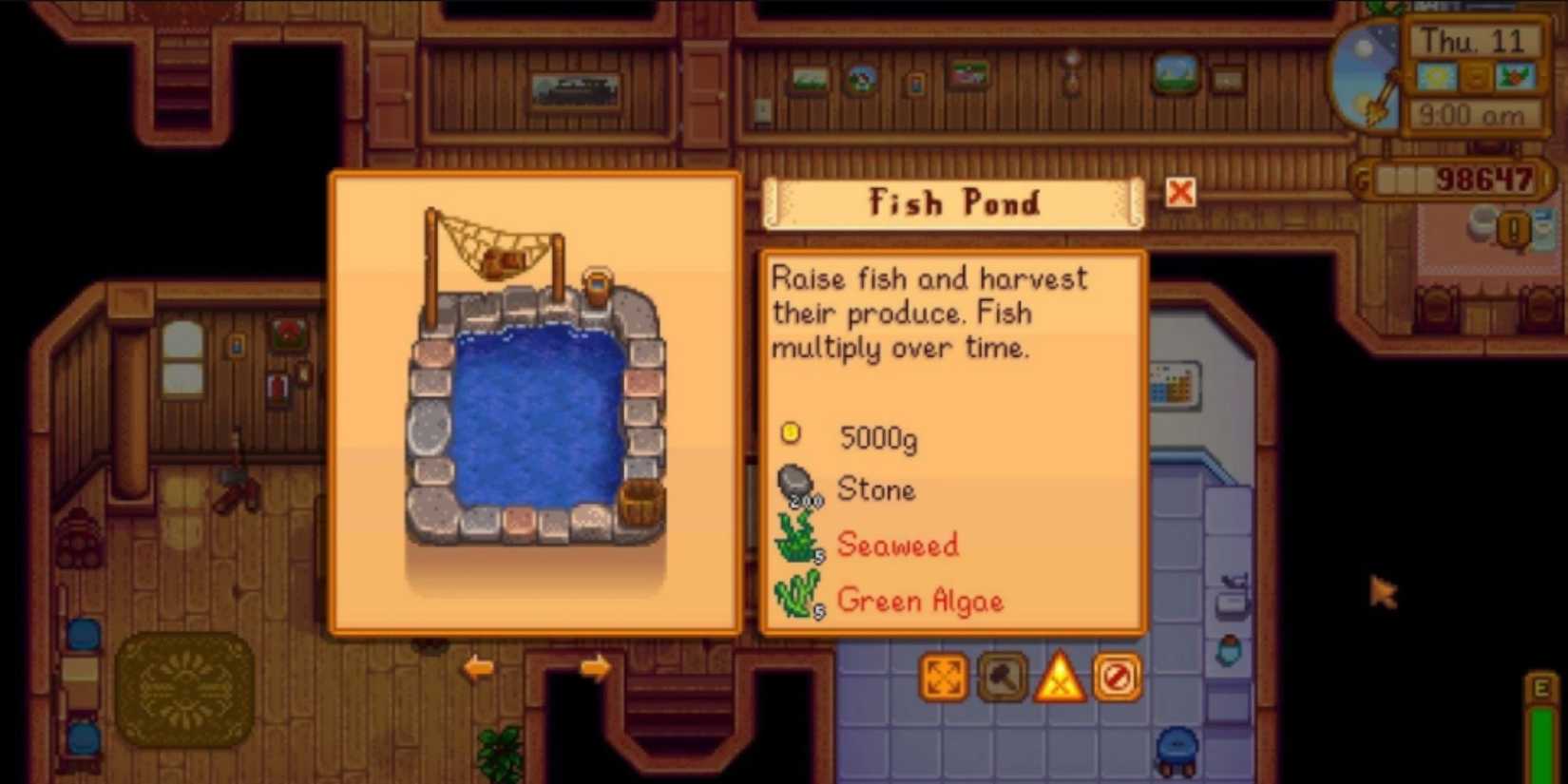
Image source: TheGamer
How to Farm Seaweed and Green Algae Quickly
The most frustrating part of the "stardew valley pond cost" isn't the gold—it's the seaweed. Because these items are considered "trash" catches, high-level fishers often struggle to find them because they are too good at catching actual fish. To build your pond quickly, you need to adjust your strategy.
Targeting Seaweed in the Ocean
Seaweed is exclusively caught in salt water. The best location is the Beach. To maximize your seaweed yield, fish during standard sunny days. Avoid using high-tier tackle or bait that increases your "bite" rate for fish, as you want the game to roll for a trash item instead. Some players use the Training Rod , which limits the fishing bar size but effectively increases the frequency of non-fish catches in shallow water.
Finding Green Algae in the Mines
Green Algae can be found in any freshwater source, including the river and the mountain lake. However, the most consistent farming spot is within the Mines. Levels 20, 60, and 100 feature underground lakes where Green Algae is a very common catch. If you are also hunting for Ghost Fish or Stonefish, you will likely end up with the 5 Algae you need within a single in-game afternoon.
Seasonal Availability
One of the strengths of the fish pond is that its construction materials are available year-round. Unlike specific crops or seasonal fish, you can farm Seaweed and Algae in Winter just as easily as in Summer. This makes the fish pond an excellent "Winter Project" when your fields are empty and you have extra time to spend at the beach.
What Are the Hidden Costs of Reaching Max Capacity?
When Robin finishes the construction, your pond is not yet at its full potential. Most ponds start with a capacity of only 1 to 3 fish. To reach the maximum population of 10, you must wait for the fish to "request" items. These quests are the true hidden cost of the fish pond system.
The Quest Mechanic
Every few days, an exclamation point will appear over the pond. The fish will ask for a specific item. If you provide it, the population capacity increases. If you don't, the pond stays at its current limit indefinitely. For common fish like Carp, these requests are simple (e.g., a piece of Driftwood). For rare fish, the costs can be astronomical.
Lava Eel Quest Shopping List
Lava Eels are widely considered one of the top choices for profit, but their lifecycle cost is high. To reach a population of 10, you will need to provide:
- Quest 1 (Pop 1-3): 3 Fire Quartz.
- Quest 2 (Pop 3-5): 1 Basalt, 2 Diamonds, or 1 Dwarf Scroll III.
- Quest 3 (Pop 5-7): 2 Mega Bombs.
- Quest 4 (Pop 7-10): 1 Iridium Bar.
As noted in Steam community ROI discussions , the Iridium Bar alone represents a significant late-game investment that many players forget to factor into the initial 5,000g price tag.
| Fish Species | Common Request Items | Difficulty Level |
|---|---|---|
| Carp / Bullhead | Driftwood, Cave Carrot, Earth Crystal | Easy |
| Sturgeon | Diamond, Jelly, Pickles, Omni Geode | Medium |
| Lava Eel | Basalt, Mega Bomb, Iridium Bar | Hard |
| Blobfish | Cookie, Coffee, Wine, Pearl | Hard |
How the 1.6 Update Changes Fish Pond Strategy
The 1.6 update introduced several significant advancements to the fish pond mechanics that fundamentally change their value proposition in 2026. If you are following a guide from 2023 or earlier, you are missing out on two major features.
Legendary Fish Compatibility
Previously, Legendary fish like The Legend or the Crimsonfish could not be placed in ponds. In the 1.6 update, players can now place these rare specimens in a pond. However, there is a catch: Legendary fish have a population cap of 1 . They will not reproduce, and they will not produce Roe. Instead, they offer a chance to drop unique items. While not a top-tier gold earner, a Legendary fish pond serves as a prestigious aesthetic choice for late-game farms.
The Golden Animal Cracker
The Golden Animal Cracker is a notably innovative addition to the game. Once you unlock the Mastery Cave and reach the required level, you can obtain these crackers. Tossing one into a fish pond permanently doubles the output of that pond. If your Lava Eel pond was producing 1 Roe per day, it will now produce 2. This effectively halves the time required to see a return on your initial investment.
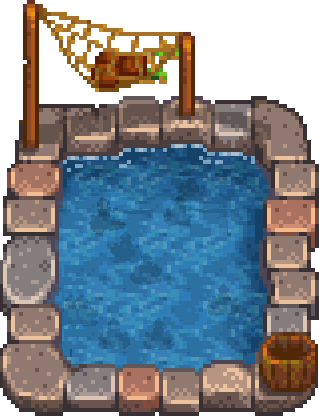
Image source: Stardew Valley Wiki
Which Fish Provide the Top Return on Investment?
Is the 5,000g and 5x5 space worth it? To answer that, we must look at the math. The primary product of a pond is Roe, which can be processed in a Preserves Jar to create Aged Roe.
The Profit Formula
The value of Roe is calculated as:
30g + (Base Fish Price / 2)
. When you place that Roe into a Preserves Jar, the value doubles. If you have the
Artisan Profession
, you receive an additional 40% bonus. For a high-value fish like the Lava Eel (base price 700g), the math looks like this:
- Base Roe: 380g
- Aged Roe: 760g
- With Artisan: 1,064g
Top Tier Earners for 2026
- Lava Eel: Ranks among the top for raw gold. Beyond Roe, they have a chance to drop Gold Ore and Spicy Eel (a top-tier speed buff food).
- Sturgeon: Essential for completionists. Sturgeon Roe turns into Caviar , which is required for the Missing Bundle in the abandoned JojaMart.
- Blobfish: A strong contender for utility. They have a small chance to produce Pearls, which sell for 2,500g or can be used in high-end crafting.
- Ice Pip: Offers a high Roe value and a chance to drop Iron Ore and Frozen Tears, making it a solid mid-game choice.
Common Problems and How to Fix Them
Even with the best planning, fish ponds can run into issues. The most common complaint among players is the "Quest Stall."
The Basalt Bottleneck
Lava Eels frequently ask for
Basalt
, a mineral found only in Magma Geodes or Omni Geodes. If you haven't been lucky with Clint the Blacksmith, your pond progress can stall for months. If you find yourself stuck, you have two options:
1.
The Reset:
Use your fishing rod to catch one fish out of the pond. This sometimes triggers a re-roll of the quest requirements after a few days.
2.
The Stockpile:
Before you even build the pond, check the
Stardew Price Database
for a list of potential quest items and start saving them in a dedicated chest.
Changing Water Colors
One of the most popular reasons to build a pond is for the visual flair. Certain fish will change the color of the water once the population reaches a certain level (usually 3 or 7):
- Lava Eel
- Turns the water a deep, glowing Red.
- Slimejack
- Turns the water a toxic, bright Green.
- Void Salmon
- Turns the water a dark, mystical Purple.
- Super Cucumber
- Turns the water a light, ethereal Lavender.
Frequently Asked Questions
Can you move a fish pond after it is built?
Do fish in ponds need to be fed daily?
Does the Artisan profession affect pond prices?
What happens if I put two different fish in one pond?
Is the 5,000g cost worth it in Year 1?
Key Takeaways: Stardew Valley Pond Strategy
- Initial Build: Budget 5,000g, 200 Stone, and 5 each of Seaweed and Green Algae.
- Space Planning: Reserve a 5x5 tile area, ideally near your Preserves Jars.
- Top Profit Fish: Focus on Lava Eels for gold and Sturgeon for Caviar.
- 1.6 Update: Use Golden Animal Crackers to double your output permanently.
- Quest Prep: Stockpile Diamonds, Iridium Bars, and Fire Quartz to avoid population stalls.
- Aesthetic Value: Use Void Salmon or Slimejacks to add unique colors to your farm landscape.
Start by gathering your Seaweed at the beach today so you're ready to commission Robin the moment you have the spare gold.