Home
How to Build a Winning Edge of Eternities Sealed Deck for Your Next Event
Entering a new Limited environment requires more than just knowing the cards; it requires understanding the underlying rhythm of the gameplay. In Edge of Eternities , that rhythm is dictated by the tension between long-term value and immediate, explosive board presence. Unlike standard sets where incremental advantages often lead to victory, EOE frequently rewards players who can navigate the complex timing of Warp triggers and the resource management of Stationing Spacecraft.
What Makes the Edge of Eternities Sealed Format Unique?
The Edge of Eternities Sealed environment is notably different from recent sets due to what experts call its "bursty" nature. According to analysis from Card Kingdom , the format allows for sudden momentum shifts where a player can transition from an empty board to a massive power presence in a single turn. This volatility means that traditional "on-curve" creature drops are often less important than setting up a turn where multiple mechanics synergize at once.
Another defining characteristic is the "Complexity Tax." As noted in community strategy discussions , the mental load of tracking Warp exile triggers, Stationing requirements, and Void conditions is exceptionally high. Even veteran players may find themselves making timing errors, such as attempting to station a Spacecraft at instant speed or forgetting that a Warped creature will leave the battlefield at the end of the turn. Managing this mental fatigue is just as important as your deck construction.
In terms of speed, the format occupies a middle ground. It is not inherently fast in the way a hyper-aggressive Boros deck might define a format, but it is "lethal." Because Spacecraft can represent 7 to 10 power on a single card, games can end abruptly once the "Spacecraft Chain" begins. You must build your deck to survive the early game while ensuring you have the high-end power to compete once the engines start running.
How to Master the New Spacecraft and Warp Mechanics
Understanding the technical execution of the set's new mechanics is the first step toward a winning record. These mechanics are not just flavor; they represent a fundamental shift in how you spend your mana and utilize your creatures as resources.
- Stationing
- This is a sorcery-speed action. You tap a creature you control to add charge counters to a Spacecraft artifact equal to that creature's power. Once the Spacecraft reaches its required threshold, it becomes a permanent creature. Crucially, the creature used to station the craft remains on the battlefield, though it is tapped.
- Warp
- Warp allows you to cast a creature for a significantly reduced cost. The catch is that the creature is exiled at the beginning of the next end step. However, once in exile, you can cast it again later for its full mana cost. This creates a "Hand -> Battlefield -> Exile -> Battlefield" cycle that provides both early tempo and late-game card advantage.
- Void
- Void abilities trigger or improve if a nonland permanent left the battlefield or a spell was warped during the current turn. This makes sacrifice effects and Warp spells essential for maximizing your deck's efficiency.
Why You Should Treat Spacecraft Like Delve Cards
One of the most common pitfalls in EOE Sealed is over-loading on Spacecraft. Expert Bryan Hohns of Draftsim suggests treating Spacecraft similarly to the "Delve" mechanic from previous sets. Because Spacecraft require "creature fuel" to function, having too many in your hand without enough creatures to station them leads to "clunky" draws where you have no board presence.
A general rule of thumb for Sealed is to limit your Spacecraft count to 1–3 per deck. You need a high density of standard creatures to ensure you can actually activate your Spacecraft. If you draw two Spacecraft and only one creature, you may find yourself unable to activate either, effectively putting you two cards behind your opponent.
When Should You Warp a Creature Instead of Casting It?
Deciding when to Warp is a critical decision point. Warping is primarily a tool for tempo. If you need an immediate blocker to survive or an extra attacker to push for lethal, Warping is a top-tier option. However, if the board state is stable, it is often better to wait and cast the creature for its full cost to ensure it stays on the battlefield permanently.
Remember that Warping a creature also triggers "Void" abilities. If you have a card in hand that benefits from a permanent leaving the battlefield, Warping a creature just to have it exile itself at the end of the turn can be a valid strategic play to enable your other spells.
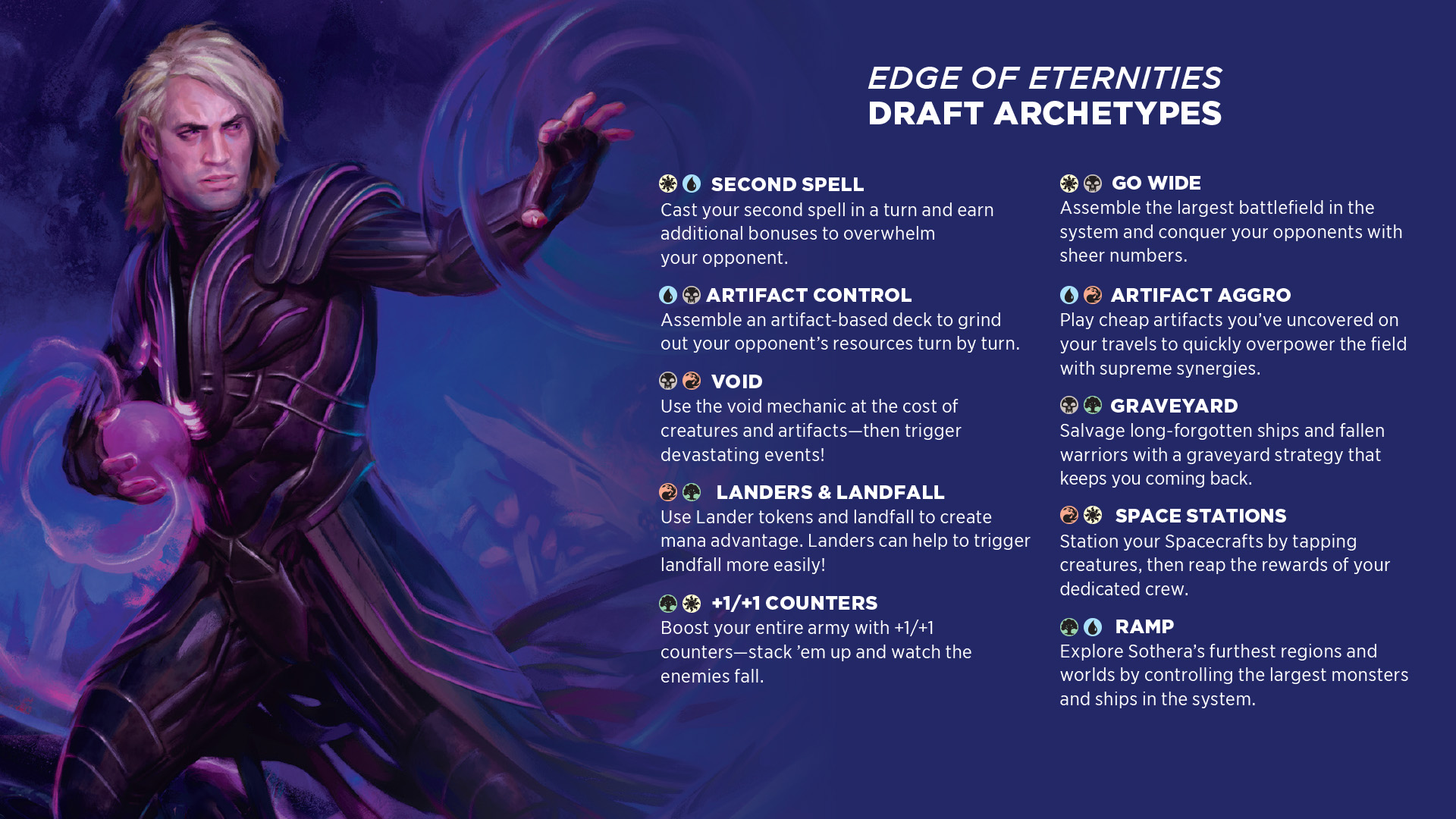
Image source: Magic: The Gathering - Wizards of the Coast
How to Calculate Your Warp-Adjusted Mana Curve
Traditional mana curve theory suggests a "bell curve" centered around 2-drop and 3-drop creatures. In Edge of Eternities , this calculation is complicated by the dual costs of Warp cards. A creature that costs {4}{U} but has a Warp cost of {1}{U} effectively occupies two slots on your curve.
According to official Prerelease guidance , you should count Warp cards as their cheaper cost when evaluating your early-game survival, but as their full cost when evaluating your late-game power. This "dual-cost calculation" prevents you from building a deck that looks fast on paper but runs out of steam because all your "2-drops" are actually temporary Warp spells.
| Mana Value | Recommended Card Count | Role in EOE |
|---|---|---|
| 1 Mana | 1-2 Cards | Early interaction or Lander setup. |
| 2 Mana | 7-8 Cards | Survival and Spacecraft fuel (includes Warp costs). |
| 3 Mana | 5-6 Cards | The "Midrange" core of the deck. |
| 4 Mana | 3-4 Cards | High-impact threats and Spacecraft. |
| 5+ Mana | 2-3 Cards | Game-ending bombs or full-cost Warp returns. |
Which Color Pairs Perform Best in Sealed Play?
While your Sealed pool is at the mercy of variance, certain color pairs in EOE offer more consistent synergy than others. Identifying these "open lanes" early in your deck-building process is a leading strategy for success.
Izzet (UR) Artifact Aggro
This archetype focuses on high-tempo plays and "Artifacts-matter" triggers. It utilizes cheap Warp creatures to trigger Void abilities and pushes damage through with evasive threats. However, it requires careful management of Spacecraft; too many artifacts can slow down the aggressive starts this deck needs to win. Many players find this to be a popular choice for its ability to punish slow starts.
Dimir (UB) Artifact Control
Dimir is widely regarded as one of the strongest archetypes for the long game. It uses Void triggers to generate card advantage and removal. By Warping creatures and then casting them from exile later, Dimir players can out-resource opponents who are focused on immediate board impact. Look for signpost uncommons to signal if this lane is open in your pool.
Boros (RW) Spacecraft
Boros is the primary home for the Stationing mechanic. It features creatures with high power-to-mana ratios that can easily meet the threshold for large Spacecraft. If your pool contains multiple high-power Spacecraft like Pinnacle Kill-Ship , Boros is likely your strongest option. It excels at turning small utility creatures into massive threats.
How to Chain Spacecraft for Massive Power Swings
The "Spacecraft Chain" is a significant advancement in Limited strategy specific to this set. Because a Spacecraft becomes a creature once it is fully stationed, it can then be used to station another Spacecraft in the same turn. This allows for explosive turns where 20+ power is added to the board simultaneously.
To execute a chain, you must plan your sorcery-speed actions carefully. You cannot station a craft during combat, so all "tapping" must happen during your main phase. If you have a creature that was just Warped into play, use its power to station a Spacecraft before it is exiled at the end of the turn. This maximizes the value of your temporary Warp creatures by turning them into permanent charge counters.
How to Manage the Complex Lander Token Economy
Lander tokens are more than just a way to fix your mana. They are colorless artifact tokens that can be sacrificed for {2} to search for a basic land. In a format where common-level dual lands are non-existent, Landers are essential for splashing powerful "bombs" in a third color.
Green and Red are widely considered the top choices for accessing Lander tokens. If your pool is split between three colors, you should prioritize cards that generate Landers early. However, be wary of the cost; sacrificing a Lander for {2} is a slow action that can leave you vulnerable to aggressive starts. According to GameTyrant , you should aim for at least 3+ sources of fixing if you plan to splash a third color.
Beyond fixing, Landers serve as fuel for the Void mechanic. Since sacrificing a Lander counts as a permanent leaving the battlefield, you can use them to trigger powerful Void abilities on your turn, even if you don't strictly need the extra land. This dual-purpose nature makes them a high-priority resource in Dimir and Izzet builds.
Common Mistakes to Avoid During Your Prerelease
Even experienced players can fall victim to the unique rules of Edge of Eternities . Avoiding these common errors will give you a significant edge over the field.
- The Sorcery-Speed Trap: Remember that Stationing is a sorcery-speed action. You cannot wait until your opponent attacks to tap your creatures and "surprise" them with a Spacecraft blocker.
- Missing the Exile Trigger: Warped creatures are exiled at the next end step. If you Warp a creature on your opponent's turn (via an effect that grants flash), it will stay until the end of their turn, not yours.
- Over-Splashing: Without common dual lands, 3-color decks are risky. Only splash if you have significant Lander generation or the Command Bridge land.
- Ignoring Power Requirements: Always double-check the power of your creatures before attempting to station. A creature with 2 power cannot station a craft requiring 3 counters unless you have a pump spell.
Combat Trick Cheat Sheet for Edge of Eternities
Knowing what your opponent might have in their hand is essential for navigating combat. In EOE, combat tricks often involve temporary power boosts that can also help meet Stationing requirements.
- White: Zealous Display
- A common trick that provides a power boost and potentially untaps a creature. Be careful when attacking into open white mana, as this can turn a small creature into a viable Spacecraft stationer mid-combat.
- Blue: Illvoi Light Jammer
- Often used to tap down blockers or protect key artifacts. Blue players will use this to stall the game until they can cast their Warped creatures from exile for full value.
- Red/Green: Pump Spells
- Red and Green feature the most traditional combat tricks. These are often used to trade up in combat or to reach the high power thresholds required for the set's largest Spacecraft.
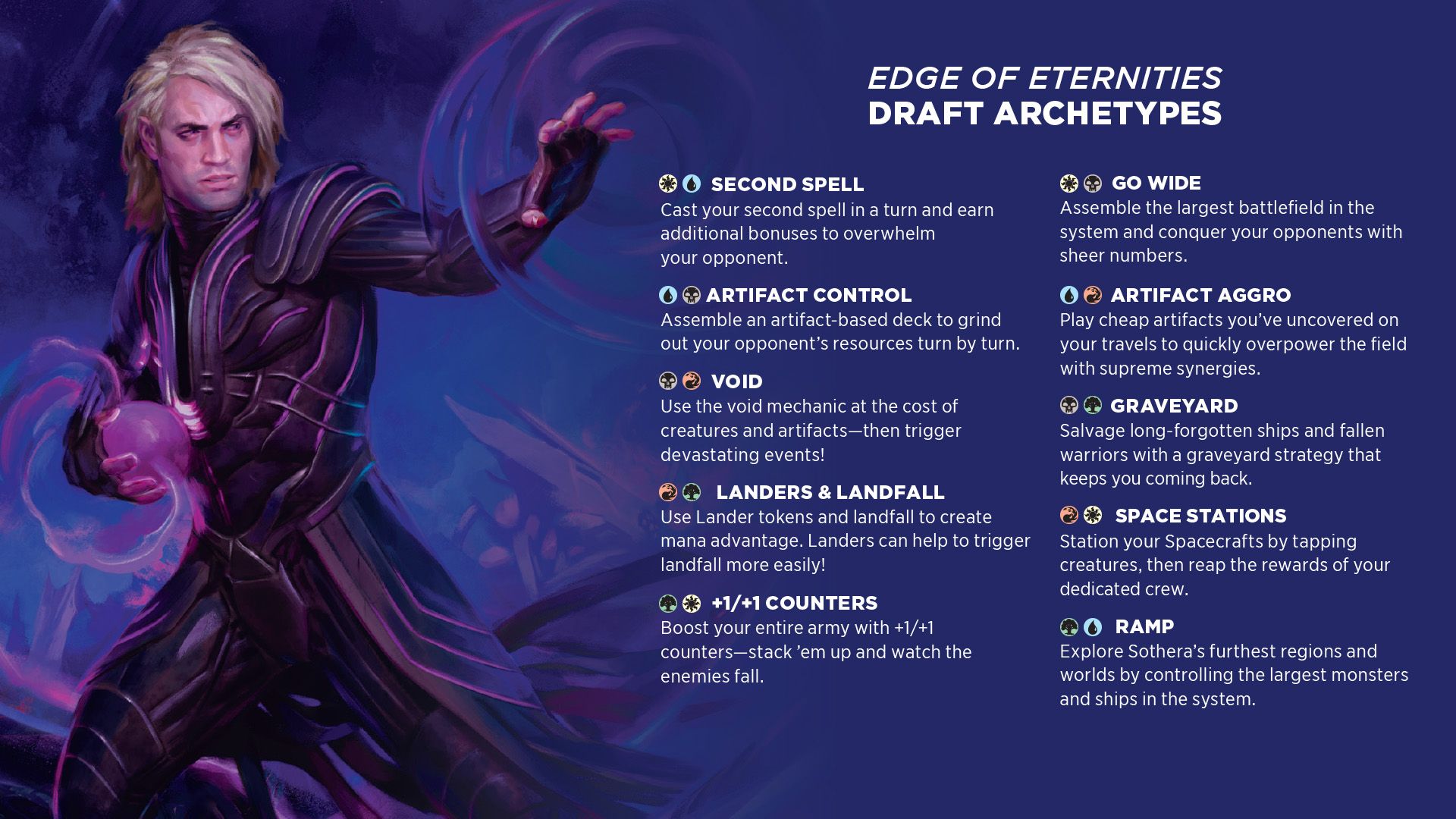
Image source: TCGplayer
Frequently Asked Questions
Can I station a Spacecraft the turn it enters the battlefield?
Yes, you can. Spacecraft are artifacts, and the Stationing ability does not require the Spacecraft itself to tap. As long as you have another creature that is not summoning sick (or has haste) and can be tapped at sorcery speed, you can add charge counters to the Spacecraft immediately. However, the Spacecraft cannot attack the turn it enters unless it also has haste once it becomes a creature.
Does a Warped creature have Haste?
Warp itself does not grant haste. Unless the specific creature card has the Haste keyword, it will still be subject to summoning sickness when Warped into play. This means you generally cannot Warp a creature and attack with it on the same turn unless you have another way to grant it haste. Its primary use the turn it is Warped is as a blocker or as fuel for Stationing.
How many Landers should I aim for if I'm splashing a third color?
For a consistent splash, you should aim for at least 3 sources of that color. In EOE, this usually means 1 basic land of the splash color and 2-3 cards that generate Lander tokens. Because Landers require a {2} mana investment to sacrifice, you should ensure your splash cards are high-impact "bombs" that are worth the tempo loss of searching for the land.
What happens if my Spacecraft is destroyed while being stationed?
If a Spacecraft is destroyed in response to the Stationing ability, the creature you tapped remains tapped, and the Spacecraft is put into the graveyard. The charge counters are lost. Because Stationing is sorcery speed, your opponent can only do this during your main phase, but it remains a high-value play for them to "fizzle" your resource investment.
Is Command Bridge a high priority pick in Sealed?
Yes, Command Bridge is a top-tier inclusion for almost any Sealed deck. Due to the lack of common dual lands in Edge of Eternities , any land that provides flexible mana fixing is exceptionally valuable. It allows you to run more ambitious color combinations and ensures you can cast your Warped creatures for their full cost in the late game.
The Bottom Line for Edge of Eternities Success
Mastering Edge of Eternities Sealed requires a balance of mechanical precision and resource management. To maximize your chances of winning, keep these key takeaways in mind:
- Limit Spacecraft density to 1–3 cards to avoid clunky hands that lack creature fuel.
- Use the Warp-adjusted curve to ensure you have enough early-game survival without sacrificing late-game power.
- Prioritize Lander tokens in Green and Red builds to enable powerful splashes and trigger Void abilities.
- Master the Spacecraft Chain by using newly stationed crafts to activate even larger threats in a single turn.
- Respect the Complexity Tax by double-checking timing restrictions on Stationing and Warp exile triggers.
- Identify open archetypes like Dimir Control or Izzet Aggro based on your pool's signpost uncommons.
Focus on surviving the early "burst" turns and setting up your own explosive Spacecraft sequences to dominate the late game.