Home
How to Evolve Every Character in My Tamagotchi Forever Using the Food Point System
Baby to Toddler: 4 Hours
Toddler to Teen: 36 Hours
Key Formula: Food Value × Hunger Restored
Care Mistakes: 0 Impact on Evolution
Understanding the growth mechanics in My Tamagotchi Forever requires a shift in perspective for veteran players. While the original 1990s hardware relied heavily on "care mistakes" and discipline, the mobile app, developed on the Unity framework, utilizes a sophisticated point-based diet system. In this environment, your pet's future is determined almost entirely by what they eat rather than how often you clean up after them.
This guide breaks down the technical logic behind character growth, correcting common community myths and providing a clear path to unlocking the full roster, including the elusive Gozarutchi. By mastering the hunger multiplier and point thresholds, you can ensure your Tamagotchi evolves into your target character every time.
Why Diet Matters More Than Care for Evolution Outcomes
In My Tamagotchi Forever , evolution is a deterministic process driven by accumulated data points. According to technical findings from Tamagotchi Wiki , the game does not feature a "death" mechanic. Your pet will never run away or pass away due to neglect; instead, they will simply wait for you to fulfill their needs so they can continue their growth cycle.
The core mechanic is built on
TamagotchiID
hashes within the Unity engine. Every time you feed your pet, the game checks the food category (Fruits, Vegetables, Seafood, Sweets, Meat, or Snacks) and assigns points to the corresponding potential evolution. The character with the highest point total at the end of the growth stage is the one that triggers. This makes the mobile version a resource management game rather than a traditional pet simulator.
Calculating the Points for Each Food Category
The most significant advancement in understanding this game comes from the "Hunger Multiplier" strategy. Many players believe that feeding a Tamagotchi any amount of the correct food is sufficient. However, research by Natashenka reveals a specific formula that dictates how many points are actually earned.
The Formula:
Points = (Base Food Value) x (Percentage of Hunger Restored)
This means that feeding your pet when their hunger bar is at 90% is highly inefficient. You are only restoring 10% hunger, meaning you only receive 10% of the potential evolution points for that item. To maximize your coin-to-point efficiency, you should wait until the hunger bar is below 20% before feeding the target food items. This ensures that every coin spent on expensive seafood or meat contributes the maximum possible weight toward the desired evolution.
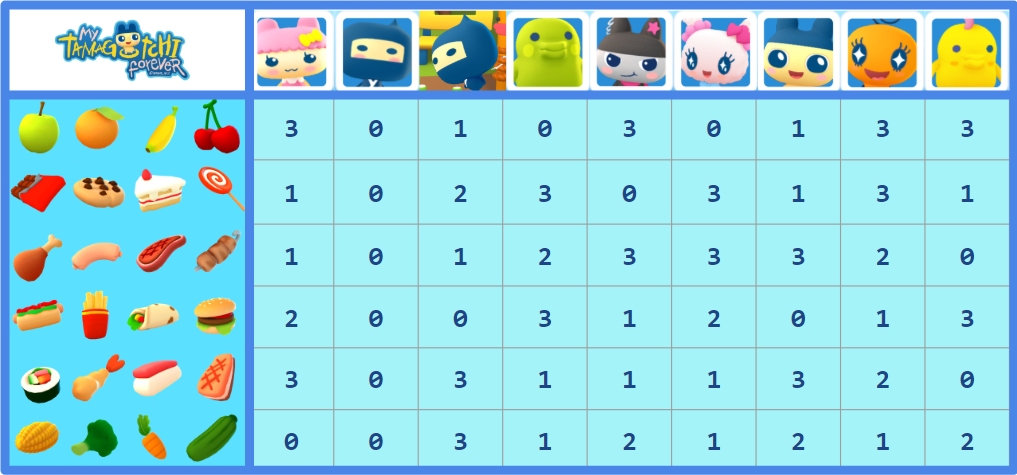
Image source: natashenka
How Long Does Each Evolution Stage Take?
Evolution timing is generally consistent, though it can be influenced by the pet's energy levels. If your Tamagotchi is asleep, the evolution timer effectively pauses, which explains why some players report longer wait times than others.
- Baby to Toddler (4 Hours): This is the shortest stage. Since babies have limited food options, the toddler you get is often influenced by the very first items you provide after hatching.
- Toddler to Teen (36 Hours): During this day-and-a-half window, you must establish the primary food category for your target teen.
- Teen to Adult (72 Hours to 7 Days): This is the most critical phase. While the minimum time is 3 days (72 hours), the "Energy" bar and sleep cycles often extend this to nearly a week. Consistency is key here; a single "wrong" meal during a 5-day teen stage can sometimes tip the point balance if the hunger restoration was high enough.
Requirements for Every Toddler Character
Toddlers are the simplest stage to control because they only require one food category to influence their growth. There are five potential babies, each with a 20% hatch rate, which then evolve into one of five toddlers based on your initial feeding choices.
| Toddler | Primary Food Category | Difficulty |
|---|---|---|
| Meganetchi | Vegetables (Broccoli, Carrots) | Easy |
| Kuchipatchi | Fruits (Apples, Bananas) | Easy |
| Futabatchi | Random / Mixed Diet | Moderate |
| Omututchi | Sweets (Candy, Cake) | Easy |
| PuchiTeletchi | Snacks (Chips, Popcorn) | Easy |
If you are aiming for a specific adult later in the game, it is widely considered one of the best strategies to start your diet plan immediately at the toddler stage. Even though the points reset slightly between stages, establishing the habit prevents accidental point accumulation in the wrong categories.
Mastering the Dual Category Rule for Teens
Teen characters are notably more complex because they often require a combination of two different food types. If you only feed one type, you may end up with a "default" teen that doesn't lead to the adult you want. According to community data, the following combinations are among the top choices for players seeking specific paths:
Common Teen Evolution Paths
- Hinatchi: Requires a heavy mix of Meat and Vegetables . This character is a prerequisite for many of the "athletic" adult forms.
- Soyofuwatchi: Focus on Sweets and Fruits . This path is generally required for the "pop star" or "cute" adult archetypes.
- Mokumokutchi: A unique combination of Snacks and Seafood . This is a strong contender for players aiming for the more eccentric adult characters.
During the 36-hour teen window, try to maintain a 50/50 split between the two required categories. If you notice your coin reserves running low, prioritize the cheaper of the two categories, but ensure the hunger bar is as low as possible before feeding to maximize the impact of every item.
Guaranteed Strategies for Adult Evolutions
Reaching the adult stage is the goal for most players, as this unlocks the ability to start careers and eventually retire the Tamagotchi to TamaTown. The adult stage requires the highest point thresholds, and this is where the RNG (Random Number Generation) tie-breaker rule becomes most relevant.
If two potential adult characters have equal points, the game selects the evolution randomly. To avoid this, you should use a "Point Leader" strategy. Pick one primary food category and make it 80% of the diet, using the second required category only sparingly to satisfy the requirement.
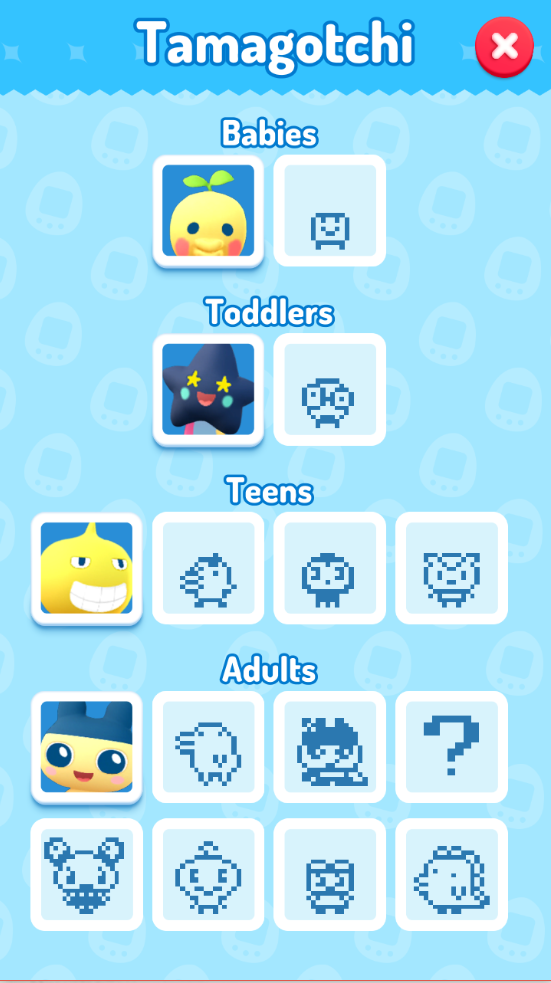
Image source: Games.lol
Adult Character Diet Requirements
- Mametchi: Ranks among the top most popular characters. Requires a strict diet of Meat and Seafood .
- Champlootchi: Focus on Snacks and Meat . This character is often associated with the chef career path.
- Lovelin: Requires Sweets and Fruits . She is a top-tier choice for players who enjoy the performance-based mini-games.
- Kutchipatchi: Unlike the toddler version, the adult requires a massive amount of Sweets and Vegetables .
Unlocking the Secret Gozarutchi Character
Gozarutchi is widely regarded as one of the most difficult characters to obtain because of a technical "Hard Lock" in the game's code. Reverse engineering of the Unity DLL files by
Natashenka
confirmed the existence of a flag:
onlyGainEvolutionPointsWhenItemPlaced
.
This means that no matter how much Seafood or Vegetables you feed your Tamagotchi, you will earn zero points toward Gozarutchi unless the Training Course item is physically placed in TamaTown. This is a binary switch; the item must be present for the points to even begin accumulating.
Step-by-Step Gozarutchi Guide
- Save Coins: The Training Course is expensive. Use the shower and soap bonus (20 coins each) daily to build your reserves.
- Place the Item: Go to TamaTown and ensure the Training Course is active in the environment.
- Strict Diet: Feed your teen a diet consisting exclusively of Seafood and Vegetables .
- Monitor Hunger: Apply the Hunger Multiplier strategy. Only feed when the pet is "starving" to ensure the points for these expensive foods are maximized.
Why Your Tamagotchi Isn't Evolving as Expected
If you find yourself repeatedly getting the same character despite changing their diet, you may be falling into the "Zero-Point" trap. If a Tamagotchi is neglected or fed a completely random assortment of foods where no single category takes a clear lead, the game defaults to a random evolution. This often results in the same "common" characters appearing repeatedly.
Another common pitfall is confusing Careers with Evolution . Evolution is the physical form your Tamagotchi takes based on diet. Careers are unlocked *after* the pet becomes an adult by placing specific items in the town. For example, placing a laboratory doesn't make your pet evolve into Mametchi; rather, it allows an *already evolved* Mametchi to become a scientist.
"The distinction between evolution and career is the most common source of confusion for new players. Evolution is about what you put IN the Tamagotchi (food), while careers are about where you put the Tamagotchi (town items)."
Debunking Care Mistakes and Classic Myths
Many online guides for My Tamagotchi Forever are unfortunately cluttered with information from the 1996 P1/P2 hardware. In those classic versions, "Care Mistakes"—such as leaving poop on the screen or ignoring a hunger cry—were the primary way to get "bad" characters like Gozarutchi or Kuchipatchi.
In the mobile app, this logic is entirely absent. Technical verification of the Unity evolution classes shows no variables for hygiene, sickness, or discipline. Leaving your Tamagotchi in a dirty room or letting them stay sick for hours will lower their happiness and reduce the coins they generate, but it will not change who they evolve into. This is a significant step forward in game accessibility, but it can be frustrating for players following outdated advice.
| Feature | Classic P1/P2 Logic | My Tamagotchi Forever Logic |
|---|---|---|
| Evolution Driver | Care Mistakes & Discipline | Food Point System |
| Death | Possible via neglect | Impossible (Pets never die) |
| Hygiene | Affects health/evolution | Affects coin generation only |
| Item Interaction | Minimal | Required for specific evolutions |
Key Takeaways for Successful Evolution
- Diet is the sole decider of evolution outcomes in the mobile version; care quality has no impact on the character you receive.
- Use the Hunger Multiplier by waiting until the hunger bar is below 20% to maximize the points earned from each food item.
- Identify dual-category needs for teens early to ensure you are building the correct point foundations for adulthood.
- Unlock Gozarutchi by placing the Training Course in TamaTown before you start the Seafood/Veggie diet.
- Ignore classic care mistake myths ; focus your energy on coin efficiency and strict dietary management instead.
- Energy levels matter ; ensure your pet sleeps regularly to keep the evolution timer moving forward.
Start by checking your target character's food requirements and clearing your inventory of any "distraction" foods that might interfere with your point totals.
Frequently Asked Questions
Can I reset an evolution if I get the wrong character?
You cannot directly "reset" a growth stage once it has occurred. However, the game is designed around a retirement cycle. Once your Tamagotchi reaches adulthood and completes a career goal, you can retire them to TamaTown. This allows you to hatch a new egg and try a different dietary path. This cycle is a core part of the gameplay loop, allowing you to eventually collect every character in the game.
Does the character's mood or happiness affect evolution?
No, mood and happiness levels do not influence the evolution outcome. Happiness is primarily used to determine how many coins your Tamagotchi generates while performing tasks or being petted. While it is important for your overall progression and ability to buy expensive food, a "sad" Tamagotchi will evolve into the same character as a "happy" one, provided their diets are identical.
How do I get more coins for expensive evolution foods?
The most reliable way to earn coins is through daily maintenance and mini-games. Showering your pet and using soap provides a 20-coin bonus for each activity. Additionally, completing career tasks in TamaTown provides significant payouts. Many players find that focusing on the "Match-3" mini-game is a highly effective way to farm coins quickly when a specific evolution requires high-cost items like Seafood.
Why is my teen taking longer than 72 hours to evolve?
The 72-hour window is the minimum time required for the evolution trigger to activate. However, the internal clock only progresses while the Tamagotchi is awake and has energy. If your pet spends a significant amount of time sleeping or if you leave the app closed for long periods without managing their energy, the "real-world" time to evolve can stretch to 5 or 7 days. Keeping the energy bar filled helps ensure the timer runs as efficiently as possible.
Is there a way to speed up the evolution process?
While some players attempt to "time-skip" by changing their phone's system clock, this is not recommended. The game has built-in checks for time consistency, and skipping forward can lead to "hard locks" where the hunger and energy bars stop refreshing entirely. The safest way to speed up growth is to ensure your Tamagotchi is always awake during the day and that you are maximizing point gain through the hunger multiplier strategy.