Home
How to Level Blacksmithing from 1 to 375 in TBC Classic Efficiently
Leveling Blacksmithing in TBC Classic requires approximately 170 Fel Iron Bars and 140 Adamantite Bars for the Outland stretch (300-375). To break the difficult 360-375 wall, most players choose the Aldor reputation path for the Flamebane recipes, as it is widely considered one of the most cost-effective methods. Expect to spend significant gold if you are not pairing this with Mining, as the total material cost is substantial.
Blacksmithing in The Burning Crusade (TBC) Classic is a profession that offers significant personal power, particularly for melee DPS and tanks. Unlike the original Azeroth experience, TBC introduces powerful Bind-on-Pickup (BoP) weapons and armor that remain relevant through multiple raiding tiers. However, the path to mastery is notoriously resource-intensive, requiring a strategic approach to material gathering and recipe selection.
This guide provides a comprehensive roadmap for navigating the 1-375 journey. We will address the common pitfalls of the "360-375 wall," compare the specialization paths, and provide a data-driven shopping list to help you prepare for the forge. Whether you are a dedicated raider looking for a top-tier weapon or a casual player seeking steady gold through consumables, understanding the nuances of TBC Blacksmithing is essential.
Why Should You Choose Blacksmithing in TBC Classic?
The primary draw of Blacksmithing in TBC is the introduction of upgradeable, BoP epic weapons. For many classes, these items represent a significant advancement over dungeon or early raid drops. For example, the Dragonmaw mace is a top-tier choice for Enhancement Shamans due to its haste proc, while the Lionheart Champion stands out as a strong contender for Arms Warriors in both PvE and PvP environments.
Beyond the high-profile epics, Blacksmithing provides what experts call "performance supplies." These are the consistent, small advantages that stack up over the course of an expansion. Sharpening Stones and Weightstones, such as the Adamantite Weightstone , provide a flat damage and critical strike rating boost that is highly valued by melee raiders. According to ConquestCapped , the profession is at its most effective when you are actively wearing the gear you forge, making it a "performance supply" profession rather than just a commercial one.
Finally, Blacksmithing offers utility in the form of Adamantite Weapon Chains , which are essential for PvP to reduce disarm duration, and Shield Spikes , which help tanks generate additional threat. While the initial investment is high, the long-term utility makes it a premier choice for players focused on character optimization.
Image source: Warcraft Tavern
Where to Find Blacksmithing Trainers in Azeroth and Outland
One of the most significant improvements in TBC is the consolidation of trainers. In the original game, players often had to travel to specific remote locations to learn higher tiers of Blacksmithing. In TBC Classic, the new faction capitals—The Exodar for Alliance and Silvermoon City for Horde—serve as one-stop shops where you can learn everything from Apprentice to Artisan (1-300) levels.
Outland Trainer Locations
Once you cross the Dark Portal at level 58 or higher, you will need to visit the Master Blacksmithing trainers to unlock the 300-375 skill bracket. These trainers are located in the initial questing hubs of Hellfire Peninsula:
- Horde: Rohok is located in Thrallmar at coordinates (52.2, 38.2).
- Alliance: Humphry is located in Honor Hold at coordinates (56.8, 63.8).
- Neutral: Bari, located in the Lower City of Shattrath, can also train all players regardless of faction.
It is highly recommended to train in your faction's hub early, as many of the initial Outland recipes use Fel Iron, which is abundant in Hellfire Peninsula. According to Warcraft Tavern , the convenience of these new trainers significantly reduces the travel time previously required in the old world.
How Much Gold and Material Do You Need for 1-375?
The cost of leveling Blacksmithing is a major barrier for many players. If you are not a Miner, you should prepare for a significant gold sink. The total material requirements can vary based on your luck with "yellow" recipes, which do not guarantee a skill point every time you craft them.
The Azeroth Shopping List (1-300)
To reach the Outland threshold, you will typically need the following bulk materials:
- Copper Bars
- ~150x
- Tin Bars
- ~100x
- Iron Bars
- ~150x
- Mithril Bars
- ~200x
- Thorium Bars
- ~300x
The Outland Shopping List (300-375)
The 300-375 stretch is where the costs escalate. Based on data from WoW-Professions , you should aim for these minimums:
- Fel Iron Bars: Approximately 170 bars for the 300-360 stretch.
- Adamantite Bars: Between 75 and 140 bars, depending on whether you use RNG-heavy recipes or guaranteed ones.
- Primal Earth/Fire: Required for the final 360-375 push.
Community wisdom from the r/classicwowtbc subreddit suggests that if you are already level 70, it is often faster to farm gold in Outland and buy low-level materials (like Copper and Iron) from the Auction House rather than flying through low-level zones to mine them yourself. The gold-per-hour at level 70 far exceeds the time-saving value of manual low-level mining.
The Fastest Way to Level Blacksmithing from 1 to 300
The Azeroth leveling phase is a well-trodden path. The goal here is to use the fewest materials possible to reach skill 300. Focus on items that use only bars and stones, avoiding recipes that require expensive leathers or gems unless necessary.
- 1-75 (Apprentice): Start with Rough Sharpening Stones until 30, then move to Rough Grinding Stones . Finish the bracket with Copper Chain Belts .
- 75-150 (Journeyman): Focus on Coarse Grinding Stones until 100. From 100-125, Runed Copper Belts are a solid choice. Transition to Heavy Grinding Stones to reach 150.
- 150-225 (Expert): This is the Mithril era. Use Solid Grinding Stones until 165, then Green Iron Bracers until 190. The 190-225 stretch is best handled with Golden Scale Bracers .
- 225-300 (Artisan): The Thorium stretch. Mithril Spurs are a popular choice if you have the plans, but otherwise, Thorium Bracers and Imperial Plate pieces are the standard route.
By the time you reach 300, you should head immediately to Outland. The recipes available at skill 300 in Hellfire Peninsula are significantly more efficient than trying to squeeze the last few points out of Thorium.
How to Level Blacksmithing from 300 to 375 in Outland
Outland Blacksmithing is characterized by the use of Fel Iron and Adamantite. The initial points are relatively easy to acquire, but the difficulty ramps up significantly after skill 350.
- 300-315: Fel Iron Plate Gloves . These are the most cost-effective start to the Outland journey.
- 315-325: Fel Iron Chain Gloves .
- 325-340: Lesser Rune of Warding . Note that this recipe turns yellow, so you may need more materials than expected.
- 340-350: Lesser Ward of Shielding . This requires Adamantite Bars and is generally the last "easy" stretch.
- 350-360: Adamantite Weightstones . You must be Honored with the Cenarion Expedition to purchase this recipe. It is a highly impactful craft because you can sell the results to other players to recoup some costs.
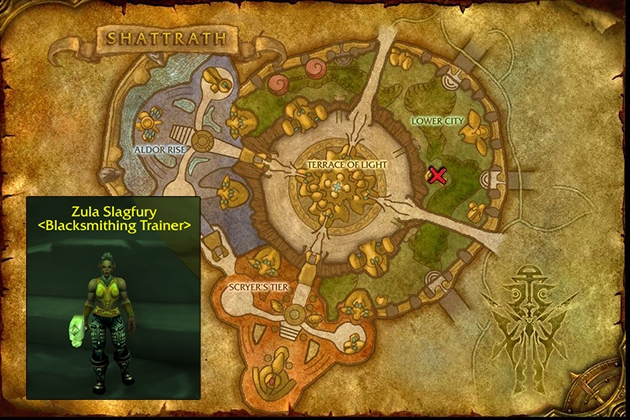
Image source: WoW-Professions
How to Break Through the Difficult 360 to 375 Skill Wall
The "360-375 wall" is the most common point where players stall. Standard trainer recipes turn grey or green, meaning they no longer provide guaranteed skill points. To finish the profession, you must choose one of three primary paths based on your reputation or luck with drops.
| Path | Requirement | Pros | Cons |
|---|---|---|---|
| Aldor (Flamebane) | Revered with Aldor | Widely regarded as the cheapest gold-wise. | Requires Aldor reputation grind. |
| Scryer (Enchanted Adamantite) | Revered with Scryer | Good if you are already Scryer. | Materials (Arcane Dust) are often pricier. |
| Dungeon (Felsteel Gloves) | Auchenai Crypts Drop | No gold cost for the plans themselves. | BoP plans; requires high RNG and a Blacksmith in the group. |
According to GoldGoblin , the Aldor Flamebane path is generally the most reliable. The Flamebane Gloves and Flamebane Bracers stay orange or yellow for longer, providing a more predictable path to 375 than relying on green-quality trainer recipes.
Which Blacksmithing Specialization Is Best for Your Class?
At skill 200 and level 40, you face a choice: Armorsmithing or Weaponsmithing. In TBC, this choice is more impactful than ever because it determines which BoP epics you can craft and wear.
Weaponsmithing Sub-Specializations
Upon reaching level 70 and skill 300, Weaponsmiths can further specialize. This is where the most powerful melee weapons are found:
- Master Hammersmith: The path for Dragonmaw and Dragonstrike . This is a top-tier choice for Enhancement Shamans due to the haste procs.
- Master Swordsmith: The path for Lionheart Champion and Blazeguard . Highly recommended for Arms Warriors and Retribution Paladins.
- Master Axesmith: The path for Bloodmoon . A strong choice for Orcs or those who prefer the aesthetics and crit profile of axes.
Armorsmithing ROI
Armorsmithing is less popular for DPS but offers exceptional value for tanks. The Bulwark of Kings and Breastplate of Kings provide massive defensive stats that are difficult to match in early phases. Protection Paladins and Warriors often find this path helps them reach uncrushable status much faster than relying on raid drops alone.
"Blacksmithing is at its best when you actually wear what you forge. The specialization you choose should align perfectly with your class's primary weapon or armor needs, as switching later is extremely costly." — General Community Consensus
How to Make Gold with Blacksmithing After Reaching Level 375
Once you reach the level cap, Blacksmithing transitions from a gold sink to a potential income stream. While you cannot sell your BoP epics, you can sell the "performance supplies" mentioned earlier.
High-Demand Consumables: The Adamantite Weightstone and Adamantite Sharpening Stone are required by almost every melee raider for every raid night. Keeping a steady supply of these on the Auction House is a reliable way to earn gold. Additionally, the Adamantite Weapon Chain is a staple for PvP players, as being disarmed in an arena match often leads to an immediate loss.
Hardened Adamantite: Blacksmiths are also responsible for creating Hardened Adamantite Bars , which are used by other professions (like Engineering) for high-end crafts. By monitoring the price of raw Adamantite versus the Hardened bars, you can often find profitable arbitrage opportunities.
Frequently Asked Questions
Is Blacksmithing worth the cost in TBC Classic?
For many melee classes, the answer is a resounding yes. The ability to craft a weapon like Dragonmaw or Lionheart Champion provides a level of power that is often not surpassed until later raiding tiers. While the gold investment is high, the performance boost is among the strongest available from any profession.
Can I level Blacksmithing without the Mining profession?
Yes, you can level it entirely by purchasing materials from the Auction House. However, this is significantly more expensive. If you choose this route, it is recommended to have a high-level "gold farm" character to fund the thousands of gold required for the 1-375 journey.
What is the fastest way to get from 360 to 375?
The most reliable method is obtaining Revered reputation with The Aldor and crafting Flamebane gear. These recipes stay "orange" (guaranteed skill points) longer than trainer recipes. Alternatively, farming the Felsteel Gloves plans in Auchenai Crypts is a gold-efficient but time-intensive alternative.
How do I switch my Blacksmithing specialization?
To switch specializations, you must visit the appropriate NPC (often in Tanaris for the old-world specs) and pay a significant gold fee. In TBC, you can also switch your sub-specialization (e.g., Hammersmith to Swordsmith) by talking to the trainers in Shattrath, but be prepared to lose access to your previously crafted BoP weapons.
Where is the best place to farm Fel Iron and Adamantite?
Fel Iron is most abundant in Hellfire Peninsula and Zangarmarsh. Adamantite is found primarily in Nagrand, Blade's Edge Mountains, and Netherstorm. For the highest density of nodes, Nagrand is widely regarded as a top-tier location for Adamantite farming.
Key Takeaways for TBC Blacksmithing
- Prioritize BoP Epics: Choose your specialization (Hammersmith, Swordsmith, etc.) based on your class's BiS weapon needs.
- Use Capital Trainers: Save time by training 1-300 in Silvermoon or The Exodar rather than traveling across Azeroth.
- Plan for the 360 Wall: Start your Aldor or Scryer reputation grind early so you have access to the 360-375 recipes as soon as you need them.
- Recoup Costs: Sell Adamantite Weightstones and Weapon Chains to melee DPS and PvP players to offset your leveling expenses.
- Gold Farming vs. Mining: If you are level 70, consider farming gold to buy low-level mats rather than mining them manually.
- Check RNG Recipes: Always have extra materials on hand for "yellow" skill brackets, as you will rarely get a point for every craft.
Start gathering your Fel Iron today and secure your reputation with the Aldor to ensure a smooth transition into the final tiers of TBC crafting.