Home
How to Play Isekai Slow Life and Progress Faster as a Free-to-Play Mushroom
Success in the isekai slow life game hinges on aggressive resource management rather than passive play. To progress efficiently as a free-to-play (F2P) player, you must save at least 6,000 gems for Ultra Rare (UR) events, prioritize Fellow recruitment over Family members using Acquaint Stones, and match Artifact types to Fellow specialties. While the game is marketed as a "slow life" experience, late-game viability requires joining a top-tier guild to survive server merges and the inevitable "whale wall."

Image source: Otaku USA Magazine
What Is Isekai: Slow Life and Why Are You a Mushroom?
The isekai slow life game taps into the popular "reincarnation" trope found in modern anime. You play as a former human who finds themselves transported to a fantasy realm, but unlike the typical overpowered hero, you are reborn as a walking, talking mushroom. This premise sets the stage for a town-management simulator where the goal is to transform a struggling village into a thriving economic hub.
The core gameplay loop involves three main pillars: Town Management (building and upgrading shops), Character Collection (recruiting Fellows and Family), and Negotiation Stages (a combat-lite system where your economic power determines victory). While the game starts at a leisurely pace, the complexity increases significantly as you unlock more advanced systems like the World Tree, the Museum, and the Archdemon Challenges.
How to Get Started and Which Character Should You Choose?
Your first 30 minutes in the game are guided by Fifi and Belle, two characters who introduce you to the basic mechanics of hiring employees and upgrading the Inn. The primary gatekeeper for all content in Isekai: Slow Life is your Village Earnings . Every upgrade you perform should be viewed through the lens of how much it increases your gold-per-second income.
Early game priorities should focus on unlocking the Apothecary and the Tavern as quickly as possible. These buildings provide the baseline income needed to fund Fellow level-ups. According to TheGamer , focusing on raw income early on is essential because it allows you to clear negotiation stages faster, which in turn unlocks more building slots.
The Difference Between Fellows and Family Members
Understanding the distinction between Fellows and Family members is one of the most important aspects of the game's strategy. Fellows are your active units; they are the ones who participate in negotiations, defend the village, and manage buildings. Family members, on the other hand, are passive units that provide "Blessings" to specific Fellows, significantly boosting their power and the income of the buildings they manage.
Fellows are categorized into five distinct types, each represented by a specific icon and color. Matching these types to the correct Artifacts and Family blessings is the key to maximizing your power without spending real money.
| Feature | Fellows (Active) | Family (Passive) |
|---|---|---|
| Primary Role | Negotiations & Building Management | Blessings & Income Multipliers |
| Growth Metric | Level, Aptitude, & Artifacts | Intimacy & Blessing Points |
| Combat Utility | Directly determines Negotiation power | Provides percentage-based buffs |
| Income Impact | High (Flat building boosts) | Very High (Percentage multipliers) |
For F2P players, the synergy between these two groups is vital. For example, recruiting a Fellow like Loya (Informed type) and pairing her with a Family member who offers an "Informed Blessing" will result in a much higher power spike than spreading your resources thin across unrelated characters.
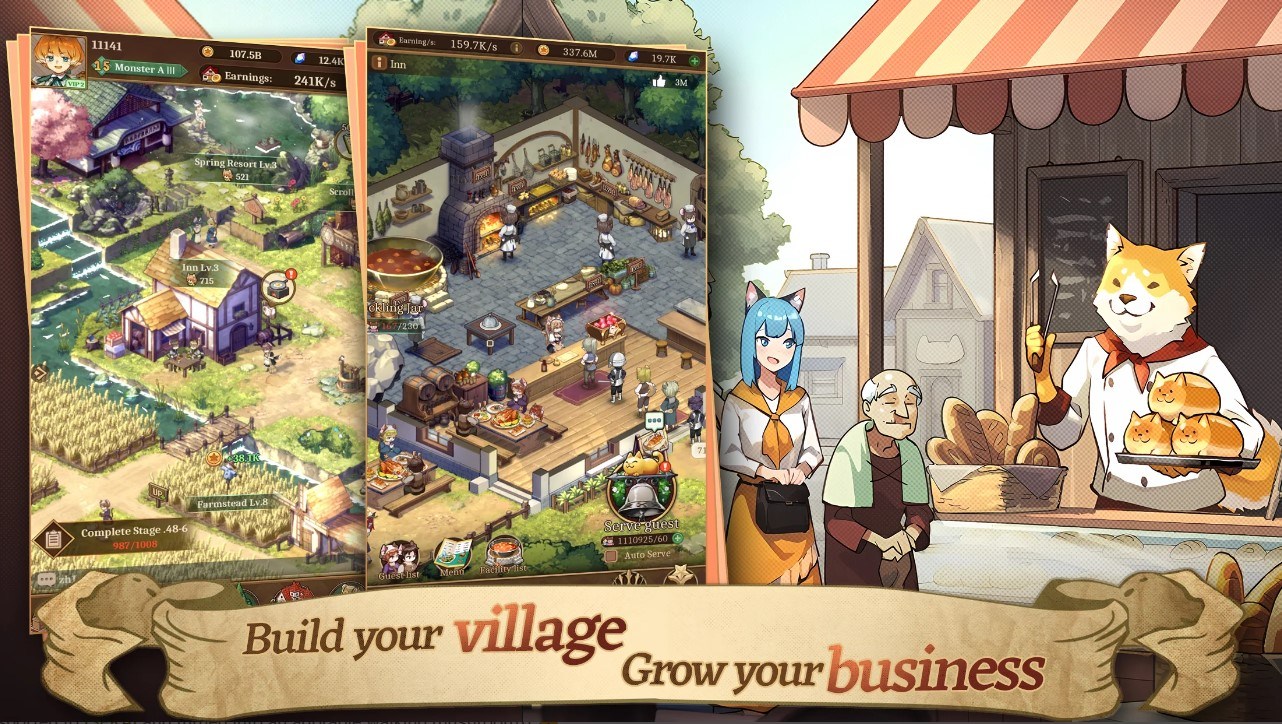
Image source: BlueStacks
How to Optimize Your Resources Without Spending Real Money
The isekai slow life game is designed to tempt you into spending gems on immediate gratification, such as shop refreshes or instant building upgrades. However, veteran players emphasize a strict "Gem Math" strategy to ensure long-term viability. The most critical rule is the 6,000 Gem Threshold . You should always maintain a reserve of at least 6,000 gems to participate in UR (Ultra Rare) events like the "World Tree" or "Purification of Frantic Forest." These events are the only way for F2P players to obtain top-tier characters, and missing them due to poor gem management can set your progress back by months.
Avoiding the Gem Trap
New players often waste premium currency on Acquaint Stones in the shop. This is a mistake. Acquaint Stones are frequently rewarded through daily tasks and event milestones. Instead, use your gems to buy event-specific stamina items that allow you to climb the leaderboards during limited-time rotations. According to Reddit community guides , the return on investment for event stamina is significantly higher than direct shop purchases.
Artifact Reforging and Matching
Artifacts provide massive stat boosts, but only if they are optimized. Every Fellow has a type: Diligent , Brave , Informed , Inspiring , or Unfettered . When equipping an Artifact, you must ensure the Artifact's skills match the Fellow's type. A "Brave" skill on an "Informed" Fellow provides zero benefit. Use your Reforge Stones only on high-tier (SSR or UR) Artifacts to avoid wasting materials on gear you will eventually replace.
The Most Efficient Progression Order for New Players
Efficiency in Isekai: Slow Life is about timing. Doing tasks in the wrong order can result in lost rewards and slower growth. Following a specific daily routine ensures you are always operating at your maximum potential power.
Why You Should Prioritize Fishing and Familiars Early
Fishing is often overlooked by new players, but it provides a steady stream of "Familiar" materials. Familiars are monsters that can be contracted to your Fellows, providing a flat percentage boost to their total power. By prioritizing the Fishing pond early in your session, you can accumulate the bait needed to catch rare fish, which in turn provides the resources to star-up your Familiars. This creates a snowball effect where your Fellows become stronger, allowing you to clear higher-level negotiations.
When to Tackle the Museum Dungeon and Expo
The Museum and Expo systems are late-morning or early-afternoon tasks. The Museum Dungeon requires a certain amount of "Negotiation Power" to clear efficiently. If you attempt it too early in the day before upgrading your Fellows, you may find yourself stuck on a floor you could have otherwise cleared. Similarly, the Expo rewards are based on your current Village Earnings; therefore, you should perform all building upgrades before starting your daily Expo runs to maximize the gold and prestige rewards.
How to Time Your Challenge Tower Attempts for Maximum Rewards
The Challenge Tower is one of the primary sources of gems in the game, offering 200 gems for every major milestone reached. The common mistake is attempting the tower as soon as you log in. Instead, wait until the very end of your daily session . By this time, you will have completed your daily Fellow level-ups, Artifact reforges, and Family blessings. This ensures your team is at its absolute peak strength, allowing you to push 5–10 floors higher than you would have in the morning.
How to Survive the Late-Game Whale Wall and Server Merges
As you progress, you will eventually encounter the "Whale Wall"—a point where high-spending players dominate the individual leaderboards. This becomes even more pronounced during Server Merges . When two or more servers are combined, the competition for top-tier rewards intensifies, and F2P players who were previously ranked in the top 50 may find themselves dropping to rank 300 or lower.
To survive this transition, you must shift your focus from individual rankings to Guild-Centric Play . Being a member of an active, high-ranking guild is the most effective way to secure UR shards and rare materials post-merge. Guild rewards are distributed based on collective effort, meaning a well-coordinated group of F2P players can often outperform a disorganized group of spenders. Veteran players often cite VIP 6 as the "management threshold"—the point where the game's automation features make long-term play sustainable—but even at VIP 0, a strong guild connection can keep you competitive.

Image source: Otaku USA Magazine
How to Automate Your Daily Tasks on PC
While marketed as a "slow life" game, the daily chores in Isekai: Slow Life can become repetitive. Many players choose to run the game on PC using emulators like BlueStacks to take advantage of automation tools. To run the game smoothly, you typically need a PC with Windows 7 or higher, at least 4GB of RAM, and 10GB of free disk space.
The primary benefit of playing on PC is the ability to set up Macros . You can record a macro to handle "Farmstead tapping" or "Stage negotiations," allowing the game to progress while you are away from your desk. Additionally, the Multi-Instance Sync feature is useful for players who want to run multiple accounts to test different Fellow builds or Artifact strategies before committing resources on their main account. This "Slow Life Automation" workflow significantly reduces the burnout associated with the game's high-frequency daily tasks.
Frequently Asked Questions
While the game features a heavy VIP system and microtransactions ranging from $0.99 to $99.99, it is not strictly pay-to-win for casual players. However, reaching the top of the leaderboards in competitive events is mathematically difficult for F2P players. Success for non-spenders requires extreme patience, strategic gem saving, and active participation in a top-tier guild to offset the advantages held by "whales."
Yes, the game features a costume system that allows you to change the appearance of both your main character and your Fellows. While the initial choice of Slime, Skeleton, or Spider is cosmetic and doesn't change your village model, you can unlock various outfits through events, achievements, and the shop. These costumes often provide small stat boosts in addition to their visual changes.
Obtaining UR (Ultra Rare) characters as an F2P player requires saving at least 6,000 to 10,000 gems for specific rotating events like the World Tree. You must use these gems to purchase event-specific stamina or items that allow you to reach the shard milestones. It typically takes multiple rotations of the same event to collect enough shards to fully summon a UR Fellow.
The game has an age rating of 13+ on most platforms. This is primarily due to "Suggestive Themes" and character art that may be considered provocative. While the core gameplay is a standard management simulator, the "Family" system involves dating mechanics and art styles common in the isekai anime genre, which parents should be aware of before allowing younger children to play.
The most important daily task is completing your "Daily Quests" to earn the maximum amount of Battle Pass experience and free gems. Beyond that, ensuring your "Inn" and "Apothecary" are always fully staffed and upgraded is vital for maintaining the gold flow necessary for all other progression systems. Never let your stamina or negotiation attempts sit at their maximum cap for too long.
Key Takeaways for Success
- Save 6,000+ gems exclusively for UR events to ensure you can eventually unlock top-tier Fellows.
- Prioritize Fellows over Family members when spending your early-game Acquaint Stones to maximize immediate power.
- Match Artifact types (Brave, Diligent, etc.) to the Fellow's specific specialty to avoid wasting precious stat boosts.
- Wait until the end of the day to attempt the Challenge Tower, ensuring your team is at its maximum daily strength.
- Join an active guild before your first server merge to secure a safety net against high-spending players.
- Use PC automation via emulators to handle repetitive daily chores like Farmstead tapping and stage negotiations.
Start by auditing your current gem count and Fellow-Artifact pairings to ensure you aren't leaving easy power boosts on the table.