Home
Who Are the Prime Evils in Diablo and How Do They Rank?
The Prime Evils are the three dominant rulers of the Burning Hells: Mephisto (Lord of Hatred), Baal (Lord of Destruction), and Diablo (Lord of Terror). Born from the three strongest heads of the primordial dragon Tathamet, they form a "Trinity" that seeks to corrupt Sanctuary and defeat the High Heavens. In terms of raw power, their strength often depends on the mortal host they possess, though Mephisto is widely considered the eldest and most cunning strategist.
In the dark, sprawling universe of Sanctuary, few names command as much dread as the Prime Evils. These entities are not merely powerful demons; they are the fundamental manifestations of the darkest human emotions and cosmic forces. For players navigating the endgame of Diablo 4 or lore enthusiasts diving into the Book of Cain , understanding the hierarchy and origins of these beings is essential for grasping the narrative stakes of the Sin War.
As of recent updates in Season 15, the Prime Evils have taken on a new mechanical significance through the "Prime Evil Echo" system. This article explores their ancient history, compares their relative power levels, and provides data-driven insights into mastering their seasonal mechanics.
Where Did the Prime Evils Come From?
The genesis of the Prime Evils predates the creation of Sanctuary and even the Burning Hells themselves. According to the Diablo Wiki , their existence is the result of a primordial schism between two absolute beings: Anu, the sum of all good, and Tathamet, the sum of all evil.
The Seven Heads of the Dragon Tathamet
Before time began, Anu sought to achieve purity by casting out all discordant parts of itself. These discarded aspects coalesced into Tathamet, a seven-headed dragon of singular malice. The ensuing battle between Anu and Tathamet resulted in a mutual destruction that birthed the universe. From the rotting carcass of Tathamet, the Burning Hells were formed, and from its seven heads, the Great Evils emerged.
The three strongest heads became the Prime Evils, while the four remaining heads became the Lesser Evils. This distinction is not just a matter of title; it represents the core aspects of suffering that define the demonic hierarchy. The Primes represent the "Trinity" of Hatred, Destruction, and Terror—forces that are interconnected and self-sustaining.
How the Burning Hells Formed Around the Trinity
The Burning Hells are not a monolithic landscape but a reflection of the Primes' specific domains. Mephisto’s realm is a place of endless political intrigue and simmering resentment, while Baal’s domain is a wasteland of perpetual ruin. Diablo’s realm, the Realm of Terror, is perhaps the most psychological, shifting to reflect the deepest fears of those who enter it. This geography reinforces the idea that the Primes are not just residents of Hell; they are its architects and its very essence.
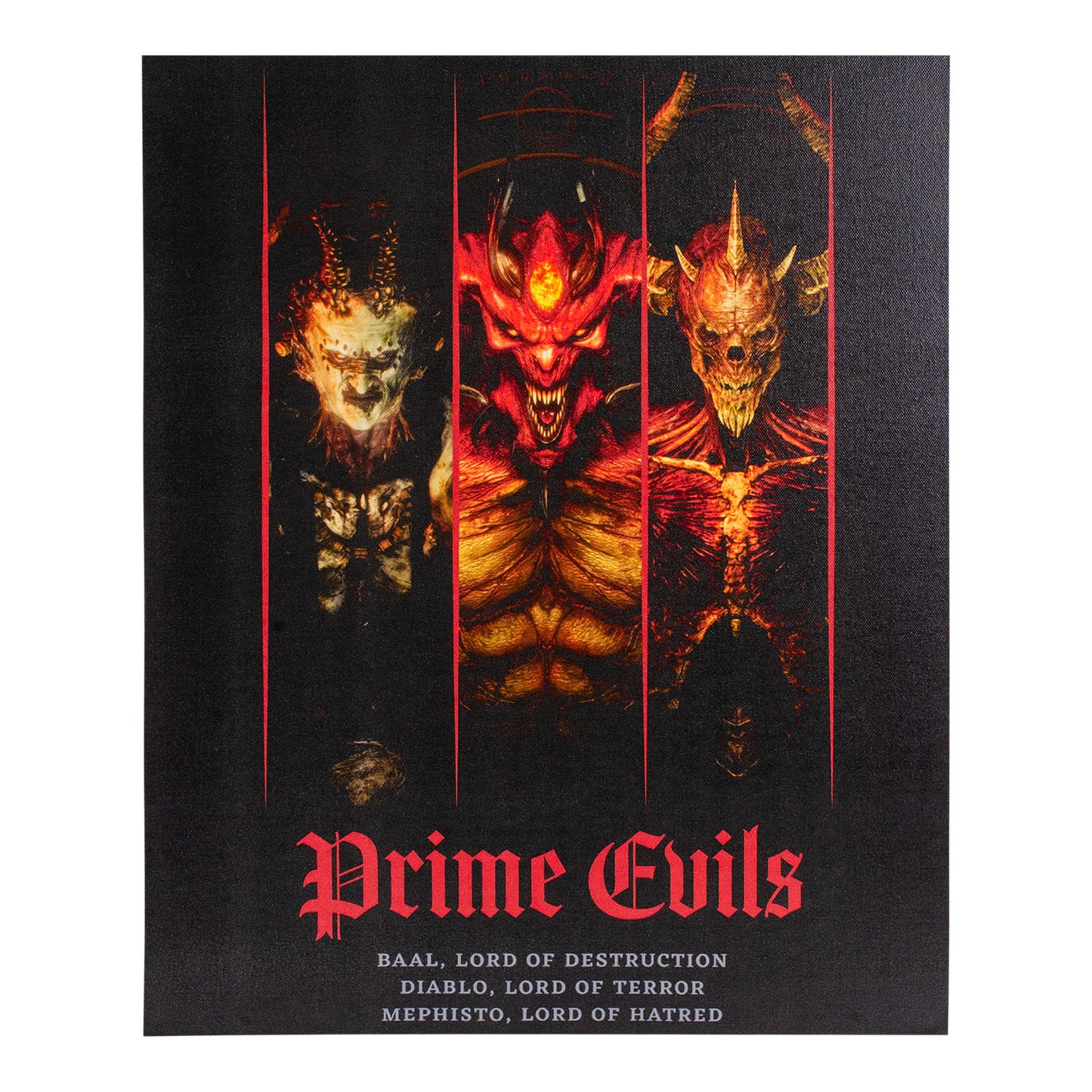
Image source: Blizzard Gear Store
Meet the Three Brothers of the Burning Hells
While they are often referred to as brothers, the relationship between the Prime Evils is one of convenience and shared goals rather than familial affection. Each brings a distinct flavor of malice to the struggle against the High Heavens.
Mephisto the Lord of Hatred and Eldest Brother
Mephisto is the eldest of the three and is widely regarded as the most intelligent and manipulative. He is the father of Lilith and Lucion, making him a central figure in the creation of the Nephalem. Mephisto does not rely on brute force; instead, he sows discord among his enemies, turning allies against one another. In the lore, he is often the one who coordinates the brothers' grander schemes, such as the Dark Exile.
Baal the Lord of Destruction and the Middle Brother
Baal is the embodiment of pure, unadulterated ruin. While Mephisto plots, Baal acts. He is famously remembered for the siege of Mount Arreat and the corruption of the Worldstone in Diablo 2: Lord of Destruction . Baal’s power is physical and overwhelming, often leaving nothing but ash in his wake. His possession of the Horadric mage Tal Rasha remains one of the most significant events in Sanctuary's history, as it combined demonic might with high-tier human sorcery.
Diablo the Lord of Terror and the Youngest Brother
Despite being the youngest, Diablo is the namesake of the franchise for a reason. He is the most adaptable of the three, capable of weaponizing the fears of his victims to paralyze them before he strikes. Diablo’s strength lies in his persistence; he has been defeated many times, yet he always finds a way to return, often using the very heroes who defeated him as his next host. His ability to manipulate the human psyche makes him a top-tier threat to Sanctuary.
Why Host Bodies Change the Power Level of a Prime Evil
A critical nuance in Diablo lore is that a Prime Evil’s power on the mortal plane is not static. Because they are spirits of pure energy, they require a physical vessel to manifest in Sanctuary. The strength of this vessel acts as a "power ceiling" for the demon.
When Diablo possessed Prince Aidan (the warrior who defeated him in the first game), he gained immense physical prowess but lacked the arcane depth he later achieved when possessing Leah in Diablo 3 . Leah, being the daughter of Adria and having a unique lineage, allowed Diablo to manifest as the "Prime Evil"—a singular entity containing the essences of all seven Great Evils. This suggests that the choice of host is just as important as the demon's own inherent strength.
Prime Evils vs Lesser Evils — What Is the Real Difference?
The distinction between "Prime" and "Lesser" is often misunderstood as a simple power ranking. In reality, it is as much a political designation as it is a measure of strength. The Lesser Evils—Andariel, Duriel, Belial, and Azmodan—are exceptionally potent in their own right, but they lack the cosmic scope of the Trinity.
| Name | Title | Rank | Primary Domain | D4 Damage Type |
|---|---|---|---|---|
| Mephisto | Lord of Hatred | Prime | Intellect / Discord | Cold / Shadow |
| Baal | Lord of Destruction | Prime | Physical Ruin | Fire / Physical |
| Diablo | Lord of Terror | Prime | Fear / Nightmares | Fire / Lightning |
| Andariel | Maiden of Anguish | Lesser | Mental Suffering | Poison |
| Duriel | Lord of Pain | Lesser | Physical Torture | Physical / Poison |
| Azmodan | Lord of Sin | Lesser | Temptation / War | Fire |
Why the Term Prime Is Often a Misnomer
According to Blizzard Watch , Deckard Cain once warned that Lesser Evils might actually be more dangerous to mortals in the short term. This is because the Primes are focused on eon-spanning machinations and the corruption of the human soul, whereas the Lesser Evils are more direct. For example, Duriel’s focus on immediate physical pain makes him a terrifying combatant, even if he lacks Mephisto’s strategic depth.
How to Master Prime Evil Powers in Diablo 4 Season 15
In the current state of Diablo 4 , players can harness the essence of the Trinity through the "Hell’s Legacy" seasonal mechanics. This involves collecting Splinters of Terror, Destruction, and Hatred to unlock powerful character modifiers.
Upgrading the Splinters of Terror, Destruction, and Hatred
The Splinter system features a 7-rank upgrade path. Each rank increases the potency of the associated Prime Evil's blessing. According to Fextralife , specific breakpoints at Ranks 4, 12, and 22 provide transformative modifiers:
- Rank 4: Adds a 15% chance to proc a domain-specific explosion (e.g., Fear for Diablo).
- Rank 12: Reduces the cooldown of Ultimate abilities by 2 seconds whenever a Prime Evil Echo is summoned.
- Rank 22: Grants "Trinity Resonance," allowing the player to benefit from all three Splinters simultaneously for 10 seconds after killing an Elite.
The Best Ways to Farm Prime Evil Echoes
Farming Prime Evil Echoes is the primary bottleneck for seasonal progression. While many players roam Helltides, data-driven analysis suggests a more efficient method involving Legion Events.
The Legion Event Math
Each player has a base 2% chance to spawn a Prime Evil Echo upon completing a "3-Whisper" event. However, in a full Legion Event group of 10 players, the probability of at least one Echo spawning for the group is significantly higher.
Calculation: 1 - (0.98^10) = 18.29% probability per Legion Event completion.
Staying within the ritual circle of a Rupture Portal also increases the density of high-value targets, which correlates with higher drop rates for Splinters compared to standard open-world roaming.
Who Is the Strongest Prime Evil?
The debate over which brother is the strongest is a staple of the community. The answer typically depends on how you define "strength."
- The Case for Mephisto
- As the mastermind, Mephisto’s strength is his ability to control the board. He is the only Prime who has successfully corrupted an entire religion (the Zakarum) from within his prison. His power is insidious and nearly impossible to root out entirely.
- The Case for Baal
- Baal represents raw destructive output. In a direct physical confrontation, Baal’s ability to conjure destructive elements and his sheer resilience make him a top-tier combatant. His victory over the Barbarian tribes at Arreat remains a testament to his martial dominance.
- The Case for Diablo
- Diablo is the most balanced. He possesses high intelligence, immense physical power, and the unique ability to strike at the mind. His adaptability allows him to thrive in almost any situation, making him a popular choice for the "strongest" among fans who value versatility.
Why Do the Prime Evils Turn Into Animals?
In Diablo 4 , players encounter Mephisto not as a towering demon, but as a "Wounded Wolf." This has led to questions about why these cosmic horrors would choose animal forms.
The Mystery of the Wounded Wolf in Diablo 4
Lore experts suggest these are "Incorporeal Avatars." When a Prime Evil is severely weakened or cut off from the Burning Hells, they cannot maintain their true demonic form on Sanctuary. The wolf form represents Mephisto’s predatory nature while acknowledging his current state of vulnerability. Other historical forms include a one-eyed owl and a wingless bat, each serving as a low-profile vessel for the demon's consciousness while they recover their strength.
Frequently Asked Questions
Can a Prime Evil actually die?
In the Diablo universe, energy cannot be destroyed, only transformed. When a Prime Evil's physical form is destroyed, their essence returns to the Black Abyss. Over time, they reform and eventually return to the Burning Hells. This cycle of rebirth is why they are considered an eternal threat to Sanctuary, as no victory by the Nephalem is ever truly permanent.
Who is the father of the Prime Evils?
The Prime Evils do not have a father in the traditional sense. They were birthed from the three dominant heads of Tathamet, the primordial dragon of all evil. Tathamet was the dark counterpart to Anu, the first being. Therefore, the Primes are essentially the living remnants of the original source of all malice in the universe.
Is Lilith a Prime Evil?
No, Lilith is not a Prime Evil. She is the daughter of Mephisto, making her a high-ranking demon of the second generation. While she is exceptionally powerful and played a leading role in the creation of Sanctuary, she does not hold the rank of "Prime." Her power is distinct from the Trinity, focusing more on creation and the potential of the Nephalem.
Which Prime Evil is the oldest?
Mephisto, the Lord of Hatred, is the eldest of the three brothers. His seniority is reflected in his role as the strategist and his fatherhood of Lilith. Baal is the middle brother, and Diablo is the youngest. Despite their age differences, they generally operate as a unified front when dealing with the High Heavens.
What happened to the Black Soulstone?
At the end of Diablo 3: Reaper of Souls , Malthael shattered the Black Soulstone to consume the power of the Seven Evils. When Malthael was defeated, the essences of the Prime and Lesser Evils were released back into the ether. This event paved the way for their eventual return in Diablo 4 , as they are no longer trapped within the stone.
Key Takeaways for Lore Seekers and Players
Understanding the Prime Evils is the first step to mastering both the narrative and the mechanics of the Diablo series. Here are the essential points to remember:
- The Trinity consists of Mephisto (Hatred), Baal (Destruction), and Diablo (Terror), all born from the dragon Tathamet.
- Host bodies act as a power ceiling; a stronger mortal vessel allows a Prime to manifest more of their true strength.
- Mephisto is the eldest and most cunning, often acting as the architect of the brothers' long-term plans.
- Season 15 mechanics allow players to use Splinters to gain Prime-themed powers, with Rank 22 being a major power spike.
- Legion Events are the most efficient way to farm Prime Evil Echoes, offering an 18.29% spawn chance in a full group.
- Incorporeal Avatars , like Mephisto’s Wounded Wolf, are used by the Primes when they are too weak to maintain their true forms.
To optimize your Season 15 progress, prioritize grouping up for Legion Events to maximize your Echo spawn rates and Splinter upgrades.