Home
Complete Diablo 2 Rune List With Socket Stats and Cube Recipes
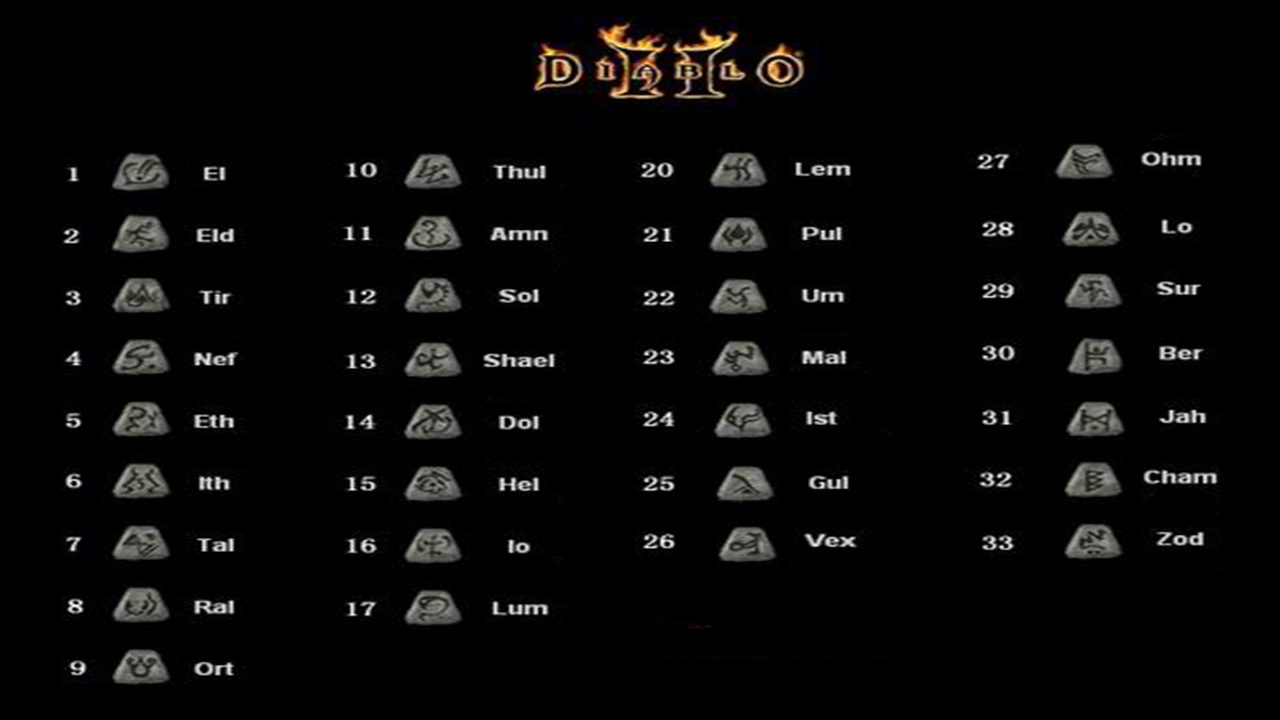
Image source: mmoso
What Are the 33 Runes in Diablo 2 and What Do They Do?
Runes serve as the primary currency and power-scaling mechanism in Diablo 2: Resurrected . Unlike gems, which provide static bonuses, runes offer highly specialized utility. For instance, the Ber rune provides Damage Reduced by 8% in armor, making it a staple for survivability, while the Um rune is widely regarded as a top choice for fixing resistance gaps in shields.
According to the Arreat Summit , runes must be used strategically based on your character's level and gear needs. A notable exception in the list is the Hel rune (#15) . It is the only rune with no level requirement and provides no combat stats; instead, it reduces item requirements or is used in the Horadric Cube to clear sockets.
| Rune | # | Lvl | Weapon Effect | Armor/Helm Effect | Shield Effect |
|---|---|---|---|---|---|
| El | 1 | 11 | +50 AR, +1 Light | +15 Def, +1 Light | +15 Def, +1 Light |
| Eld | 2 | 11 | +75% Dmg vs Undead | 15% Slower Stamina Drain | 7% Increased Block |
| Tir | 3 | 13 | +2 Mana After Each Kill | +2 Mana After Each Kill | +2 Mana After Each Kill |
| Nef | 4 | 13 | Knockback | +30 Def vs Missile | +30 Def vs Missile |
| Eth | 5 | 15 | -25% Target Defense | Regenerate Mana 15% | Regenerate Mana 15% |
| Ith | 6 | 15 | +9 Max Damage | 15% Damage Taken to Mana | 15% Damage Taken to Mana |
| Tal | 7 | 17 | +75 Poison Dmg (5s) | Poison Res +30% | Poison Res +35% |
| Ral | 8 | 19 | +5-30 Fire Damage | Fire Res +30% | Fire Res +35% |
| Ort | 9 | 21 | +1-50 Lightning Dmg | Lightning Res +30% | Lightning Res +35% |
| Thul | 10 | 23 | +3-14 Cold Dmg (3s) | Cold Res +30% | Cold Res +35% |
| Amn | 11 | 25 | 7% Life Stolen Per Hit | Attacker Takes Dmg of 14 | Attacker Takes Dmg of 14 |
| Sol | 12 | 27 | +9 Min Damage | Damage Reduced by 7 | Damage Reduced by 7 |
| Shael | 13 | 29 | 20% Increased Attack Speed | 20% Faster Hit Recovery | 20% Faster Block Rate |
| Dol | 14 | 31 | Hit Causes Monster to Flee | Replenish Life +7 | Replenish Life +7 |
| Hel | 15 | - | Requirements -20% | Requirements -15% | Requirements -15% |
| Io | 16 | 35 | +10 Vitality | +10 Vitality | +10 Vitality |
| Lum | 17 | 37 | +10 Energy | +10 Energy | +10 Energy |
| Ko | 18 | 39 | +10 Dexterity | +10 Dexterity | +10 Dexterity |
| Fal | 19 | 41 | +10 Strength | +10 Strength | +10 Strength |
| Lem | 20 | 43 | 75% Extra Gold | 50% Extra Gold | 50% Extra Gold |
| Pul | 21 | 45 | +75% Dmg vs Demons | +30% Enhanced Defense | +30% Enhanced Defense |
| Um | 22 | 47 | 25% Chance of Open Wounds | All Res +15 | All Res +22 |
| Mal | 23 | 49 | Prevent Monster Heal | Magic Dmg Reduced by 7 | Magic Dmg Reduced by 7 |
| Ist | 24 | 51 | 30% Better MF | 25% Better MF | 25% Better MF |
| Gul | 25 | 53 | 20% Bonus to AR | +5% Max Poison Res | +5% Max Poison Res |
| Vex | 26 | 55 | 7% Mana Stolen Per Hit | +5% Max Fire Res | +5% Max Fire Res |
| Ohm | 27 | 57 | +50% Enhanced Damage | +5% Max Cold Res | +5% Max Cold Res |
| Lo | 28 | 59 | 20% Deadly Strike | +5% Max Lightning Res | +5% Max Lightning Res |
| Sur | 29 | 61 | Hit Blinds Target | Increase Max Mana 5% | +50 Mana |
| Ber | 30 | 63 | 20% Crushing Blow | Damage Reduced by 8% | Damage Reduced by 8% |
| Jah | 31 | 65 | Ignore Target's Defense | Increase Max Life 5% | +50 Life |
| Cham | 32 | 67 | Freeze Target +3 | Cannot Be Frozen | Cannot Be Frozen |
| Zod | 33 | 69 | Indestructible | Indestructible | Indestructible |
Strategic Use Cases for Common Runes
While high runes get the most attention, many low and mid-tier runes are essential for progression. For example, the Tir rune is a staple for early-game casters because the "+2 Mana After Each Kill" significantly reduces the need for mana potions. Similarly, the Shael rune is often socketed into weapons to reach specific "Increased Attack Speed" (IAS) breakpoints, which can dramatically increase a character's damage per second.
In the endgame, the Cham rune is frequently used in helms (like Harlequin Crest Shako) to provide the "Cannot Be Frozen" property. This frees up a ring slot that would otherwise be occupied by a Raven Frost, allowing for more specialized gear setups. Understanding these nuances is what separates casual players from those who master the D2R economy.
How to Upgrade Runes Using Horadric Cube Recipes
The Horadric Cube allows players to combine lower-tier runes into higher-tier ones. This is a vital mechanic for "cubing up" to reach the elusive high runes like Vex, Ohm, or Lo. In the original Diablo 2, high-tier rune cubing was restricted to Ladder characters. However, a significant advancement in Diablo 2: Resurrected (Patch 2.4+) removed these restrictions, allowing all players in all modes to upgrade runes all the way to Zod.
The upgrade process follows a specific progression. For the first ten runes (El through Ort), the recipe is simply three of the same rune. Starting with the Thul rune , the recipe requires an additional gem to act as a catalyst. This adds a layer of inventory management, as players must keep a stock of chipped, flawed, and standard gems to facilitate their upgrades.
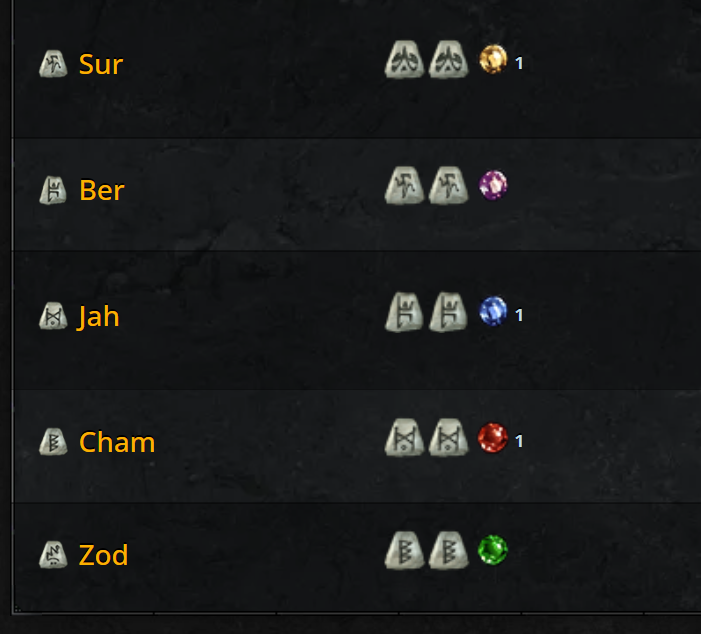
Image source: diablo2.io
Complete Rune Upgrade Recipe List
Below is the standard progression for upgrading runes in the Horadric Cube. Note that as you reach the highest tiers (Pul and above), the requirement drops from three runes to two runes, but the gem quality increases.
- Low Tier (3:1 Ratio, No Gems)
- 3 El → 1 Eld | 3 Eld → 1 Tir | 3 Tir → 1 Nef | 3 Nef → 1 Eth | 3 Eth → 1 Ith | 3 Ith → 1 Tal | 3 Tal → 1 Ral | 3 Ral → 1 Ort | 3 Ort → 1 Thul
- Mid Tier (3:1 Ratio + Chipped/Flawed Gems)
- 3 Thul + 1 Chipped Topaz → 1 Amn
- 3 Amn + 1 Chipped Amethyst → 1 Sol
- 3 Sol + 1 Chipped Sapphire → 1 Shael
- 3 Shael + 1 Chipped Ruby → 1 Dol
- 3 Dol + 1 Chipped Emerald → 1 Hel
- 3 Hel + 1 Chipped Diamond → 1 Io
- 3 Io + 1 Flawed Topaz → 1 Lum
- 3 Lum + 1 Flawed Amethyst → 1 Ko
- 3 Ko + 1 Flawed Sapphire → 1 Fal
- 3 Fal + 1 Flawed Ruby → 1 Lem
- 3 Lem + 1 Flawed Emerald → 1 Pul
- High Tier (2:1 Ratio + Standard/Flawless Gems)
- 2 Pul + 1 Flawed Diamond → 1 Um
- 2 Um + 1 Topaz → 1 Mal
- 2 Mal + 1 Amethyst → 1 Ist
- 2 Ist + 1 Sapphire → 1 Gul
- 2 Gul + 1 Ruby → 1 Vex
- 2 Vex + 1 Emerald → 1 Ohm
- 2 Ohm + 1 Diamond → 1 Lo
- 2 Lo + 1 Flawless Topaz → 1 Sur
- 2 Sur + 1 Flawless Amethyst → 1 Ber
- 2 Ber + 1 Flawless Sapphire → 1 Jah
- 2 Jah + 1 Flawless Ruby → 1 Cham
- 2 Cham + 1 Flawless Emerald → 1 Zod
Why Your Runeword Didn't Work and How to Fix It
One of the most frustrating experiences for a Diablo 2 player is gathering expensive runes, only to have the Runeword fail to activate. This usually results in a "gemmed" item that provides the individual rune bonuses but lacks the powerful Runeword properties. According to community troubleshooting guides on Maxroll , there are four primary reasons for this failure.
The "Mace" Category Confusion
Many popular Runewords, such as "Heart of the Oak" (Ko-Vex-Pul-Thul), require a "Mace" base. However, the game's internal classification of maces is notoriously confusing. In the context of Runeword recipes, a "Mace" refers only to the following items:
- Mace
- Morning Star
- Flail
- Exceptional/Elite versions (e.g., Knout, Scourge)
Crucially, this excludes Hammers (like War Hammers), Clubs, and Scepters. If you attempt to make "Heart of the Oak" in a 4-socket War Hammer, it will fail. Always double-check the base item's sub-type before committing high runes.
Correct Socket Order and Superior Item Tax
Runes must be inserted into the item in the exact sequence listed in the recipe. If a recipe calls for Jah-Ith-Ber (Enigma), and you insert them as Ber-Ith-Jah , you will simply have a chest piece with some life, mana, and damage reduction, but no Teleport ability. There is no way to "re-order" runes once they are socketed.
Additionally, using "Superior" bases (items with +15% Enhanced Defense or Damage) can be a double-edged sword. While they provide a slight stat boost, they increase the gold repair costs by up to 10 times. To bypass this "tax," you can use the Horadric Cube repair recipes:
- Armor: Ral Rune + Damaged Armor = Fully Repaired Armor
- Weapon: Ort Rune + Damaged Weapon = Fully Repaired Weapon
Where Are the Best Places to Farm High Runes?
Farming high runes (HRs) is a game of probability and monster density. Unlike unique items, runes are not affected by "Magic Find" (MF) stats. To find more runes, you simply need to kill more monsters as quickly as possible. However, certain locations and mechanics offer a significant advantage for those looking to build wealth.
The Countess "Players 1" Strategy
The Countess in Act 1 is a unique case. She has a "special" rune drop table that is separate from her standard item drop table. Paradoxically, farming her on Players 1 (P1) is often more efficient for runes than Players 7. This is because her special rune table only triggers if her standard item table fails to drop an item. On higher player counts, the "No Drop" chance decreases, meaning she drops more items but fewer runes from her special table.
Lower Kurast (LK) Super Chests
For Single Player or high-player-count online games, the "Super Chests" in Lower Kurast are widely regarded as one of the top sources for runes up to Ber. These chests are located in specific huts surrounding a circular torch pattern. In Single Player, you can "roll" a map with two of these patterns close to the waypoint, allowing for 30-second runs that can yield incredible results over hundreds of iterations.
High-Density Zones for Global Drops
If you prefer traditional combat, focus on areas with high monster density and few "physical" obstacles. The following zones are top-tier choices for rune hunting:
- The Secret Cow Level: Massive density and no immunities make this a favorite for Javazons and Corpse Explosion Necromancers.
- Chaos Sanctuary: High-level monsters and the presence of ghosts (which have a higher rune drop rate) make this a premier farming spot.
- Arcane Sanctuary: The Specters here have a limited drop table that heavily favors runes, though you must kill them while they are over the platforms to ensure the loot drops.
Understanding the Trading Meta and Rune Values in D2R
In the D2R economy, runes function as the "gold standard" for trading. While gold itself is mostly used for gambling, runes have intrinsic value based on their rarity and their necessity in meta Runewords. This creates a hierarchy where certain runes are worth significantly more than others, regardless of their numerical order.
The Ber vs. Zod Paradox
Technically, the Zod rune (#33) is the rarest drop in the game. However, the Ber rune (#30) is consistently more expensive in the trading market. This is because Ber is required for the two most impactful Runewords in the game: Enigma and Infinity . Because demand for Ber is exponentially higher than demand for Zod, the market value reflects utility over raw rarity. This is a crucial concept for new traders to understand—just because a rune is "higher" on the list doesn't mean it's more valuable.
Rune Currency Tiers
Players often categorize runes into tiers to facilitate trading:
- Low Runes (El to Amn): Mostly used for "Spirit" or "Insight" sets. Often traded in bulk.
- Mid Runes (Lem to Gul): The "small change" of the economy. Used to buy mid-tier uniques like Shako or Arachnid Mesh.
- High Runes (Vex to Zod): The primary currency for high-end items. A "Ber" is often used as the baseline unit of measurement for extremely rare items (e.g., "This ring is worth 3 Ber").
The "Spirit Set" Economy
A popular way for low-level players to build wealth is by selling "Spirit Sets." This includes the runes Tal, Thul, Ort, and Amn, along with a Hel rune for unsocketing. Because players often "roll" Spirit shields dozens of times to hit the 35% Faster Cast Rate (FCR) breakpoint, there is a constant demand for these sets in bulk. This provides a reliable income stream for those who cannot yet farm Hell difficulty efficiently.
Frequently Asked Questions
What is the rarest rune in Diablo 2?
Can you unsocket runes without destroying them?
Does Magic Find (MF) help find more runes?
Why did my "Spirit" Runeword fail in a blue sword?
What is the best early-game runeword for a caster?
Key Takeaways for Mastering Diablo 2 Runes
- Verify your base: Always ensure your item is "Grey" (Normal/Superior) and not "Blue" (Magic) before socketing.
- Check the category: Remember that "Maces" for Runewords only include Maces, Morning Stars, and Flails.
- Optimize player counts: Farm the Countess on Players 1 for runes, but use Players 7 for Lower Kurast chests.
- Save your gems: Keep a stash of chipped and flawed gems to upgrade mid-tier runes in the Horadric Cube.
- Understand value: Rarity does not always equal value; Ber and Jah remain the gold standard due to utility.
- Use Hel wisely: Keep Hel runes on hand to "re-roll" Spirit or Insight items until you hit perfect breakpoints.
- D2R Parity: Take advantage of the fact that all rune upgrades now work in Non-Ladder and Single Player modes.
Start your next farming session by clearing the Secret Cow Level on Players 1 to maximize your chances of finding high-quality grey bases and mid-tier runes.