Home
How Much Are MTG Avatar: The Last Airbender Cards Worth Right Now?
The Avatar Aang [Raised Foil] #363 remains the primary chase card of the set, currently valued at approximately $3,787.50 for ungraded copies. Prices for the Avatar: The Last Airbender (TLA) and Eternal (TLE) sets have stabilized significantly since their November 2025 release. While Standard-legal TLA cards offer high utility, the TLE variants found in Collector Boosters command a premium due to their scarcity and specific appeal to Commander players.
Current Market Value of the Top Avatar MTG Cards
As of late 2026, the secondary market for Magic: The Gathering: Avatar: The Last Airbender has transitioned from the volatile "hype phase" into a more predictable collector's market. According to recent data from PriceCharting , the top-tier variants have maintained their value remarkably well, particularly those with unique foil treatments that are difficult to replicate.
The following table outlines the current market standing for the most sought-after cards in the set across various treatments. Note that prices for "Raised Foils" are significantly higher than their standard or even galaxy foil counterparts.
| Card Name | Treatment | Set Code | Market Price (USD) |
|---|---|---|---|
| Avatar Aang (#363) | Raised Foil | TLE | $3,787.50 |
| Toph, the First Metalbender (#362) | Borderless | TLA | $980.00 |
| Fire Lord Zuko (#360) | Borderless | TLA | $519.72 |
| Avatar Aang (#207) | Mythic Rare (Standard) | TLA | $45.00 |
| Appa, Steadfast Guardian | Rare (Non-Foil) | TLA | $17.00 |
| The Cabbage Merchant | Uncommon (Foil) | TLE | $15.25 |
The $3,700 Question: Avatar Aang Raised Foil
The Avatar Aang [Raised Foil] #363 is widely regarded as one of the most significant pulls in modern Universes Beyond history. While the standard mythic version is accessible for most players, the Raised Foil variant—exclusive to Collector Boosters—has become a trophy piece. Recent sales for PSA 10 graded copies have exceeded $5,200 , reflecting a strong demand from both MTG players and Avatar franchise collectors. This card's value is driven by its incredibly low pull rate, estimated to be similar to the "Neon Ink" cards from Kamigawa: Neon Dynasty .
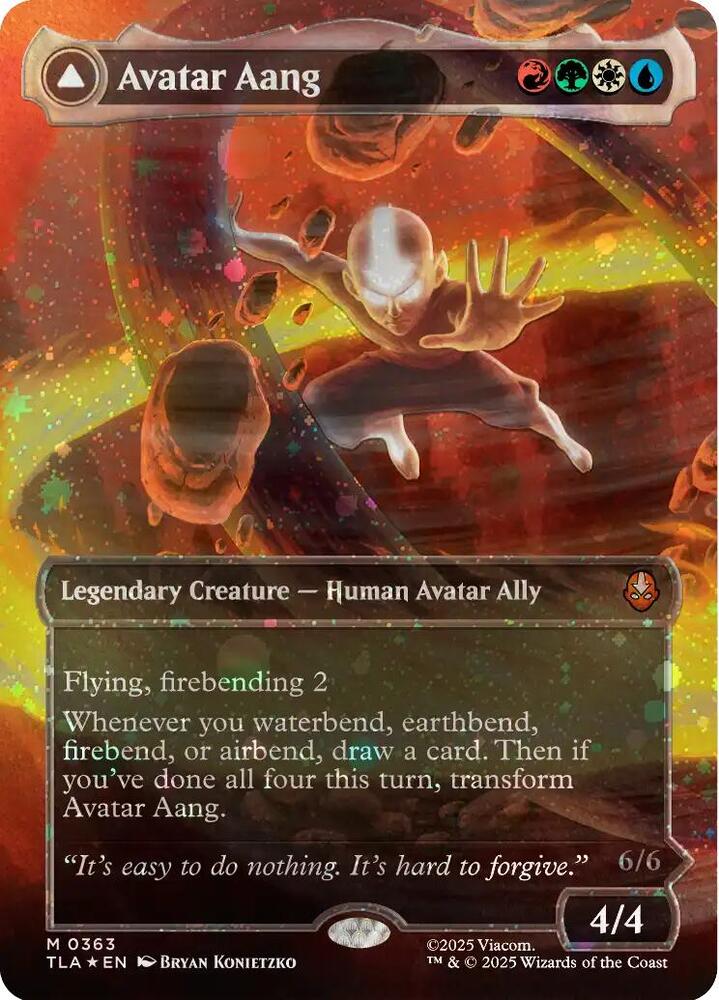
Image source: TCGplayer
Why Do Some Avatar Cards Have Different Set Symbols?
One of the most confusing aspects for new collectors is the presence of two distinct set symbols and codes within the same release. Understanding the difference between TLA and TLE is crucial for determining both the legality and the long-term value of your cards. According to Draftsim , these codes separate the cards based on their intended play environment.
- TLA (Avatar: The Last Airbender): This is the main set, featuring the "Aang’s Head" symbol. These cards are Standard-legal and were primarily distributed through Play Boosters. Because they are more common, their price floor is generally lower, though high-demand mythics still command respectable prices.
- TLE (Avatar: The Last Airbender Eternal): Featuring the "Glider" symbol, these cards are legal only in Eternal formats like Commander, Legacy, and Vintage. This set includes "Source Material" cards and specific promos. Because TLE cards are harder to come by and often possess higher power levels tailored for multiplayer formats, they frequently maintain higher average prices than TLA rares.
Which Avatar: The Last Airbender Cards Are the Most Expensive?
Beyond the headline-grabbing Aang, several other characters have emerged as heavy hitters in the secondary market. The value of these cards is often a combination of character popularity and their utility in the Commander (EDH) format.
Toph, Metalbender
Borderless #362
$980.00A staple for mono-green and artifact-heavy decks. Her ability to manipulate the board makes her a top choice for competitive play.
Fire Lord Zuko
Borderless #360
$519.72Highly favored in aggressive red builds. The borderless art featuring his Agni Kai duel is a major draw for fans.
Appa, Guardian
Standard Rare
$17.00The "workhorse" of the set. As a non-foil rare, its price is driven entirely by its protective abilities in white-based decks.
The price of Fire Lord Zuko is particularly interesting. While not as expensive as Toph, Zuko sees more frequent play in "Burn" and "Aristocrat" style decks in Commander. His ability to generate value through combat has kept his price stable even as other cards from the set have fluctuated. Meanwhile, Appa, Steadfast Guardian serves as a reminder that not all value is tied to rarity; its status as a "must-include" for many tribal and defensive strategies keeps its non-foil price higher than many mythics in the set.
How to Identify Rare Foil Treatments in the Avatar Set
Identifying the correct foil treatment is the difference between a $50 card and a $3,000 card. The Avatar set introduced several layers of "bling" that can be difficult to distinguish at a glance.
- Raised Foils
- These feature a physical texture that you can feel on the card surface. The gold accents on the character's clothing or bending elements are slightly elevated. These are the rarest and most expensive variants.
- Galaxy Foils
- Similar to the foils found in Unfinity , these have a "starfield" effect. While beautiful, they are much more common than Raised Foils and usually sell for a 50-100% premium over non-foils.
- Scene Box Panoramas
- Found in specific bundles, these cards form a larger image when placed side-by-side. The black-and-white variants are particularly prized by collectors for their unique aesthetic.
According to community discussions on r/mtgfinance , the "Source Material" cards found in the TLE set are the primary drivers of box Expected Value (EV). These cards use original art from the animated series rather than new illustrations, tapping into deep nostalgia that keeps prices high regardless of the card's power level.
How New Mechanics Like Airbend and Earthbend Affect Card Prices
The financial success of a Magic set is often tied to how well its new mechanics integrate with existing popular decks. The Avatar set introduced several keywords that have become favorites in the Commander community.
Airbend has proven to be a significant advancement for "Blink" strategies. The ability to exile a permanent and re-cast it for a reduced cost of {2} synergizes perfectly with commanders like Brago, King Eternal and Yorion, Sky Nomad. This synergy has kept the prices of cards like Aang and various Air Nomad uncommons higher than they would be based on rarity alone.
Earthbend , on the other hand, provides a unique finisher for land-based decks. By turning lands into 0/0 creatures with +1/+1 counters, it allows decks like Lord Windgrace or The Gitrog Monster to pivot into an aggressive stance late in the game. This utility has made Toph, the First Metalbender a top-tier option for green mages.
Is It Worth Opening Avatar: The Last Airbender Collector Boosters?
The "Crater vs. Moon" debate is a common topic among MTG investors. Some argue that the lack of serialized cards (e.g., 1 of 500) will cause the set to "crater" over time. However, others point to the high demand for the Beadle & Grimm exclusive bundles, which were limited to only 1,000 units, as evidence of the set's long-term "moon" potential.
When calculating ROI (Return on Investment) for a Collector Booster box, you are essentially gambling on the "Source Material" slot. These TLE variants are the only way to consistently find high-value foils. If you fail to pull a Raised Foil or a high-end Borderless mythic, the average box EV tends to fall below the retail price. However, for those who enjoy the thrill of the chase, the Avatar set offers some of the most visually stunning cards produced in recent years.
Final Thoughts on Collecting MTG Avatar
Navigating the market for Avatar: The Last Airbender cards requires a keen eye for set symbols and foil treatments. Whether you are a player looking for Standard-legal staples or a collector hunting for the next big investment, these key takeaways will help you make informed decisions:
- Check the set symbol first; TLE (Glider) cards are generally rarer and more valuable for Eternal formats.
- Raised Foils are the only true high-end investment pieces, with Aang leading the market at over $3,700.
- Mechanical synergy drives the price of uncommons like The Cabbage Merchant, proving that utility often trumps rarity.
- Standard legality (TLA) provides a solid price floor for cards like Appa and Zuko, which see heavy play in multiple formats.
- Collector Boosters are high-risk, high-reward; the value is heavily concentrated in the "Source Material" and Raised Foil slots.
Before purchasing high-value singles, compare prices across TCGplayer and eBay to ensure you are getting a fair market rate based on the most recent 2026 data.
Frequently Asked Questions
What is the rarest card in the MTG Avatar set?
The rarest card is the Avatar Aang [Raised Foil] #363 . It features a unique textured foil treatment and borderless art. Its pull rate is exceptionally low, making it the definitive chase card for the entire release. As of September 2026, it is widely considered one of the most valuable cards in the Universes Beyond series.
Are Avatar MTG cards legal in Standard?
Only cards with the TLA set code (Aang’s Head symbol) are legal in the Standard format. Cards with the TLE code (Glider symbol) are legal only in Eternal formats such as Commander, Legacy, and Vintage. Always verify the set code before including these cards in a competitive Standard deck.
Why is the Cabbage Merchant card so expensive for an uncommon?
The Cabbage Merchant's price is driven by its mechanical synergy with "Food" tokens. In Commander, it functions similarly to high-tier mana generators, but specifically for decks that care about artifacts or life gain. Its status as a beloved "meme" character from the show further increases its desirability among casual collectors.
How can I tell if my Aang card is a Raised Foil?
Raised Foils have a distinct physical texture. If you run your finger over the card, you will feel slight elevations on the gold-foiled areas. Additionally, check the collector number at the bottom; the Raised Foil version of Aang is #363, whereas the standard mythic is #207. The visual "pop" of the gold elements is much more intense than a standard foil.
Will the prices of Avatar cards go down in 2027?
Market trends suggest that while standard rares may see a slight decline as they rotate out of Standard, the high-end TLE variants and Raised Foils are likely to remain stable or appreciate. Universes Beyond sets often follow a pattern where supply dries up significantly two years after release, leading to a "second wave" of price increases for iconic characters.