Home
How to Craft Powerful Items in Path of Exile 2 Using Deterministic Logic
Path of Exile 2 introduces a fundamental shift in how players interact with gear. In the original game, crafting often felt like a slot machine where you could reset an item thousands of times until you hit a "jackpot." In the sequel, every click of a currency orb carries permanent weight. This guide explores the mechanics of this new system, providing the logic needed to build high-tier equipment without wasting valuable resources.
How the New One-Way Rarity System Changes Everything
The most significant mechanical change in Path of Exile 2 is the removal of the Orb of Scouring. In the previous era, players could take any item base and reset it to a "White" (Normal) state to start over. According to expert analysis from GhazzyTV , rarity is now a one-way street. You can upgrade a Normal item to Magic, and a Magic item to Rare, but you can never go back.
This "No U-Turn" rule makes the initial item base exceptionally valuable. If you find an "Expert Dualnaught Greaves" base with a high item level (ilvl), you only have one chance to roll its initial rarity. If you use an Orb of Alchemy and hit low-tier modifiers, you cannot simply "scour" it and try again. You must instead use more expensive currency like Chaos Orbs to fix the existing modifiers, or discard the item entirely.
The cost of failure is much higher in this environment. Players are encouraged to be more selective about which items they choose to invest in. A base with the wrong attribute requirements (e.g., an Intelligence base for a Strength-based character) is often not worth the currency investment, as the modifier pool is strictly tied to those attributes.
Understanding Item Anatomy and Modifier Limits
To craft effectively, you must understand the rigid constraints placed on item modifiers. Path of Exile 2 maintains the Prefix and Suffix system but applies stricter limits on how many can exist based on the item's rarity. As noted by PoE2DB's technical data , the limits are as follows:
- Magic Items: Limited to a maximum of 2 modifiers (1 Prefix and 1 Suffix).
- Rare Items: Limited to a maximum of 6 modifiers (3 Prefixes and 3 Suffixes).
Magic items are now viewed as transitional gear. Because they can only hold two stats, they rarely provide enough utility for the endgame. However, they are easier to manipulate. You can use an Orb of Augmentation to add a second mod to a Magic item, or an Orb of Transmutation to create one from a Normal base.
Rare items are the goal for every build. The 6-modifier limit allows for a combination of offensive power (usually Prefixes like Added Physical Damage) and defensive utility (usually Suffixes like Elemental Resistances). Understanding the "Implicit" stats is also vital; these are fixed bonuses granted by the base type itself, such as Energy Shield on Intelligence bases or Evasion on Dexterity bases. These implicits do not count toward the 6-modifier limit.
Image source: Maxroll
Why Identifying Items Is Often Better Than Crafting Them
In a surprising twist for veterans, identifying loot found on the ground is often more cost-effective than building an item from scratch. This is known as the "Wisdom Scroll Meta." Community research suggests that items dropped by monsters have a higher probability of rolling "natural" high-tier modifiers (T1-T3) compared to the results of basic currency spamming.
Currency in Path of Exile 2 is designed as a "finishing tool." The logic is simple: find a Rare item that already has two or three high-tier stats you need, then use your currency to fill the remaining slots or swap out a single bad stat. Starting with a blank slate and trying to hit six perfect modifiers is statistically improbable and prohibitively expensive for most players.
Furthermore, the removal of the "reroll" function of the Chaos Orb reinforces this. In PoE1, a Chaos Orb rerolled the entire item. In PoE2, it removes one random mod and adds one new one. This makes it a surgical tool for fixing a "near-perfect" item rather than a tool for mass production.
How to Use Basic Currency for Early Game Progression
During the campaign, your goal is survival and meeting attribute requirements. You don't need "perfect" gear; you need "functional" gear. Basic currency allows you to fill gaps in your resistances or damage output quickly.
| Currency Name | Allowed Rarity | Effect | Best Use Case |
|---|---|---|---|
| Orb of Transmutation | Normal | Upgrades to Magic (1-2 mods) | Early weapon upgrades. |
| Orb of Augmentation | Magic | Adds a mod to a Magic item | Adding life to a resist item. |
| Orb of Alchemy | Normal | Upgrades to Rare (4-6 mods) | Mid-campaign gear spikes. |
| Regal Orb | Magic | Upgrades Magic to Rare | Transitioning a T1 mod item. |
| Chaos Orb | Rare | Replaces 1 random mod | Fixing a single bad resistance. |
The Regal Orb jump is a critical moment. If you have a Magic item with a Tier 1 Life roll and a Tier 1 Fire Resistance roll, using a Regal Orb will turn it into a Rare item and add a third random modifier. This is a low-risk way to start building a high-end piece of gear. If the third mod is also good, you have a strong foundation for further enhancement with Exalted Orbs.
How to Force Deterministic Results With Exalted Orbs
Deterministic crafting is the "backbone" of high-level play. The most powerful technique involves the "Full Pool" strategy. Because an item is limited to 3 Prefixes and 3 Suffixes, you can manipulate the game's logic to guarantee what type of stat an Exalted Orb will add.
Imagine you have a Rare sword with 3 Prefixes (all related to Physical Damage) and 2 Suffixes (Attack Speed and Accuracy). If you use an Exalted Orb, the game must add a Suffix because the Prefix pool is already full. This allows you to "force" a resistance or a critical strike modifier onto the item. By using the crafting bench to "block" a specific low-value suffix before you slam the Exalt, you further increase your chances of hitting a high-tier result.
This method transforms the Exalted Orb from a gamble into a calculated investment. Top-tier players will often spend hours "prepping" an item by filling the unwanted pool before using their most expensive currency. This is widely considered one of the most effective ways to reach the endgame power ceiling.
How to Master the Desecration Meta Using Omens and Bones
Desecration is a new layer of crafting that adds "blue text" modifiers to items, similar to the Unveiling system from the previous game but with more player control. This system uses specific monster remains—Collarbones, Jawbones, and Ribs—to imbue items with unique powers. According to Craft of Exile's PoE2 simulator , these mods often provide utility that cannot be found in the standard modifier pool.
To master this, you must utilize Omens. These are special items that influence the outcome of a Desecration attempt:
- Omen of Sinistral Necromancy: Guarantees that the Desecrated modifier will be a Prefix. This is vital for weapons where you need specific damage multipliers.
- Omen of Dextral Necromancy: Guarantees the modifier will be a Suffix, perfect for utility or defensive layers.
- Omen of Light: This is your safety net. If you hit a "bad" Desecrate mod that doesn't fit your build, the Omen of Light allows you to remove only that specific mod without affecting the other 6 modifiers on the item.
The Desecration meta is currently a leading strategy for perfecting "Best-in-Slot" (BiS) gear. By combining a 6-mod Rare item with a perfectly rolled Desecrate mod, you create an item that ranks among the top tier of available equipment in the game.
Image source: Path of Exile
How to Fix Your Character Stats Using Rune Sockets and Rings
One of the most common pitfalls for players is focusing too much on "perfect" gear and ignoring immediate needs. "Gap-Filling Crafting" is the practice of using small, guaranteed upgrades to fix your character's weaknesses during the campaign. As highlighted in the official PoE forums , the new Rune Socket system is the primary tool for this.
If you find yourself lacking Cold Resistance in Act 3, you don't need to craft a new chest piece. You can simply socket a specific Rune into your gear to gain a flat resistance bonus. This system is highly flexible; runes can be swapped out as your gear evolves. Similarly, rings and amulets are the most efficient way to fix attribute requirements. If a new skill gem requires more Intelligence than you have, a quick craft on a Lapis Amulet can solve the problem instantly.
This "problem-solving" approach to crafting ensures that you never get stuck behind a stat wall. Instead of waiting for a lucky drop, you use the tools available to "patch" your build until you find a permanent solution.
A Step-by-Step Decision Tree for Crafting End-Game Gear
Before you spend a single Chaos Orb on an item, follow this logical progression to ensure you aren't throwing currency away. This flowchart logic is a preferred method for high-level players to minimize risk.
- Base Selection: Check the item level (ilvl). For endgame gear, you generally want ilvl 80 or higher to allow for Tier 1 modifiers. Ensure the base type matches your primary attribute (Str/Dex/Int).
- Quality Check: Use Perfect Transmutations while the item is still Normal (White). It is much cheaper to hit 20% quality now than it is later.
- The Magic Phase: Use Transmutations and Augmentations to hit at least one Tier 1 or Tier 2 modifier that your build requires. If you fail, discard the base (since you cannot scour).
- The Regal Jump: Use a Regal Orb to turn the item Rare. If the new modifier is usable, proceed. If it "bricks" the item with a useless stat, consider if it's worth a Chaos Orb to swap it.
- Rare Refinement: Use Chaos Orbs to replace low-tier stats. Once you have 4-5 strong modifiers, use the "Full Pool" logic with an Exalted Orb to finish the item.
- Desecration Finish: Apply your monster bones and Omens to add the final powerful "blue" modifier.
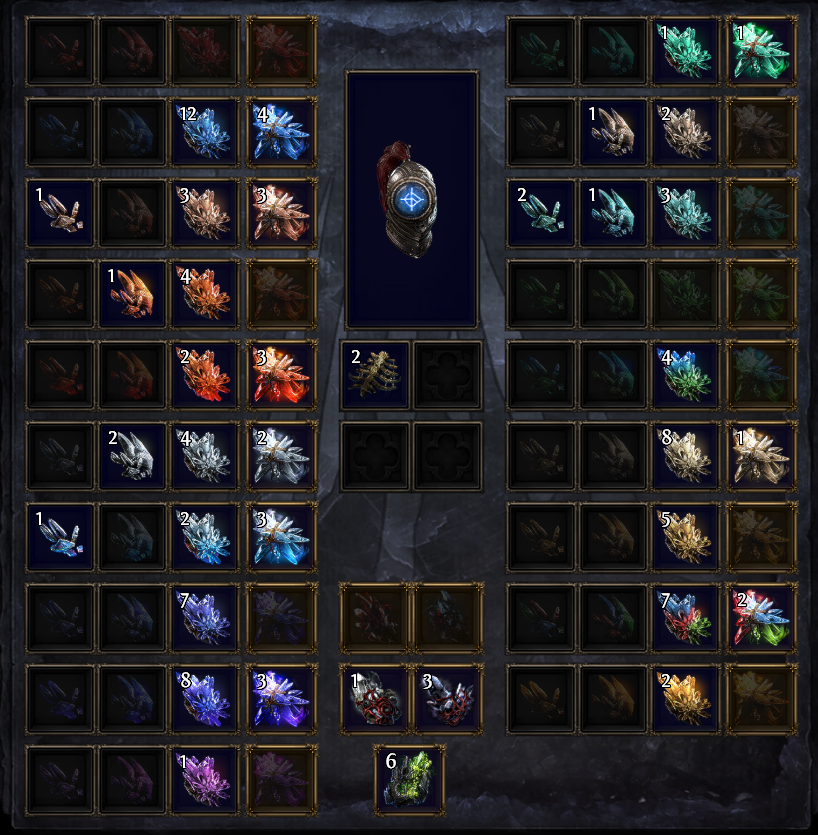
Image source: Mobalytics
Frequently Asked Questions
- Can I downgrade a Rare item to Magic in PoE2?
- No, rarity is a one-way street in Path of Exile 2. Once an item becomes Rare, it can never return to Magic or Normal status because the Orb of Scouring has been removed from the game. This makes your initial crafting decisions much more impactful.
- What happens if I use a Chaos Orb on a 6-mod item?
- The Chaos Orb will select one of the six modifiers at random, remove it, and replace it with a new modifier from the available pool. It does not reroll the entire item like it did in the first game. This allows for surgical improvements to high-end gear.
- How do I get more Desecration currency like Collarbones?
- These items drop from specific endgame bosses and certain league mechanics. They are generally rarer than basic currency like Alchemy orbs, so they should be saved for items that already have a strong foundation of 5 or 6 good modifiers.
- Is the Crafting Bench still in PoE2?
- Yes, but its role has changed. It is now used more for "fixing" and "blocking" modifiers rather than being the primary source of power. The new Rune Socket system handles many of the flat stat bonuses that the bench used to provide.
- Do attribute requirements affect what mods I can roll?
- Absolutely. An Intelligence-based item (like a Wand or Energy Shield Circlet) is heavily weighted to roll mana, spell damage, and energy shield. A Strength base will roll life and armor. Hybrid bases can roll both, but this makes hitting a specific stat more difficult due to the larger pool.
Key Takeaways for Successful Crafting
- Rarity is permanent: Choose your high-level bases carefully, as you cannot reset them.
- Identify first: Ground loot often has better "natural" tiers than what you can roll with basic currency.
- Use "Full Pool" logic: Fill your prefixes or suffixes to guarantee the type of stat an Exalted Orb adds.
- Master Omens: Use Omen of Sinistral/Dextral Necromancy to control your Desecration outcomes.
- Quality matters: Always max out an item's quality while it is still in its Normal (White) state.
- Chaos Orbs are surgical: Use them to swap out a single bad modifier on an otherwise great item.
- Rune Sockets are for fixing: Use runes to fill resistance or damage gaps during the campaign.
Start by identifying every Rare item that drops in high-level maps to find a strong foundation before spending your currency.