Home
How to Get and Grow Mangoes in Stardew Valley
Mangoes are tropical fruits introduced in the 1.5 update, primarily grown on Ginger Island . To start your orchard, you must obtain a Mango Sapling by cracking open Golden Coconuts at Clint's or trading 75 Cinder Shards at the Island Trader. Once planted, the tree takes 28 days to mature. On Ginger Island or in the Greenhouse, it produces one fruit every day year-round; on the Pelican Town farm, it only produces during Summer. Mangoes are essential for gaining friendship with Leo and cooking the Mango Sticky Rice recipe.
Introduction to Tropical Farming
The introduction of the 1.5 update brought a significant expansion to the world of Stardew Valley, most notably the addition of Ginger Island. Among the many new crops and items, the Mango stands out as a top choice for players looking to diversify their late-game agricultural output. Unlike the standard fruit trees found in Pierre’s General Store, Mangoes are tied specifically to the tropical progression of the Fern Islands.
Mangoes serve multiple purposes beyond simple profit. They are a critical component in building a relationship with Leo, the young boy living on the island, and they provide unique combat buffs through specialized cooking recipes. According to the official Stardew Valley Wiki , the Mango tree is one of the few plants that can provide a daily harvest indefinitely if placed in the correct environment. This guide explores the nuances of finding, growing, and optimizing your mango production to ensure your tropical farm thrives.

Image source: Stardew Valley Wiki - Fandom
Where to Find Mango Saplings in Stardew Valley
Acquiring your first Mango Sapling is a milestone that marks your transition into the late-game content of Ginger Island. Unlike Apple or Cherry saplings, you cannot simply buy these with gold at the start of the game. Instead, you must engage with the island's unique mechanics.
Cracking Golden Coconuts
The most common way to find a Mango Sapling is by processing Golden Coconuts . These are rare versions of standard coconuts that can be found by shaking palm trees on Ginger Island, digging up artifact spots, or occasionally finding them in supply crates. Once you have a Golden Coconut, you must take it to Clint the Blacksmith in Pelican Town. For a small fee of 25g, he will crack it open. The loot table for Golden Coconuts includes Mango Saplings, Banana Saplings, and various tropical artifacts.
The Island Trader Exchange
If luck isn't on your side with Golden Coconuts, you can take a more direct route. The Island Trader , located in the northern part of Ginger Island (near the entrance to the Volcano Dungeon), offers Mango Saplings in exchange for 75 Cinder Shards . Cinder Shards are obtained by mining the glowing orange rocks within the Volcano Dungeon. While 75 shards may seem like a high price, it is a reliable way to guarantee you get the sapling without relying on the randomness of coconut drops.
Professor Snail and the Field Office
For players who enjoy the completionist aspect of the game, Professor Snail offers Mango Saplings as rewards for completing specific fossil collections in the Island Field Office. Specifically, completing the Large Animal collection will net you several saplings, helping you jumpstart your orchard without spending shards or searching for coconuts. This method is highly recommended for players who are already exploring the island's caves and dig sites.
How to Plant and Grow Mango Trees Successfully
Growing a Mango tree requires patience and a specific understanding of the game's tree mechanics. While they function similarly to standard fruit trees, their environmental requirements are more flexible due to their tropical nature.
The 28-Day Maturation Cycle
Every Mango Sapling requires exactly 28 days to reach full maturity. During this time, the tree will progress through several visual stages. It is important to note that fruit trees do not need to be watered. However, they are sensitive to their surroundings. If any debris, such as rocks, weeds, or even grass, occupies the 3x3 area surrounding the sapling, the growth will be stunted, and you will receive a notification in the morning that your tree was unable to grow.
Optimal Planting Locations
Where you plant your Mango tree significantly impacts its utility. You have three primary options:
- Ginger Island Farm: This is widely considered the top choice. The tropical climate allows the tree to produce one Mango every single day, regardless of the season.
- The Greenhouse: Like Ginger Island, the Greenhouse provides a year-round growing environment. However, space here is often better reserved for Ancient Fruit or Starfruit.
- Pelican Town Farm: If planted on your main farm, the tree will only produce fruit during the Summer . During Fall, Winter, and Spring, the tree will remain dormant.
What Can You Do With Mangoes?
Mangoes are more than just a snack; they are a versatile resource used in social progression, cooking, and even industrial farm quests.
Building Friendship with Leo
Leo is a unique NPC who initially lives in a hut on Ginger Island. To progress his heart levels and eventually convince him to move to Pelican Town, you need to give him gifts he loves. The Mango is one of Leo's "Loved" gifts. According to Fandom's Stardew stats , giving a gold-quality Mango on his birthday is one of the most efficient ways to maximize his friendship quickly.
Cooking Mango Sticky Rice
Once you reach seven hearts with Leo, he will send you the recipe for Mango Sticky Rice in the mail. This dish is a strong contender for one of the most useful combat foods in the late game. It requires:
- 1 Mango
- Provides the tropical base for the dish.
- 1 Coconut
- Found commonly on the beach or in the desert.
- 1 Rice
- Grown from Rice Shoots or purchased from Pierre.
The resulting dish provides a +3 Defense buff that lasts for 5 minutes and 1 second. This makes it an excellent choice for deep runs into the Skull Cavern or the Volcano Dungeon, where mitigating damage is crucial.
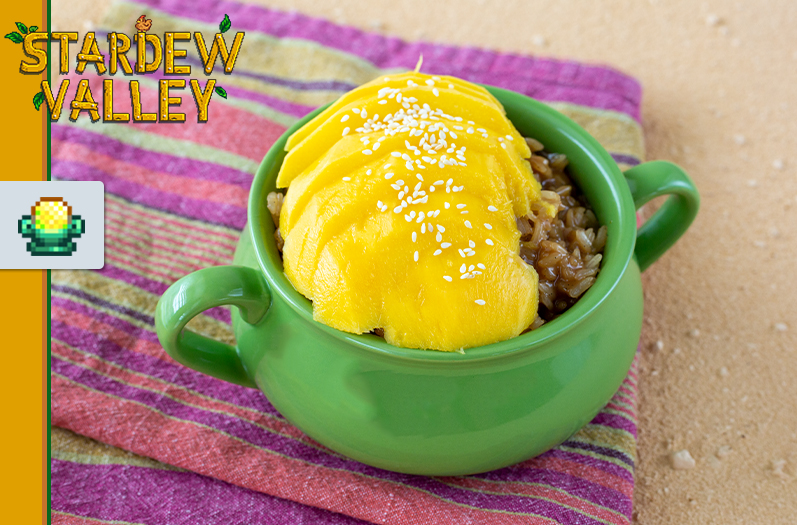
Image source: Pixelated Provisions
The Lionfish Fish Pond Quest
If you are managing Fish Ponds, you will eventually encounter a request from Lionfish. To increase the pond's capacity from 5 to 10 fish, they will request a single Mango. Keeping a few Mangoes in a chest is a smart move for players looking to complete all pond upgrades.
Is Mango Farming Profitable?
When comparing Mangoes to other fruit trees, it is important to look at the raw data. While they may not be the highest-earning item in the game, they offer consistent value, especially with the Artisan profession.
| Fruit Type | Base Price | Artisan Wine Price | Daily Production |
|---|---|---|---|
| Banana | 150g | 450g | Yes (Island) |
| Mango | 130g | 390g | Yes (Island) |
| Pomegranate | 140g | 420g | No (Summer only) |
| Peach | 140g | 420g | No (Summer only) |
As shown in the table, Mangoes are slightly less profitable than Bananas but outperform standard seasonal fruits because they produce daily on Ginger Island. When processed into Mango Wine with the Artisan profession (+40% value), the price jumps to 546g for a standard bottle. While not as lucrative as Ancient Fruit Wine, a large Mango orchard on the non-tillable areas of Ginger Island provides a steady stream of passive income with zero maintenance once the trees are grown.
Fixing Common Mango Tree Glitches and Mechanics
Players often encounter confusing situations with their fruit trees. Understanding these mechanics can prevent unnecessary frustration.
The Smoking Coal Tree
If you wake up to find your Mango tree turned grey, smoking, and producing Coal instead of fruit, do not panic. This is not a bug; it is the result of a lightning strike. During a storm, lightning can hit fruit trees, temporarily transforming them into coal producers. This effect lasts for 3 to 4 days. After this period, the tree will automatically revert to its normal state and begin producing Mangoes again. There is no need to chop it down or use any tools on it.
The Invisible Tree Bug
Some players, particularly those using mods or playing in certain language settings (like Chinese), have reported Mango trees becoming invisible or appearing as weeds. This is often related to an ID conflict with Item ID 834 . If you encounter this in a vanilla game, verifying your game files through Steam or the GOG launcher usually resolves the issue. If you are using mods, ensure that any custom furniture or crop mods are updated to be compatible with the 1.6 version of the game.
Why Isn't My Tree Growing?
If your tree has been a sapling for more than 28 days, check the surrounding 8 tiles. Even a hidden piece of grass or a stray stone behind the tree can halt its growth. In the 1.6 update, the game is more forgiving about some decorations, but for fruit trees, the 3x3 clear space rule remains a strict requirement for the maturation phase.
Advanced Strategies for Mango Optimization
Once you have a basic understanding of Mangoes, you can use these advanced techniques to maximize their utility on your farm.
The Thursday Volcano Photo Trade
The Island Trader has a rotating inventory, but one of the most unique exchanges happens every Thursday. You can trade 5 Mangoes for a 'Volcano' Photo . This is a unique piece of furniture that cannot be obtained elsewhere. For players aiming to decorate their homes with every possible item, maintaining a small Mango harvest is essential for this trade.
Wild Planting on Ginger Island
One of the most effective ways to use Mango Saplings is to plant them in the "wild" areas of Ginger Island. Many of the grassy areas outside the tillable farm plot are actually valid spots for fruit trees. By planting your Mangoes here, you save the prime tillable soil for high-value crops like Pineapples or Starfruit while still benefiting from a daily fruit harvest. This "wild orchard" strategy is a significant advancement in farm efficiency for late-game players.
"Mangoes represent the perfect balance of utility and aesthetics on Ginger Island. While they might not match the raw gold-per-day of a Banana, their role in Leo's story and the defense buffs from Mango Sticky Rice make them a top-tier addition to any serious farm."
Frequently Asked Questions
Can Mango trees grow during the Winter season?
Mango trees can only grow and produce fruit during Winter if they are planted in the Greenhouse or on the Ginger Island farm. If planted on your standard Pelican Town farm, they will remain dormant and will not produce fruit until the Summer season returns.
What is the Item ID for a Mango in Stardew Valley?
The internal Item ID for a Mango is 834 . This is useful for players who use console commands or are looking to troubleshoot specific mod conflicts. The Mango Sapling has a different ID, which is 835. According to Stardew IDs , these numbers are consistent across all platforms.
Do I need to water my Mango trees every day?
No, fruit trees in Stardew Valley, including Mangoes, do not require watering at any stage of their life. Once planted, they will grow on their own as long as the surrounding 3x3 area is kept clear of debris and obstacles.
How can I get more Golden Coconuts for saplings?
The most effective way to farm Golden Coconuts is to shake the palm trees on Ginger Island daily. You can also find them by digging up "artifact spots" (the little wiggling worms) on the island. Occasionally, the Blue Bird Merchant or supply crates on the beach will also contain them.
Can I grow Mangoes in Garden Pots inside my house?
No, fruit trees cannot be grown in Garden Pots. They require a 3x3 area of soil to be planted directly into the ground. If you want to grow them indoors, your only option is to plant them in the soil borders of the Greenhouse.
Key Takeaways for Mango Success
Mastering the cultivation of Mangoes is a rewarding part of the Stardew Valley experience. Here are the essential points to remember:
- Acquire saplings through Golden Coconuts or by trading 75 Cinder Shards at the Island Trader.
- Plant on Ginger Island to ensure a daily harvest year-round, bypassing the Summer-only restriction of the main farm.
- Maintain clear space in a 3x3 grid around the sapling for the full 28-day growth period to avoid stunting.
- Use Mangoes for Leo to quickly build friendship, as it is one of his Loved gifts.
- Cook Mango Sticky Rice for a powerful +3 Defense buff, which is highly effective for late-game dungeon crawling.
- Don't panic over lightning ; a smoking tree producing coal will return to normal in just a few days.
- Trade for furniture on Thursdays at the Island Trader to get the exclusive Volcano Photo.
Start gathering your Cinder Shards today to establish your tropical orchard and unlock the full potential of Ginger Island's agriculture.