Home
How Many Fruit Trees Are in Stardew Valley and How Do You Grow Them?
Fruit trees represent one of the most reliable long-term investments for any farmer in Pelican Town. Unlike standard crops that require daily watering and seasonal replanting, a fruit tree is a permanent fixture that provides passive income once it reaches maturity. Whether you are aiming to complete the Community Center bundles or looking to maximize your artisan profit through wine and dried fruit, understanding the nuances of these eight varieties is essential.
According to the official Stardew Valley Wiki , all fruit trees follow a strict 3x3 spacing rule and take exactly one full month to grow. However, the introduction of Ginger Island and the Greenhouse has allowed players to bypass seasonal restrictions, turning these trees into year-round profit engines. In this guide, we will break down every variety, the math behind their growth, and the troubleshooting steps you need to take when your orchard hits a snag.
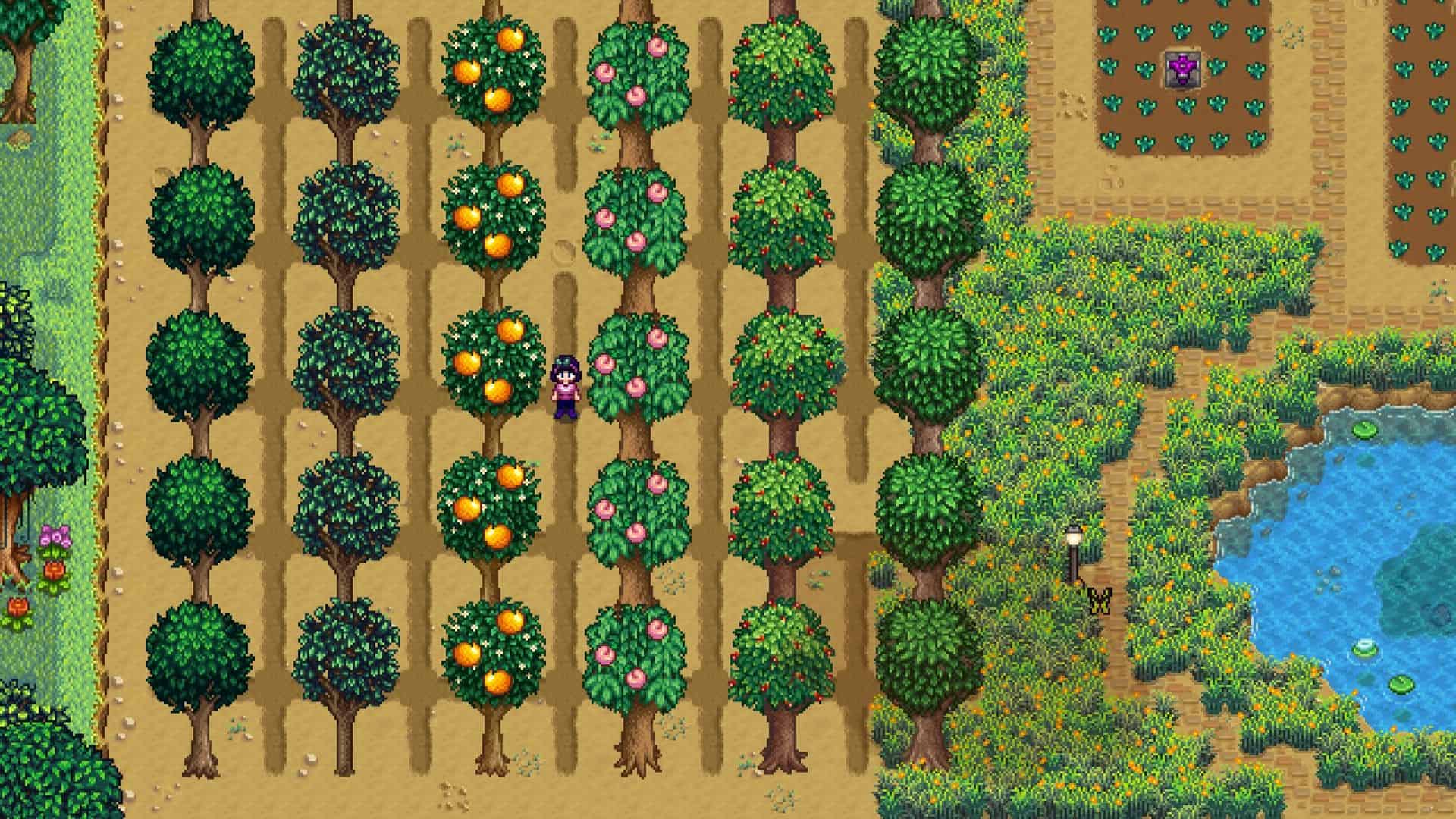
Image source: Assorted Meeples
Every Fruit Tree Variety and Their Specific Growing Seasons
The eight fruit trees are categorized by the season in which they bear fruit. While they can be planted at any time of year (including Winter), they will only produce fruit during their designated 28 days unless they are planted in a controlled environment like the Greenhouse or on Ginger Island.
Apricot & Cherry
Apricots are the most affordable entry point for new farmers, costing 2,000g. Cherries follow at 3,400g. While their individual fruit value is lower, they are vital for early-game energy and specific bundles.
Orange & Peach
Peaches stand out as a top choice for Summer, sharing the highest base-game sell price (140g) with Pomegranates. Oranges are a solid mid-tier option for consistent artisan processing.
Apple & Pomegranate
Apples are mandatory for the Fodder Bundle, while Pomegranates are widely regarded as one of the most valuable trees to plant early due to their high wine value.
Banana & Mango
Obtained via the Island Trader on Ginger Island, these trees produce year-round in the tropics. Bananas, in particular, offer a high ROI for players who have unlocked the late-game areas.
For those planning their farm's economy, the following table compares the base costs and potential returns for each tree. Note that these prices reflect the standard sapling costs at Pierre’s General Store, though prices may vary at the Night Market or through special traders.
| Tree Name | Season | Sapling Price | Base Fruit Price | Wine Value (Base) |
|---|---|---|---|---|
| Apricot | Spring | 2,000g | 50g | 150g |
| Cherry | Spring | 3,400g | 80g | 240g |
| Orange | Summer | 4,000g | 100g | 300g |
| Peach | Summer | 6,000g | 140g | 420g |
| Apple | Fall | 4,000g | 100g | 300g |
| Pomegranate | Fall | 6,000g | 140g | 420g |
| Mango | Island/Summer | 75 Mussels | 130g | 390g |
| Banana | Island/Summer | 5 Dragon Teeth | 150g | 450g |
How to Plant Fruit Trees Without Getting Growth Errors
The most common frustration for Stardew Valley players is the dreaded morning notification: "Your [Tree] was unable to grow last night." This occurs because fruit trees have much stricter spacing requirements than common trees like Oak or Maple. While a Maple tree can grow with objects adjacent to it, a fruit tree requires a completely clear 3x3 grid centered on the sapling.
This 3x3 area must remain empty of all debris, including grass, stones, and even tilled soil. If you accidentally hit the ground with a hoe near a growing sapling, the tree will stop its growth cycle until the soil returns to its natural state. Many players find that using a pickaxe to "un-till" the soil immediately is a reliable fix to keep the growth on track.
Why Your Fruit Tree Failed to Grow Overnight
Even if you follow the 3x3 rule perfectly during planting, external factors can interfere with growth. The game checks the 3x3 area every single night. If any new object is detected, the growth for that 24-hour period is skipped. Common culprits include:
- Artifact Spots: Those small "worms" in the ground can spawn overnight within the 3x3 area, blocking growth.
- Spreading Grass: If you have grass starters nearby, the grass can grow into the tree's zone.
- Hidden Torches: Many players place torches in their Greenhouse to see at night. If a torch is within the 3x3 grid of a sapling, it will prevent the tree from maturing.
- Debris Spawns: In the Spring, new rocks or logs can spawn on the farm and land right next to your sapling.
To ensure your tree reaches maturity in the standard 28 days, it is a top-rated practice to floor the area around the 3x3 grid with paths to prevent grass and debris from encroaching, while keeping the immediate 8 tiles around the stump completely bare.
Maximizing Space With the Greenhouse and Ginger Island
Once you unlock the Greenhouse, the utility of fruit trees changes significantly. In the Greenhouse, trees produce fruit every single day, regardless of the season. This makes the Greenhouse one of the most efficient locations for high-value trees like Peach and Pomegranate.
One of the most useful pieces of insider knowledge is the Greenhouse Border Trick . You are not limited to planting trees in the central soil patch. You can actually plant fruit trees directly onto the decorative tiles surrounding the soil. Because the Greenhouse walls and permanent decorations are considered "structures" rather than "debris," they do not block the tree's growth. This allows for an optimized layout of 18 trees around the perimeter, leaving the central soil entirely free for ancient fruit or other high-value crops.
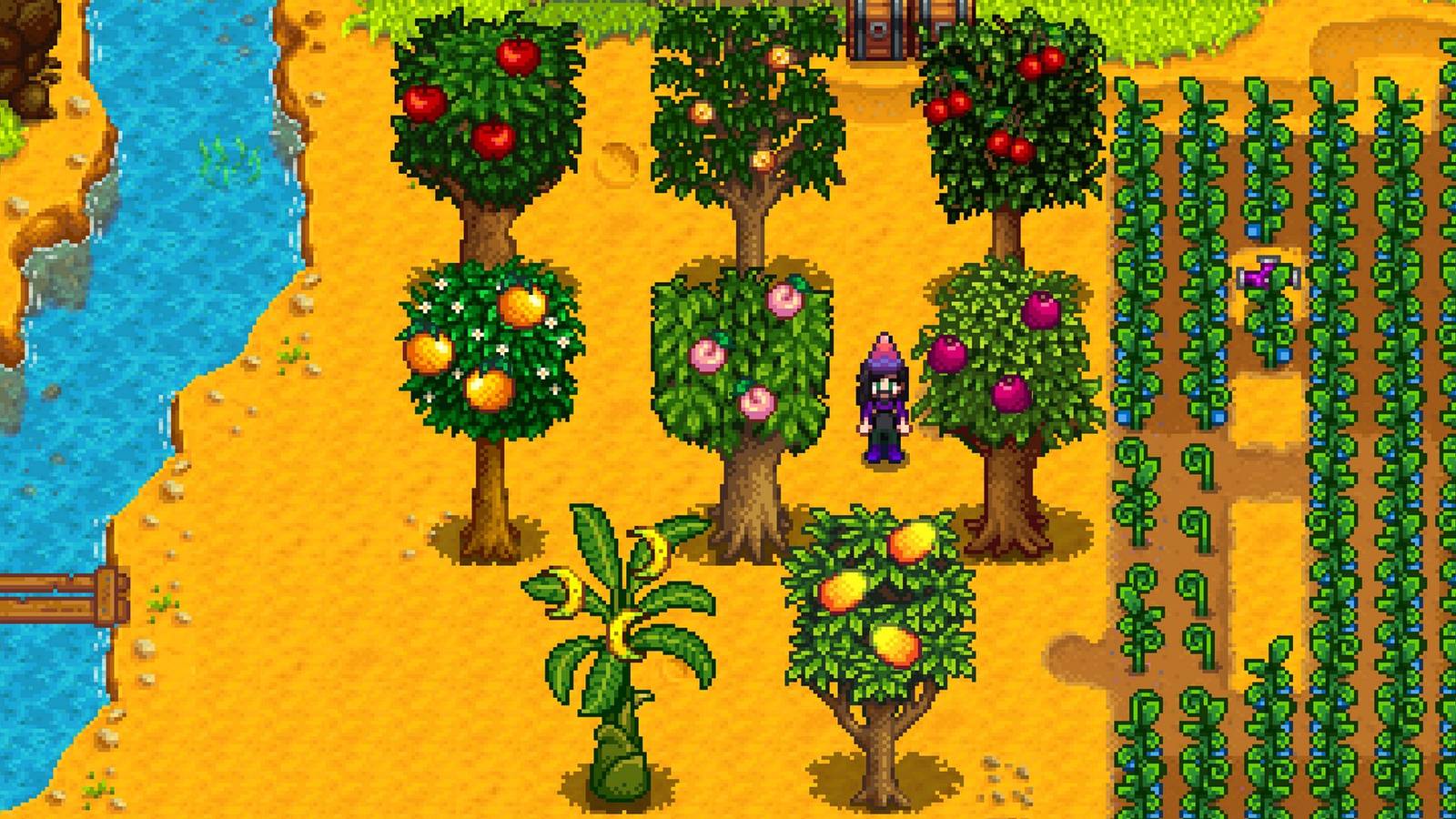
Image source: TheGamer
Ginger Island offers a similar advantage. The island farm behaves like a giant Greenhouse where every season is Summer. Planting Mango and Banana trees here is highly recommended, as they will produce fruit 365 days a year. According to community testing, the ROI on a Banana tree planted on Ginger Island is exceptionally strong, paying for itself much faster than a tree planted on the standard farm.
How Fruit Quality Increases Over Time
A unique mechanic of Stardew Valley fruit trees is their ability to "level up" as they age. Unlike crops, which rely on fertilizer for quality, fruit trees improve simply by existing. Once a tree reaches maturity, it begins a yearly progression:
- Year 1 (Maturity): The tree produces Normal quality fruit.
- Year 2: The tree begins producing Silver-star quality fruit.
- Year 3: The tree begins producing Gold-star quality fruit.
- Year 4+: The tree produces Iridium-star quality fruit.
The 1.6 update introduced a significant advancement in this system: High-Quality Saplings . Players can now obtain Silver, Gold, or even Iridium-grade saplings. When planted, these trees skip the yearly wait and immediately produce fruit of that quality once they mature. This is a major improvement for players looking to optimize their late-game artisan production without waiting four in-game years for Iridium fruit.
Which Fruit Trees Make the Most Money on Your Farm?
When deciding which trees to plant, you must choose between raw fruit sales and artisan processing. While Iridium-quality fruit sells for a high price, processing that fruit into Wine or Jelly almost always yields a higher return. However, the 1.6 update introduced the Dehydrator , which has changed the "Wine-only" meta.
The Dehydrator processes 5 pieces of fruit into 1 Dried Fruit. While the value of Dried Fruit is slightly lower than the equivalent amount of Wine, the processing time is significantly faster (one day versus seven days). For farmers with hundreds of trees, the Dehydrator offers a highly impactful way to clear out inventory and maintain a steady cash flow without the massive keg requirement.
If you are looking for the highest profit per tile, Pomegranate and Peach Wine remain the top-performing options for base-game trees. If you have access to Ginger Island, Banana Wine stands out as a top-tier earner. To buy one of every core sapling at Pierre's, you will need a total investment of 25,400g—a steep price for the first year, but one that pays for itself within two seasons of production.
Troubleshooting Common Fruit Tree Problems
Even the most experienced farmers encounter issues with their orchards. One of the most confusing events is the "Coal Tree." During a thunderstorm, there is a small chance that lightning will strike a mature fruit tree. Instead of being destroyed, the tree will turn black and produce Coal instead of fruit for four days. Do not chop it down! The tree will naturally recover and return to its original state after the fourth day.
Another common issue is accidental removal. If you use an Axe or a Hoe on a sapling that has not yet matured, you will receive the sapling back in your inventory. However, once the tree is fully grown, using an axe will chop it down into wood and fruit, and you will lose the initial investment. Always be careful when clearing grass or debris near your mature orchard.
Adding More Varieties With the Stardew Valley Expanded Mod
For players on PC who use the Stardew Valley Expanded (SVE) mod, the fruit tree count increases significantly. This mod adds four additional varieties that integrate seamlessly into the game's existing systems:
- Money Tree: A rare tree that produces bags of gold.
- Nectarine: A Summer variety that offers a fresh artisan path.
- Pear: A Fall tree that complements the Apple and Pomegranate.
- Persimmon: Another Fall addition with unique cooking applications.
These modded trees follow the same 3x3 spacing and 28-day growth rules as the base-game trees, but they provide more diversity for players who have already mastered the original eight varieties.
Frequently Asked Questions
- Do fruit trees need to be watered during their growth phase?
- No, fruit trees do not require any watering. They will grow independently as long as their 3x3 area remains clear of debris and obstacles. This makes them a very low-maintenance investment compared to traditional crops.
- Can I move a fruit tree once it has been planted?
- In the base game, you cannot move a fruit tree. If you want to change its location, you must chop it down and purchase a new sapling. However, if the tree is still a sapling (not fully grown), you can hit it with a hoe or axe to retrieve the sapling and replant it elsewhere.
- Do fruit trees die in the Winter?
- No, fruit trees are permanent and will not die during the Winter. They simply go dormant and will not produce fruit unless they are located in the Greenhouse or on Ginger Island. They will continue to age and increase in quality during the Winter months.
- Can I plant fruit trees next to water or the farm's edge?
- Yes, you can plant fruit trees next to permanent features like ponds, cliffs, or the farm's boundary. These permanent structures do not count as "debris" and will not block the tree's growth, provided the 3x3 grid is technically on walkable land.
- What is the fastest way to get a Banana tree?
- The most efficient way to obtain a Banana tree is by trading 5 Dragon Teeth to the Island Trader on Ginger Island. You can also occasionally find them in Golden Coconuts or as a reward for completing the Large Animal collection in the Island Field Office.
The Bottom Line
Managing an orchard in Stardew Valley is a rewarding endeavor that provides both aesthetic beauty and significant financial returns. To ensure your success, keep these key takeaways in mind:
- Verify the count: Ensure you have all 8 base-game varieties to maximize your artisan options.
- Respect the gap: Maintain a 2-tile distance between all fruit tree stumps to avoid growth errors.
- Clear the zone: Regularly check the 3x3 area for tilled soil, torches, or overnight debris spawns.
- Use the Greenhouse: Plant trees on the outer tiles of the Greenhouse for year-round daily production.
- Embrace the 1.6 update: Utilize Dehydrators for faster processing and seek out high-quality saplings to skip the aging process.
- Plan for Fall: Pomegranates and Peaches are among the most profitable trees; prioritize them for early-game wealth.
Start by planting your Spring trees during the first week of Winter to ensure a full season of profit as soon as the snow melts.
All trademarks, copyrighted content, and quoted material referenced in this article belong to their respective owners. Brief excerpts are used under fair use (17 U.S.C. § 107) for purposes of commentary, criticism, and informational reporting. This article is not affiliated with or endorsed by ConcernedApe or Chucklefish.