Home
How to Get Every Personality Type in Tomodachi Life Living the Dream Using Slider Settings
In Tomodachi Life: Living the Dream (LTD) , a Mii's personality is determined by a 4x4 matrix of 16 types, categorized into Easygoing, Energetic, Confident, and Reserved . To achieve a specific type, you must adjust five sliders—Movement, Speech, Expressiveness, Attitude, and Overall—on a scale of 1 (left) to 8 (right). The LTD version specifically fixes the "Overall" slider logic found in the original game, ensuring that "Quirky" behavior is correctly mapped to the slider's position.
Understanding the 16 Personality Types and How They Work
Every Mii you create in Tomodachi Life is more than just a collection of facial features; they are defined by a complex behavioral system. This system places every resident into one of four primary categories, each containing four distinct sub-types. According to community research and official game mechanics , these labels dictate how your Mii walks, how they interact with others, and even the default style of their apartment.
The Living the Dream (LTD) mod is widely regarded as a significant advancement for the title, as it addresses several technical limitations of the base game. One of the most notable changes in the LTD version is the correction of the "Switch Language" naming conflicts and the refinement of the "Overall" slider. In the original release, the "Overall" slider (which toggles between Normal and Quirky) often had reversed logic depending on the region. The LTD mod ensures a consistent experience, making it a top choice for players seeking a more polished simulation.
How to Use the 5 Trait Sliders to Shape Your Mii
To master the personality system, you must understand the "Notch System." While the game doesn't show numbers, the community uses a 1-to-8 scale to define slider positions. Setting a slider to "1" means moving it all the way to the left, while "8" is all the way to the right.
- Movement: This slider determines how fast a Mii walks and how active they are in their room. High movement (7-8) leads to Energetic or Confident types, while low movement (1-2) leans toward Reserved or Easygoing.
- Speech: This ranges from "Polite" to "Direct." It influences the Mii's tone of voice and the specific phrases they use when greeting you or other residents.
- Expressiveness: This slider tracks how much emotion a Mii shows. A high expressiveness score (7-8) often results in a "Charmer" or "Optimist," while a low score (1-2) creates a "Thinker" or "Brainiac."
- Attitude: This is the "Thinking" vs. "Feeling" slider. It dictates whether a Mii approaches situations with logic or emotion.
- Overall: Often called the "Quirky" slider. In the LTD mod, this slider primarily affects the frequency of unusual animations and dialogue without necessarily changing the core personality label, though it remains a critical part of the initial quiz.
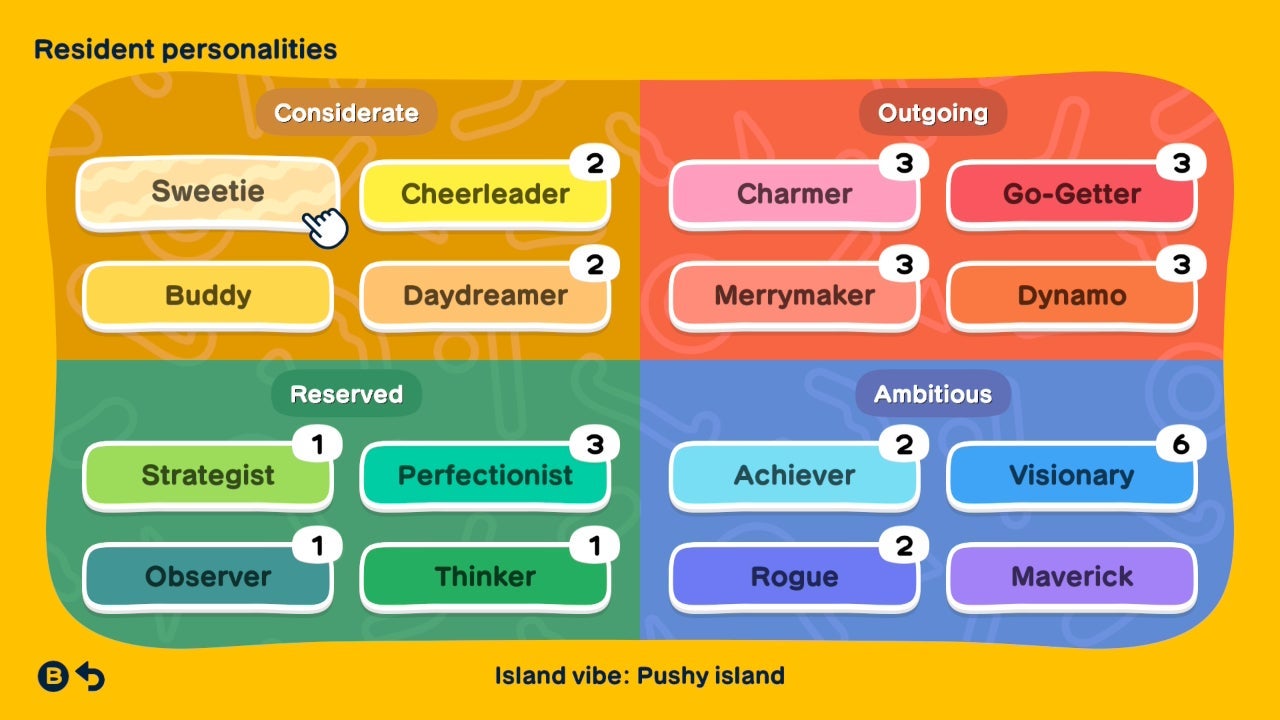
Image source: IGN
Complete Slider Chart for All 16 Personality Types
Achieving a specific personality requires precise slider placement. Below is a detailed mapping based on GameSpot's technical analysis and community data. Note that names may differ between North American (NA) and European (EU) versions.
Easygoing Personality Type Slider Settings
Movement:
1-2
Expressiveness:
7-8
A gentle soul who prioritizes harmony.
Movement:
4-5
Expressiveness:
7-8
Highly social and emotionally intelligent.
Movement:
1-2
Expressiveness:
1-2
Often found lost in thought or gazing out windows.
Movement:
7-8
Expressiveness:
7-8
Always sees the glass as half full.
Energetic Personality Type Slider Settings
Movement:
8
Speech:
Polite
The life of every island party.
Movement:
8
Speech:
Direct
Always ready for a new challenge.
Movement:
8
Expressiveness:
1-2
Independent and unpredictable.
Movement:
8
Attitude:
Balanced
Always ahead of the curve in fashion and hobbies.
Why Are My Personality Names Different?
A common point of confusion for players, especially those using the LTD mod, is the discrepancy in personality names. You might follow a guide for a "Sweetie" but end up with a "Softie." This is not a bug in the game logic, but rather a result of Regional Naming Conflicts . The North American (NA) and European/Australian (EU/UK) versions of the game use different localized strings for the same personality archetypes.
Furthermore, many players encounter the "Switch Language Bug." If your Nintendo Switch system language is set to "English (UK)" instead of "English (US)," the game will default to EU names regardless of your physical location or the version of the ROM you are using. To fix this, navigate to your System Settings, select "System," then "Language," and ensure it is set to "English (US)" if you prefer the NA naming convention.
Mapping Tomodachi Life Personalities to MBTI and Temperaments
For players who want to create Miis based on real-world friends or celebrities, mapping the 16 game types to the Myers-Briggs Type Indicator (MBTI) and the Four Temperaments is a highly effective strategy. This framework, while not official, is widely regarded as one of the strongest ways to ensure accuracy in Mii creation.
| Tomodachi Type (NA) | Temperament | MBTI Equivalent |
|---|---|---|
| Designer / Mastermind | Choleric | INTJ |
| Sweetie / Softie | Phlegmatic | ISFJ |
| Free Spirit | Sanguine | ENFP |
| Thinker / Scholar | Melancholic | INTP |
| Leader | Choleric | ENTJ |
| Artist / Individualist | Melancholic | ISFP |
How Personality Affects Your Mii’s Gameplay and Animations
Personality is not just a cosmetic label; it functions as the "brain" of your Mii. According to GeekDad's gameplay review, these traits influence several hidden mechanics:
- Interior Rewards: When a Mii is first created, their personality group determines which "Starter Interior" they receive. Easygoing Miis often start with softer, pastel-colored rooms, while Confident Miis may receive more modern or bold designs.
- Baby Clothing Colors: If two Miis have a child, the default color of the baby's outfit is influenced by the parents' personality types. This adds a genetic-like layer to the simulation.
- Idle Animations: Reserved Miis are more likely to be seen sitting quietly or reading, while Energetic Miis will frequently perform jumping jacks or run around their rooms.
Compatibility and Marriage Success Rates
While any two Miis can technically fall in love, their personality types significantly impact their "Natural Affinity." The game uses a hidden compatibility matrix to determine how quickly two Miis will build a relationship. Generally, Miis within the same primary category (e.g., two Easygoing Miis) have a higher baseline for friendship. However, for long-term marriage success, a balance of traits is often more effective. For example, an Energetic Mii and an Easygoing Mii often form a stable "Opposites Attract" dynamic.
Troubleshooting Common Personality Errors
Even with a chart, you might not get the result you expect. One of the most frequent issues is the Busy Bee vs. Thinker Swap . Many older community guides accidentally swapped the slider settings for these two types. If you are trying to get a "Busy Bee" (Achiever) but keep getting a "Thinker," try reversing your Expressiveness and Attitude sliders.
Another common pitfall is "Micro-Movements." The sliders are very sensitive; even a pixel's difference can shift a Mii from one sub-type to another. If you are stuck, try moving all sliders to the extreme ends (1 or 8) first, then gradually move them toward the center to "reset" the game's internal calculation. Remember that you can always edit a Mii's personality later via the Town Hall, though doing so will reset their current relationship levels with other residents.
Frequently Asked Questions
- Can I change a Mii's personality after I make them?
- Yes, you can change a Mii's personality at any time by visiting the Town Hall or selecting the Mii in their apartment and choosing the "Edit" option. However, be aware that changing a Mii's personality will completely reset their relationship progress with every other Mii on the island. It is usually better to get the personality right during the initial creation process to avoid losing hours of social progress.
- Does the "Quirky" slider change the personality name?
- No, the "Overall" slider (Normal vs. Quirky) does not change the core personality label (like Sweetie or Leader). Instead, it acts as a modifier for their behavior. A "Quirky Sweetie" will still have the Sweetie label but will perform unusual animations more frequently and may have slightly different dialogue triggers compared to a "Normal Sweetie." In the LTD mod, this slider's logic is more consistent than in the original 3DS release.
- What is the rarest personality type in Tomodachi Life?
- Technically, no personality type is "rarer" than others in terms of game code, as they are all equally accessible via the sliders. However, the "Lone Wolf" (Reserved) type is often considered the hardest to trigger accidentally because it requires a very specific combination of low movement, direct speech, and low expressiveness that most players don't naturally select during a blind quiz.
- Do personality types affect what gifts a Mii likes?
- Personality types do not directly dictate a Mii's favorite foods or items, as those are randomized for every Mii. However, personality does influence their *reaction* to gifts. For example, an Energetic Mii might react more explosively to a gift they love, while a Reserved Mii will offer a more subdued, though equally positive, response. Their general "Attitude" slider also subtly influences how often they ask for new clothes or room interiors.
- Why does my Mii have a UK name on a US console?
- This is almost always due to the Nintendo Switch's system language settings. If your console is set to "English (UK)," the game—especially the Living the Dream mod—will pull the European localized strings (e.g., "Softie" instead of "Sweetie"). To see the North American names, you must change your console's system language to "English (US)" in the main settings menu.
The Bottom Line
Mastering the personality system in Tomodachi Life: Living the Dream allows you to create a vibrant, realistic island community. Here are the key takeaways to remember:
- Personalities are structured in a 4x4 grid consisting of 16 unique sub-types.
- Slider precision is key , with the 1-to-8 notch system being the most reliable way to navigate the quiz.
- The LTD version fixes the "Overall" slider logic, providing a more stable experience for mod users.
- Regional names vary , so check your Switch system language if "Sweetie" shows up as "Softie."
- MBTI mapping offers a practical way to translate real-world personalities into the game.
- Animations and interiors are directly tied to these traits, giving each Mii a distinct "Visual ID."
To get started, try creating a Mii using the "Lone Wolf" settings to see how unique the Reserved animations truly are.