Home
How to Master Stardew Valley 1.6 Farming for Maximum Profit and XP
Success in Stardew Valley 1.6 farming relies on balancing early-game XP with long-term infrastructure. Kale stands out as a top choice for Spring Year 1 leveling, while the new Meadowlands Farm provides a significant head start through animal products. To maximize efficiency, prioritize reaching Farming Level 6 for Quality Sprinklers and use the "flooring trick" to protect your equipment from accidental hoe damage.
Image source: SteelSeries
What Changed for Farmers in the Stardew Valley 1.6 Update?
The 1.6 update introduced several notably innovative mechanics that shift the traditional crop-only focus. The most significant addition is the Meadowlands Farm , which replaces the standard starting seeds with a pre-built coop and two chickens. This allows players to begin earning Farming XP through animal care immediately, bypassing the initial gold barrier of building a coop.
Another major advancement is the introduction of skill-granting books. The Stardew Valley Almanac , which can be purchased from the Bookseller or found in mystery boxes, provides a flat 250 Farming XP. According to the Stardew Valley Wiki , this is a highly impactful way to bridge the gap between Level 5 and Level 6, where Quality Sprinklers are unlocked.
Furthermore, the new Blue Grass found on the Meadowlands farm (and craftable later) doubles the rate at which animal friendship increases. This leads to higher-quality products much faster than standard grass. For players focusing on the Rancher profession path, this makes animal husbandry a premier choice for early-game stability.
How to Level Up Your Farming Skill Fast
Farming XP is primarily earned by harvesting crops, but it is also granted for petting animals, milking, shearing, and collecting animal products. To reach the mid-game quickly, you must hit Level 6 Farming to unlock Quality Sprinklers, which automate the most time-consuming part of the day.
In Spring Year 1, many players make the mistake of planting only Parsnips. While cheap, Parsnips only grant 8 XP per harvest. In contrast, Kale grants 17 XP and takes the same 6 days to grow as a Potato (which only gives 14 XP). Analysis from the SDV Community Forums suggests that Kale is the most effective crop for hitting Level 6 before the end of the first Spring.
| Crop | Growth Time | XP per Harvest | XP per Day |
|---|---|---|---|
| Parsnip | 4 Days | 8 XP | 2.0 |
| Potato | 6 Days | 14 XP | 2.33 |
| Kale | 6 Days | 17 XP | 2.83 |
| Cauliflower | 12 Days | 23 XP | 1.92 |
To reach Level 10 by the end of Summer, transition into high-volume crops like Blueberries. While they offer lower XP per individual berry, the sheer quantity of harvests per plant makes them a leading choice for passive leveling while you focus on mining or social interactions.
Which Farming Profession Should You Choose?
The choice between Tiller and Rancher at Level 5 defines your entire economic strategy. While Tiller has historically been considered the standard choice, the 1.6 update has made the Rancher path a strong contender, especially for Meadowlands starts.
- Tiller (Level 5)
- Crops are worth 10% more. This is the prerequisite for the Artisan profession, which is widely regarded as one of the best ways to generate late-game wealth.
- Rancher (Level 5)
- Animal products are worth 20% more. This path is ideal for players who prefer barns and coops over massive fields of crops.
- Artisan (Level 10 - Tiller Path)
- Artisan goods (wine, cheese, oil, etc.) are worth 40% more. This remains a top-tier option for players using Kegs and Jars.
- Shepherd (Level 10 - Rancher Path)
- Sheep produce wool faster, and animal products gain a hidden +0.333 quality bonus. When combined with high friendship, this makes Iridium-quality wool almost guaranteed.
According to expert analysis in Gemini's Farming Guide , the "Shepherd and Loom Cycle" can rival the profit of Ancient Fruit wine if managed correctly, as sheep can produce wool daily at maximum friendship, which is then processed into high-value Cloth.
How to Optimize Your First Spring for Long-Term Success
The first two weeks of the game are critical. Instead of spending all your initial 500g on seeds immediately, many veteran players recommend a "Fishing Start." By spending the first five days fishing at the mountain lake, you can generate a nest egg of $5,000 or more. This capital is essential for the Egg Festival on Spring 13 .
Energy management is the biggest hurdle in Spring. To maintain a large farm without a kitchen, buy Salads from Gus at the Stardrop Saloon. They offer the most cost-effective energy-to-gold ratio in the early game. Additionally, always check the weather forecast; plan your tool upgrades (specifically the Watering Can) for days when rain is predicted for the following day, ensuring your crops don't go thirsty while Clint has your tool.
Top-Performing Crops for Every Season in Year 1
Choosing the right crop depends on whether you need immediate cash, high XP, or long-term processing material. Below are the top-rated options for each season based on current 1.6 data.
Spring
Cauliflower: High profit and potential for Giant Crops.
Kale: The premier choice for rapid XP gain.
Strawberries: The most profitable Spring crop if planted by the 13th.
Summer
Starfruit: The gold standard for wine production.
Blueberries: Excellent for consistent cash flow and XP.
Melons: High value and Giant Crop potential.
Fall
Pumpkins: High profit and massive XP per harvest.
Cranberries: Low maintenance with multiple harvests.
Sweet Gem Berry: The highest single-item value in the game.
The Ancient Fruit Transition
Once you obtain your first Ancient Seed (via artifact hunting or the Seed Maker), your goal should shift toward filling your Greenhouse. Ancient Fruit grows in all seasons except Winter (and grows year-round in the Greenhouse), providing a harvest every 7 days. This creates a permanent engine for Artisan wealth that requires very little weekly maintenance compared to seasonal replanting.
Advanced Automation and Layout Strategies
Manual watering is the primary bottleneck for farm expansion. While some players suggest skipping Basic Sprinklers to save resources for Quality Sprinklers, others argue that even the basic 4-tile coverage is worth the iron to automate small patches and maintain XP growth.
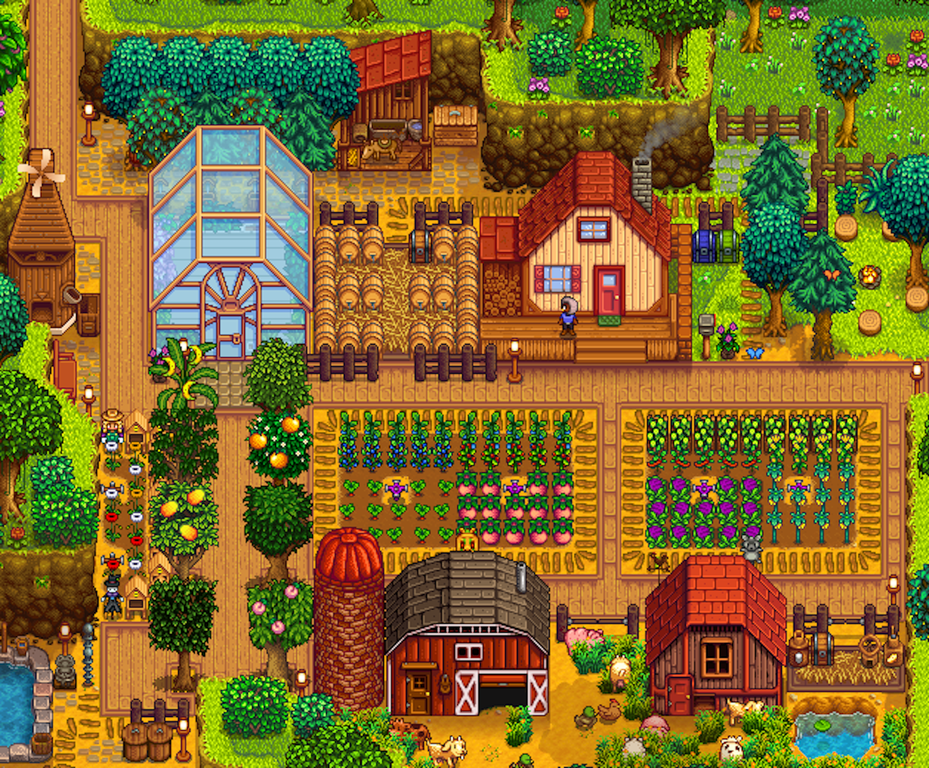
Image source: Pinterest
A highly impactful pro-tip involves the "Sprinkler Base" trick . When using the Hoe to till large areas, it is easy to accidentally uproot your sprinklers or scarecrows. To prevent this, place a piece of flooring (like Wood Path or Stone Floor) on the tile first, then place the sprinkler on top of the flooring. The Hoe will not pick up the flooring or the sprinkler, allowing for much faster seasonal replanting.
For late-game efficiency, Junimo Huts are a significant advancement. These huts automatically harvest mature crops within a 17x17 area. While they don't work in the rain, they free up your mornings to explore the Skull Cavern or Ginger Island, effectively turning your farm into a passive income stream.
How to Make Millions with Animal Products and Artisan Goods
The Artisan profession is widely considered one of the strongest choices for wealth generation because it applies a 40% bonus to a vast range of products. However, there is common confusion regarding Oil . While Truffle Oil benefits from the Artisan bonus, standard Oil (made from Corn or Sunflowers) does not. This makes Truffles a premier choice for high-end farming builds.
In the Greenhouse, you can maximize space by planting fruit trees on the outer floor tiles. As long as the surrounding 8 tiles are clear of decorations, the trees will grow to maturity, leaving the central soil free for Ancient Fruit or Pineapples. This layout is a top-tier strategy for year-round fruit production without sacrificing valuable tilled land.
Finally, consider the Sheep vs. Wine comparison. While Starfruit wine sells for thousands, it takes a week to process. A Shepherd-boosted sheep produces Iridium Wool daily, which can be turned into Cloth. For players who prefer a daily "paycheck" over a weekly windfall, the animal-heavy route is an exceptionally strong alternative in the 1.6 meta.
Frequently Asked Questions
Do I get farming XP for using sprinklers?
No, you do not earn XP for the act of watering, whether done manually or via sprinklers. Farming XP is only granted when you harvest the mature crop or interact with your animals. However, sprinklers are a top choice for leveling because they allow you to manage a much larger volume of crops than you could water by hand.
Which crop is most effective for leveling up farming in Spring Year 1?
Kale is widely regarded as the most effective crop for early leveling. It provides 17 XP per harvest, which is significantly higher than Parsnips (8 XP) or Potatoes (14 XP). Planting a large field of Kale is the fastest way to reach Level 6 and unlock Quality Sprinklers before Summer begins.
Does the Artisan profession affect Truffle Oil?
Yes, Truffle Oil is classified as an Artisan Good and receives the full 40% price increase from the Artisan profession. This makes Pigs one of the most profitable animals in the game. Note that regular Oil made from seeds does not receive this bonus, which is a common point of confusion for new players.
How do I get Giant Crops to grow?
Giant Crops (Cauliflower, Melons, and Pumpkins) have a chance to appear whenever a 3x3 grid of the same crop is fully grown and the center crop is watered. You do not have to harvest them immediately; leaving them unharvested gives them a daily chance to fuse into a Giant Crop, which yields more items when broken with an axe.
Is the Meadowlands farm good for beginners?
The Meadowlands farm is a top-rated option for beginners because it provides a Coop and two Chickens for free. This gives new players a steady source of food and income without needing to navigate the complexities of building construction and resource gathering in the first week.
Key Takeaways for SDV Farming
- Prioritize Kale in Spring Year 1 to reach Farming Level 6 as quickly as possible.
- Use the flooring trick by placing paths under your sprinklers to prevent them from being uprooted by your hoe.
- Leverage the Meadowlands farm in 1.6 to gain early XP through animal products and Blue Grass.
- Save gold for Strawberries on Spring 13 to maximize your seasonal profit margins.
- Choose the Artisan profession for long-term wealth, or Shepherd if you prefer a high-frequency animal build.
- Read the Stardew Valley Almanac as soon as you find it for a significant XP boost.
Start your next season by calculating your XP needs and investing in the crops that will unlock your next major automation milestone.