Home
Which Stardew Valley Farm Layout Should You Choose in 1.6?
Choosing a farm type is a permanent decision in Stardew Valley. For most players, the Forest Farm or Meadowlands Farm offers the most balanced early-game experience, while the Standard Farm remains a top choice for late-game industrial optimization.
How the 1.6 Update Changed Your Starting Farm Choice
The release of the 1.6 update introduced significant shifts in how players approach the early game, primarily through the introduction of the Meadowlands Farm . Unlike traditional starts that provide 15 Parsnip seeds, the Meadowlands layout grants you a Small Coop and two chickens from Day 1. This shift fundamentally alters the first week of gameplay, moving the focus from crop watering to animal husbandry.
According to the Stardew Valley Wiki , the Meadowlands farm also features a unique "Blue Grass" variant. This grass is not merely cosmetic; animals that consume it gain friendship and mood at a faster rate, which directly translates to higher-quality products like Large Eggs and Gold-star Mayonnaise much earlier in the save. For players who find the early-game watering grind tedious, this layout stands out as a top choice.
By starting with chickens, you can reach Level 2 Farming significantly faster by processing eggs into Mayonnaise. This provides a consistent daily income stream that isn't dependent on the 4-day growth cycle of Parsnips, allowing for faster tool upgrades in Spring Year 1.
Furthermore, the 1.6 update adjusted other maps to keep them competitive. The Riverland Farm now includes a Fish Smoker as a starting item. This machine doubles the value of caught fish, making a fishing-focused early game exceptionally strong for generating liquid capital. These changes mean that the "best" farm is no longer just about tile count, but about which starting resource matches your intended progression path.
Comparing All 8 Farm Types by the Numbers
When planning a long-term farm, technical specifications like tillable tiles and buildable space are critical. While every map can eventually house a successful farm, the Standard Farm remains the leader in raw production capacity. However, other maps offer unique perks that can outweigh the loss of space depending on your goals.
| Farm Type | Tillable Tiles | Unique Perk | Primary Focus |
|---|---|---|---|
| Standard | 3,427 | Maximum open space | Farming / Industry |
| Meadowlands | 2,060 | Blue Grass & Starting Coop | Ranching |
| Four Corners | 2,952 | Divided quadrants | Multiplayer / Mixed |
| Beach | 2,700 | Supply crates wash ashore | Foraging / Fishing |
| Forest | 1,413 | Renewable Hardwood stumps | Foraging |
| Hill-top | 1,648 | Renewable Ore deposits | Mining |
| Wilderness | 2,131 | Monsters spawn at night | Combat |
| Riverland | 1,578 | Starts with Fish Smoker | Fishing |
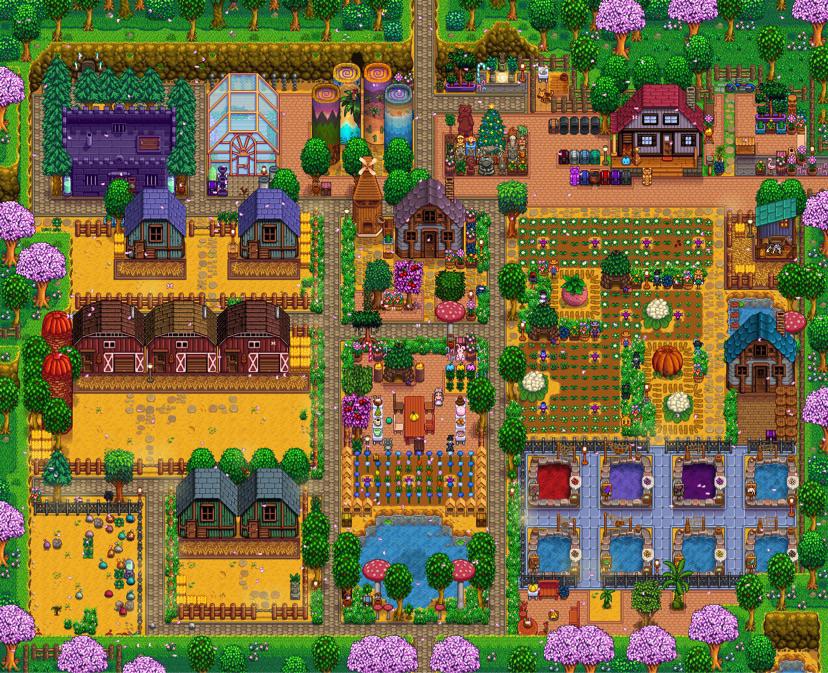
Image source: IGN
The Beach Farm presents a unique technical hurdle: while it has a high tile count, only 202 tiles are compatible with sprinklers. This makes it a highly recommended choice for veteran players who want to focus on animals or manual watering, but it can be frustrating for those aiming for massive automated crop fields. Conversely, the Four Corners map is widely regarded as one of the best for organized play, offering a mini-version of four different farm types in one layout.
Which Farm Matches Your Specific Playstyle?
Choosing a farm is as much about "vibe" as it is about math. The community often categorizes players into specific personas, each of which gravitates toward a different map layout. Understanding your own priorities—whether they be wealth, beauty, or social play—will help you make the right choice.
The Min-Maxer (Standard or Four Corners)
If your goal is to see the highest possible number in your shipping bin, the Standard Farm is a top-tier option. Its 3,427 tillable tiles allow for massive Ancient Fruit or Starfruit operations. Many high-level players utilize the "Artisan" profession synergy, where processed goods sell for 40% more. With this much space, you can fit hundreds of Kegs and Preserve Jars, creating a financial empire that few other maps can match.
The Cozy Decorator (Forest Farm)
For many in the r/CozyGamers community, the Forest Farm is a popular choice for aesthetics. The unique greenery, seasonal forage spawns, and natural lighting create a "cottagecore" atmosphere that the Standard farm lacks. While it has fewer tillable tiles, the built-in ponds and grass patches make it much easier to design a farm that looks organic and lived-in rather than industrial.
The Social Butterfly (Four Corners)
Designed specifically for multiplayer, the Four Corners map provides each player with their own distinct area. This prevents the "Ghost Farm" bugs sometimes seen in older multiplayer saves where players would accidentally overwrite each other's progress or struggle with shared resources. Each quadrant has a small perk (a pond, a mining area, etc.), making it a significant advancement for cooperative play.
Deep Dive into the Meadowlands Farm Meta
The Meadowlands farm is more than just a "chicken farm." It represents a shift in the early-game meta that rewards animal-centric builds. The Blue Grass mentioned earlier is a notable innovation; it provides double the friendship gain compared to regular grass. This means your chickens, and later your cows and goats, will produce high-quality goods much faster than on any other map.
One challenge of the Meadowlands layout is the irregular tillable patches. Unlike the Standard farm, you cannot simply place a massive grid of Iridium Sprinklers. Instead, you must work with the natural flow of the land, placing barns and coops on the non-tillable grass areas to maximize the remaining soil for high-value crops like Pumpkins or Cauliflower.
Maximizing the Forest Farm for Early Game Success
The Forest Farm is often cited as one of the strongest starts for beginners because of its resource abundance. The most significant advantage is the eight renewable Large Stumps. These provide a steady supply of Hardwood, a resource that is usually gated behind the Secret Woods or high-level axe upgrades. With these stumps, you can build a Stable and high-quality fences much earlier than on other maps.
Unique forage spawns also appear on the Forest Farm, including seasonal items like Morels and Chanterelles. These are essential for completing the Community Center bundles. Furthermore, the unique weeds on this map have a high chance of dropping Mixed Seeds when cut, providing a "free" source of crops during the first Spring when money is tight.
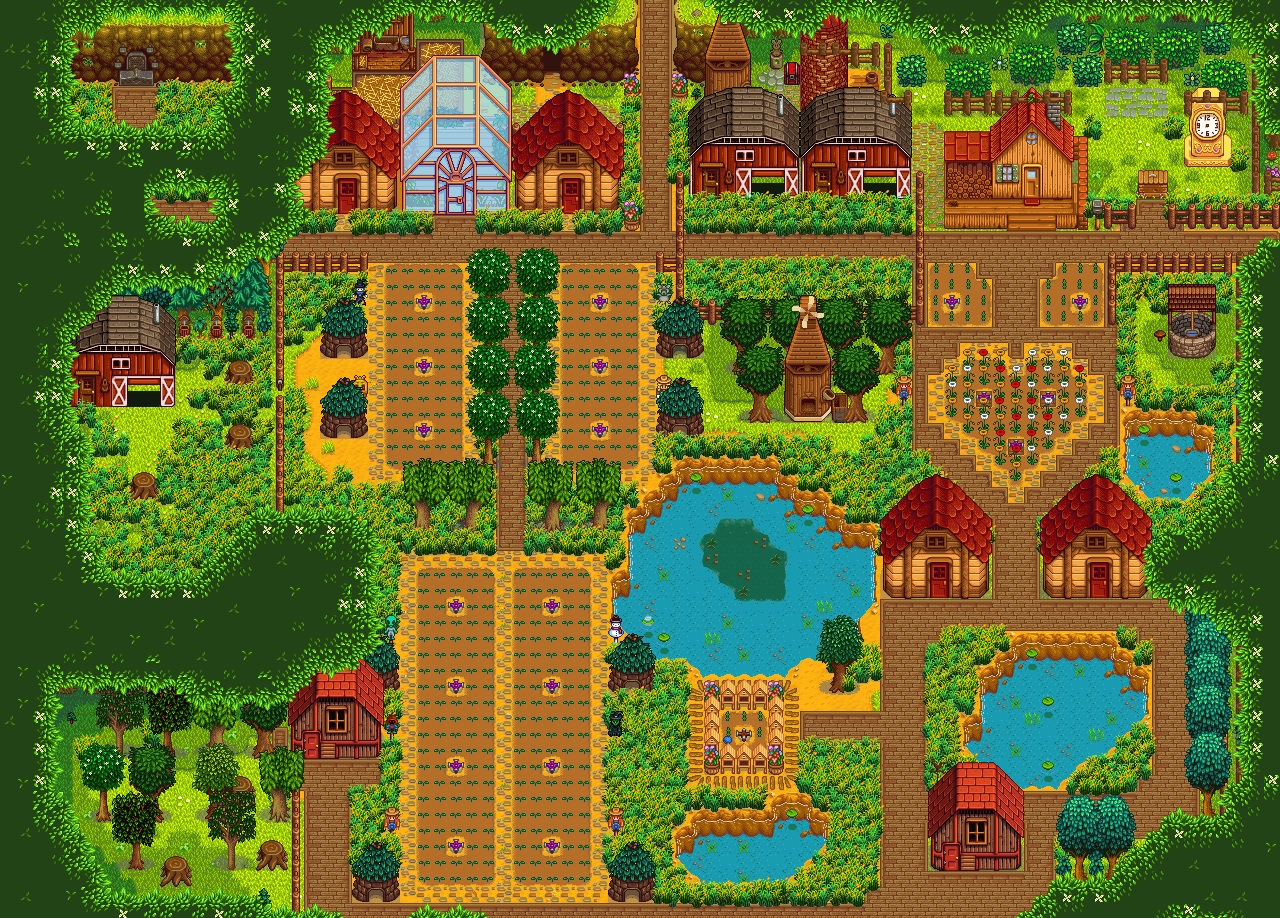
Image source: PC Gamer
To truly maximize this map, players should aim for the Botanist profession (Level 10 Foraging). This ensures that every forage item picked up on the farm is of Iridium quality, maximizing profit and inventory space. This synergy makes the Forest Farm an exceptionally strong choice for players who enjoy the gathering aspect of the game.
Overcoming Limitations on Difficult Maps
Some maps are intentionally designed to be challenging. The Beach Farm and Riverland Farm, for example, force players to rethink their reliance on automation. However, there are workarounds that can make these maps highly productive.
While you can't use sprinklers on sand, you can use them in the 202-tile patch of soil in the center-left. To expand beyond this, use the Greenhouse and the late-game Ginger Island farm. These areas allow for full automation, letting your main Beach farm focus on animals and fruit trees.
The "Island" structure of the Riverland map can be frustrating for movement. Use bridges and clear paths to connect the islands. Many players dedicate specific islands to specific tasks: one for the coop, one for the barn, and one for a small orchard, creating a clean, segmented look.
The Wilderness Farm also presents a unique challenge: monsters spawn at night. While this can be annoying, the monsters scale with your combat level, providing a way to farm combat XP and rare drops (like Iridium Ore or Coal) without leaving your property. For players who enjoy the combat mechanics, this layout offers a significant step forward in engagement compared to the peaceful Standard farm.
Late-Game Profitability: Barns vs. Sheds
As you move into the late game, the choice of farm layout impacts your scaling potential. There is a long-standing debate in the community regarding the most efficient way to generate gold: "Pig Armies" or "Preserve Jar Empires."
According to Steam community math , a Deluxe Barn filled with 12 pigs can generate an average of 17,892g per day through Truffle oil (with the Artisan profession). However, pigs do not produce in winter or on rainy days. In contrast, a Big Shed filled with 137 Preserve Jars can produce between 14,385g and 148,645g per day depending on the crop, and they work year-round.
- Standard Farm: Best for Shed-heavy builds due to flat, buildable land.
- Meadowlands: Best for Barn-heavy builds due to Blue Grass buffs.
- Four Corners: A strong middle ground that can accommodate both strategies effectively.
- Artisan Bonus: Always take the Level 10 Tiller -> Artisan branch to maximize the value of both Truffle Oil and Jelly.
For players on maps with limited tillable space, like the Hill-top or Riverland, focusing on Sheds is often more efficient. Since Sheds can be placed on non-tillable ground, you can save your precious soil for high-value crops while doing all your processing inside buildings. This strategy allows even the most constrained maps to remain highly competitive in terms of daily income.
Troubleshooting Common Farm Issues
Even with the 1.6 updates, players occasionally run into technical hurdles or regrets regarding their farm choice. It is important to know which issues are fixable and which require a fresh start.
Can You Change Your Farm Type?
In the vanilla game, your farm type is permanent. Once you select "Meadowlands" or "Forest" at the start of the game, you cannot change it through the in-game menu. While save-file editing is possible on PC, it often leads to terrain glitches (like trees growing in water or buildings floating in mid-air). If you are unhappy with your layout, it is usually better to restart early rather than trying to force a change later.
Fixing the Multiplayer "Ghost Farm" Bug
Some players have reported an issue where long-term co-op saves (Year 2+) stop appearing in the join list for friends. This is often referred to as the "Ghost Farm" bug. According to Stardew Valley Forum discussions , this can often be fixed by the host entering the save in single-player, moving a cabin slightly at Robin's shop, and then re-hosting. This "nudges" the save file and often restores visibility to other players.
Moving the Greenhouse
A common misconception is that the Greenhouse is stuck in its original location. Since the 1.5 update, once the Greenhouse is repaired, you can go to Robin's shop and move it just like any other building. This is a major improvement for layouts like the Hill-top or Wilderness farm, where the original Greenhouse placement might interfere with your ideal pathing or aesthetic design.
Frequently Asked Questions
Key Takeaways for Choosing Your Farm
- Standard Farm is the top choice for players who want to maximize industrial profit and tile count.
- Meadowlands Farm offers a significant advancement for early-game income through its starting chickens and Blue Grass.
- Forest Farm is highly recommended for those who prioritize a cozy aesthetic and easy access to Hardwood.
- Four Corners stands out as a top-tier option for multiplayer saves, providing organized quadrants for each player.
- Beach and Riverland farms are excellent choices for veteran players seeking a challenge or a fishing-focused run.
- 1.6 Mechanics like the Fish Smoker and Blue Grass have made non-Standard farms much more competitive.
- Building Placement is key: remember that you can move the Greenhouse and place Sheds on non-tillable land to save space.
Before you start your next save, decide if you prefer the slow, rewarding growth of crops or the immediate daily rhythm of animals.