Home
How to Play Ahri in Riftbound TCG and Which Card Version to Buy
Ahri stands out as a top-tier "Hold" specialist in the Riftbound TCG, rewarding players who prioritize defensive stability over aggressive conquering. As a Legend belonging to the Calm (Green) and Mind (Blue) domains, she excels at manipulating unit Might and controlling the battlefield flow. For competitive play, Ahri, Alluring is widely considered a strong choice for scoring-focused decks, while Ahri, Nine-Tailed Fox offers remarkable defensive utility with a 0-cost Might reduction ability.
Ahri is one of the 16 core Legends introduced in the Riftbound: Origins set, bringing her iconic charm and agility from the MOBA world into a strategic card game format. Unlike aggressive Legends like Darius or Rek'Sai, Ahri requires a high degree of foresight and resource management. She is not typically recommended for absolute beginners due to her reliance on the "Showdown" phase math, but for those who master her, she offers a level of control that few other Legends can match.
Which Ahri Legend Card Should You Choose?
In the current Origins set, players must decide between two primary Legend variants. While they share the same Domain requirements, their passive abilities dictate entirely different deck-building philosophies. According to data from Riftbound.gg , the choice often comes down to whether you want to win through attrition or accelerated scoring.
Ahri, Nine-Tailed Fox (#255/298)
This version is a defensive powerhouse. Her ability allows you to spend 0 Energy to give an attacking enemy unit -1 Might (to a minimum of 1) whenever they strike a battlefield you control. This is exceptionally strong against "wide" boards—decks that rely on many small units to overwhelm a lane. By reducing a 2-Might unit to 1, you effectively double the survival time of your own defenders.
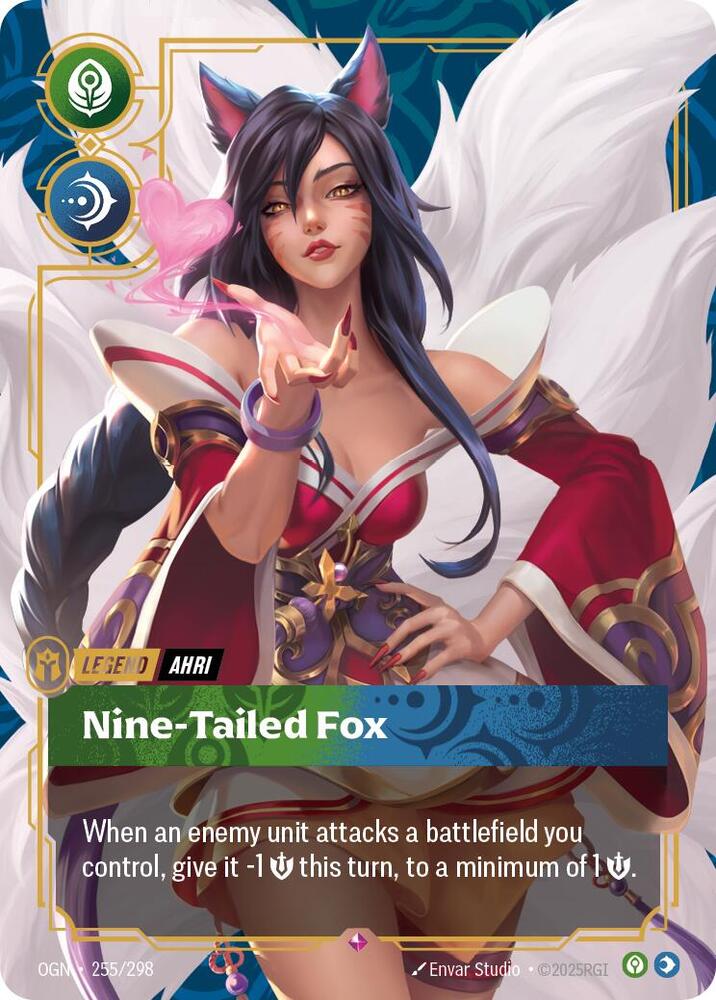
Image source: TCGplayer
Ahri, Alluring
Ahri, Alluring focuses on the "Hold" mechanic. Her passive ability states: "When I hold, you score 1 point." In Riftbound, holding a battlefield usually doesn't grant points immediately; you typically score by conquering the opponent's side. Ahri changes this fundamental rule, allowing you to sit back and accumulate victory points simply by existing on your side of the board. This makes her a top-rated option for "Turtle" decks that use shields and heals to outlast the opponent.
| Feature | Nine-Tailed Fox | Ahri, Alluring |
|---|---|---|
| Primary Role | Anti-Aggro / Control | Passive Scoring / Stall |
| Ability Cost | 0 Energy | Passive (Always Active) |
| Domains | Calm / Mind | Calm / Mind |
| Best Synergy | Sona, Shen | Clockwork Keeper, Sprite Mother |
| Skill Ceiling | High | Very High |
How the Hold Mechanic and Might Reduction Work in Practice
To play Ahri effectively, you must understand the distinction between "Hold" and "Conquer." A unit "Holds" when it is stationed on a battlefield you currently control. A unit "Conquers" when it moves onto a battlefield controlled by the opponent. Ahri is a specialist who thrives in the former state. By staying on your side, you maintain defensive bonuses from cards like Fortified Position while Ahri generates value.
The "Charm" lore from the MOBA is translated here through Might Manipulation . As noted by competitive player AlexanderTheGreatest in his Challenger TCG analysis , Ahri’s strength isn't raw damage; it is forcing the opponent into "bad math." If an opponent commits a 3-Might unit to clear your 2-Might defender, a simple -1 Might reduction from Ahri turns a successful clear into a stalemate. This forces the opponent to either over-commit resources or lose their momentum entirely.
Why Ahri Dominates in China but Struggles in the Western Meta
One of the most interesting aspects of Riftbound is the regional divergence in playstyles. Since the game's launch in China in August 2026, Ahri has consistently reached Top 32 and Top 64 brackets in major tournaments. However, in the Western (English) release, she is often viewed as a "tier 2" Legend. This discrepancy comes down to the speed of the meta.
Rather than being "weak," Ahri is widely regarded as a high skill ceiling Legend. She requires deep knowledge of the opponent's deck to know exactly when to hold back and when to push for a conquer. In the hands of a master, she is a remarkably consistent performer.
Advanced Strategies for Competitive Ahri Players
If you want to take Ahri into ranked play, you must move beyond basic Might reduction. High-level players like "Frank" on the Riftbound community forums emphasize two critical rules for Ahri pilots: the "Runes Open" rule and the "8th Point" trap.
Frank’s "Runes Open" Rule
Most beginners try to play their cards "on curve," spending all their Energy and Runes every turn. For Ahri, this is a fatal mistake. You should almost always keep at least 1 Energy or Rune available during your opponent's turn. This creates a "threat of activation." Even if you don't intend to use a combat trick, the mere fact that you could reduce an attacker's Might forces the opponent to play sub-optimally. They may hold back an attack they would otherwise make, giving you another turn of "Hold" scoring.
The "8th Point" Scoring Trap
In Riftbound, the first player to 8 points wins. However, if you score your 8th point via a "Hold" trigger at the start of your turn, the opponent still gets their full turn to react and potentially score their own 8th (or 9th) point to force a tie or a win. Advanced players recommend setting up a "Conquer" finish for the final point. Conquering ends the game state more decisively, often leaving the opponent with fewer windows for a counter-play. Use Ahri to get to 7 points, then use a movement trick to secure the 8th point through an aggressive move.
The Sprite Engine Combo
A significant advancement in Ahri strategy involves the "Sprite Engine" (Cards UNL-048 and UNL-215). By using Sprite Mother , you can generate small 1-Might tokens every time you Hold. While these tokens are weak individually, you can use new battlefield cards to move these Sprites onto the opponent's side, clearing their low-health utility units without risking your main Legend or high-cost followers.
Best Ahri Deck Lists for the Current Meta
Building a deck for Ahri requires a balance between the Calm domain (for healing and protection) and the Mind domain (for combat tricks and card draw). Below are two archetypes that have shown strong results in recent months.
1. The "Battlefield Control" Shell (Competitive Meta)
This deck focuses on protecting Ahri at all costs while slowly grinding out points. It uses Sona for her ability to grant shields and Shen as a "Bodyguard" to soak up damage.
- Legend: Ahri, Nine-Tailed Fox (x1)
- Support Legends: Sona (x1), Shen (x1)
- Core Units: Sprite Mother (x3), Clockwork Keeper (x3), Trifarian War Camp (x2)
- Spells/Tricks: Fortified Position (x3), Charm of the Fox (x2), Mind Blast (x2)
The goal here is to establish a "wall" in the center lane. Trifarian War Camp is a top-rated inclusion because its passive Might bonus protects your units from damage-based spells like Annie’s Disintegrate , which often targets units with 2 or less Might.
2. The "Body-Oriented" Counter-Meta (Budget Friendly)
If you are a new player or on a budget, you can utilize Ahri, Inquisitive . This version relies on high-health units to win Showdowns through sheer endurance rather than complex tricks.
- Legend: Ahri, Inquisitive (x1)
- Support Legends: Blitzcrank (x1), Foxfire (x1)
- Core Units: Ironback Turtle (x3), Meadow Guard (x3), Young Sprite (x4)
- Spells/Tricks: Nature's Grasp (x3), Shield of the Faithful (x2)
This deck is easier to pilot because it focuses on "winning the board" through stats. Blitzcrank provides the necessary "Pull" mechanic to drag weak enemy units into Showdowns with your high-health defenders.
Collector’s Guide to Ahri Card Rarities and Prices
For many, the hunt for Ahri is about the cards themselves rather than the gameplay. As one of the most popular characters in the League of Legends universe, her Riftbound cards carry a significant premium, especially in their rarer forms.
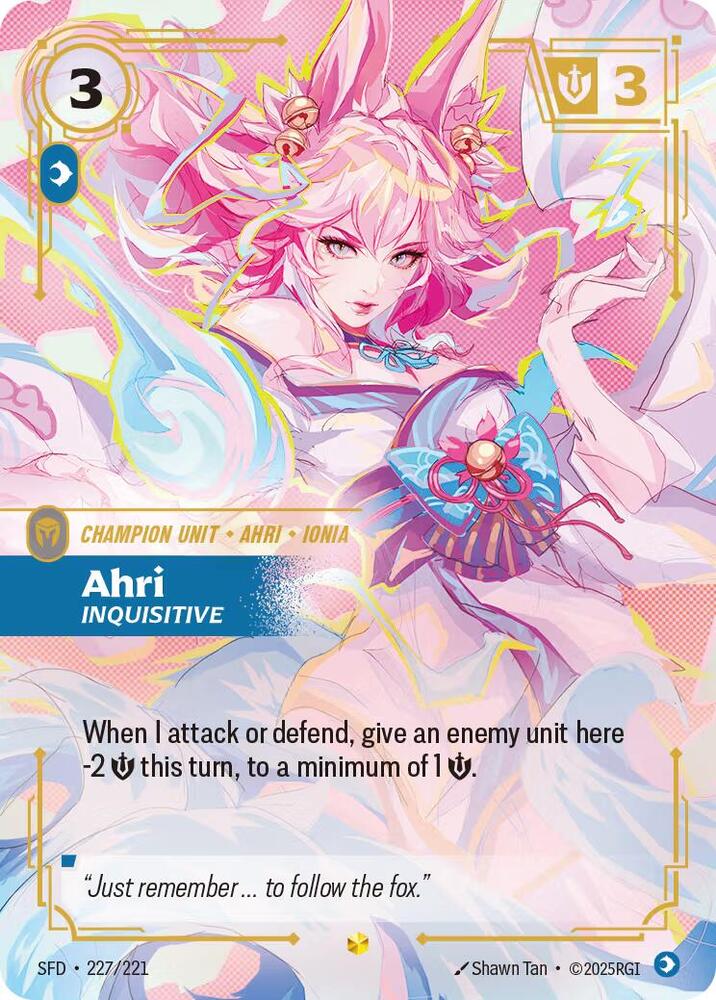
Image source: TCGplayer
Understanding the Rarity Tiers
As of late 2026, there are four distinct tiers of Ahri cards that collectors should be aware of:
- Standard (Common/Rare): The base versions found in booster packs. These are affordable and essential for players.
- Alternate Art (Alt Art): These feature unique illustrations not found in the standard set. The Ahri, Alluring Alt Art is a popular choice for those looking to "bling out" their decks.
- Spiritforged: A special holographic treatment that gives the card a shimmering, ethereal glow. These are significantly rarer than standard foils.
- Signature Series: The rarest tier, often featuring a gold-stamped signature. These are the "chase" cards of the Origins set.
| Card Version | Estimated Price (2026) | Rarity Level |
|---|---|---|
| Ahri, Alluring (Standard) | €0.05 - €0.50 | Common |
| Ahri, Nine-Tailed Fox (Rare) | €1.50 - €3.00 | Rare |
| Ahri, Alluring (Alt Art) | €5.00 - €12.00 | Promo / Super Rare |
| Spiritforged Ahri (Any) | €25.00 - €50.00 | Ultra Rare |
| Signature Ahri | €150.00+ | Secret Rare |
Prices are based on recent data from Cardmarket and TCGplayer. Note that "Near Mint" (NM) condition Spiritforged cards can often fetch a 20-30% premium over the base price.
Frequently Asked Questions
There are two primary Legend cards: Ahri, Nine-Tailed Fox and Ahri, Alluring . However, when you include rarity variants like Alt Arts, Spiritforged foils, and the Inquisitive common unit, there are over 10 distinct versions of Ahri cards for collectors to find in the Origins set.
The Signature Series Spiritforged Ahri is widely regarded as the rarest. These cards are overnumbered (e.g., #303/298) and feature a unique holographic pattern and a gold-stamped signature. They are typically found in less than one out of every five booster cases.
While there isn't a single keyword called "Charm," Ahri's abilities translate her MOBA charm through Might reduction and movement denial. By reducing an enemy's Might, she "charms" them into a state where they cannot effectively damage your defenders, effectively neutralizing their threat for a turn.
Typically, no. Ahri is a high-skill-ceiling Legend that requires a deep understanding of the "Showdown" phase and Energy management. Beginners may find more success with aggressive Legends like Garen or Darius, who have more straightforward "Conquer" win conditions.
The main difference is their win condition. Alluring helps you score points passively while you "Hold" your battlefields. Nine-Tailed Fox is a defensive tool that reduces the Might of attacking enemies, making it easier to survive aggressive pushes from your opponent.
Final Thoughts on Mastering the Nine-Tailed Fox
Ahri is a rewarding Legend for players who enjoy a tactical, defensive playstyle. To succeed with her in the 2026 meta, keep these points in mind:
- Prioritize Hold scoring with Ahri, Alluring to force the opponent to make risky aggressive moves.
- Use Might reduction to turn unfavorable Showdowns into stalemates, preserving your board presence.
- Avoid the 8th Point trap by aiming to score your final victory point through a Conquer move rather than a Hold trigger.
- Keep your Runes open to maintain a "threat of activation," forcing your opponent to play around potential combat tricks.
- Invest in the Sprite Engine (UNL-048) to generate consistent value and clear small enemy threats.
- Watch regional trends , as the slower Chinese meta often provides the best blueprints for successful Ahri control decks.
- Collect with care , prioritizing Spiritforged and Alt Art versions for long-term value and aesthetic appeal.
Start by practicing your Might reduction timing in casual matches before taking Ahri into the competitive ladder.