Home
What Are the Different Types of Phone Games and Which Ones Are Actually Worth Playing?
Mobile gaming is categorized by commitment levels (Casual, Mid-core, Hardcore) and genres (Puzzle, Strategy, RPG, Action). While Hyper-casual games lead in downloads due to their simple "one-thumb" mechanics, Strategy and RPGs generate the highest revenue because of deep progression systems. To find quality titles, look for Premium games or Subscription services like Apple Arcade, which avoid the predatory "pay-to-win" mechanics common in free-to-play charts.
How the Mobile Gaming Landscape Has Evolved Since Snake
The journey of mobile gaming is a fascinating study of hardware limitations and creative ingenuity. Long before the high-fidelity graphics of modern smartphones, the industry began with simple, monochrome experiences. The first mobile game, a version of Tetris , appeared on the Hagenuk MT-2000 in 1994. However, it was the 1997 release of Snake on Nokia devices that truly ignited the global phenomenon, eventually being pre-installed on roughly 350 million handsets worldwide, according to historical records of mobile gaming .
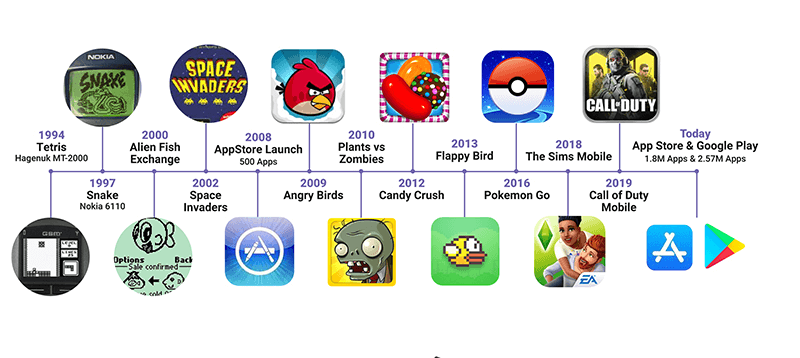
Image source: js13kGames
The real shift occurred in 2008 with the launch of the Apple App Store. This transformed the mobile phone from a communication tool into a portable gaming console. By 2009, the introduction of in-app purchases (IAP) fundamentally altered the business model, shifting the industry from "pay once" premium titles to the "freemium" model that dominates today. As of recent years, mobile gaming accounts for approximately 49% of total global gaming revenue, making it a larger market than both PC and console gaming combined.
Understanding the Three Levels of Player Commitment
When discussing types of phone games, it is helpful to categorize them by the mental energy and time they require. The industry typically divides players and games into three distinct tiers: Casual, Mid-core, and Hardcore. This framework helps users identify which titles fit their lifestyle, whether they are looking for a thirty-second distraction or a multi-hour competitive session.
Why Casual Games Are a Popular Choice for Most Users
Casual games are designed for "pick-up-and-play" accessibility. They feature simple mechanics, short levels, and low stakes. This category has a massive 58% penetration rate among mobile users because it fits into the "micro-moments" of daily life—waiting for a bus, sitting in a lounge, or taking a quick break. Within this tier lies the Hyper-casual sub-genre, characterized by "one-thumb" gameplay and minimalist visuals. These games are often notably innovative in their simplicity, focusing on a single satisfying mechanic like slicing, bouncing, or stacking.
What Makes a Game Mid-Core or Hardcore?
Mid-core games bridge the gap between casual fun and serious commitment. They often feature the accessible mechanics of casual games but add layers of strategy, collection, or social competition. Titles like Clash of Clans fall into this category; you can play for five minutes, but long-term success requires regular check-ins and strategic planning.
Hardcore games, on the other hand, are the mobile equivalent of console experiences. These games, such as PUBG Mobile or Genshin Impact , demand high skill ceilings, significant time investments, and often high-end hardware. They are frequently competitive and require the player's undivided attention, often making them a top choice for younger, more dedicated gaming audiences.
| Category | Session Length | Skill Ceiling | Typical Genres |
|---|---|---|---|
| Hyper-Casual | 30s - 2 mins | Very Low | Runners, Stackers, Slicers |
| Casual | 2 - 10 mins | Low to Medium | Match-3, Word, Hidden Object |
| Mid-Core | 10 - 30 mins | Medium | Strategy, Card Battlers, Simulators |
| Hardcore | 30+ mins | High | Battle Royale, MOBA, MMORPG |
Which Mobile Game Genres Generate the Most Downloads and Revenue?
There is a significant disconnect between what people download and where they spend their money. This data-driven insight is crucial for understanding why certain types of games are pushed so heavily in app stores. According to industry reports, the market is projected to reach $138 billion by 2025, but that wealth is not distributed evenly across genres.
The Massive Scale of Hyper-Casual Action and Puzzles
In terms of raw volume, Hyper-casual games are the titans of the industry. In 2021 alone, Action-focused hyper-casual titles saw over 4 billion downloads. These games are designed to be viral and disposable; users download them, play them for a few days, and move on to the next trend. Because they are free and have a tiny file size, they are the most accessible entry point for new smartphone users.
Why Strategy and RPGs Lead the Revenue Charts
While hyper-casual games win on downloads, they often struggle with monetization, relying heavily on intrusive ads. In contrast, Strategy and RPG (Role-Playing Game) genres are the financial powerhouses. The Strategy market recently earned approximately $9.7 billion in annual consumer spend, nearly triple that of the Match-3 puzzle genre. This is due to "deep monetization" systems—mechanics that encourage players to invest in their progress over months or even years. These genres stand out as a top-tier choice for developers looking for sustainable, long-term growth.
A Deep Dive into Mainstream Mobile Game Genres
To truly understand the types of phone games available, we must look at the specific mechanics that define each genre. While many games now blend multiple categories, most titles still have a "core loop" that fits into one of the following buckets.
The Evolution of Puzzle and Word Games
Puzzle games are the bedrock of mobile gaming. They have evolved from simple tile-matching like Bejeweled into complex, narrative-driven experiences. Modern puzzles often incorporate "meta-layers," where solving a grid allows you to renovate a mansion or solve a mystery. Word games, including hits like Wordle or Crossword Jam , remain a staple for older demographics, offering a cognitive challenge that feels productive rather than just entertaining.
Strategy and Management Games for Long-Term Play
Strategy games on mobile are often divided into "Build and Battle" (like Clash of Clans ) and "4X" (Explore, Expand, Exploit, Exterminate). These games focus on resource management and long-term planning. They are highly social, often requiring players to join "Clans" or "Alliances" to survive. This social pressure is a key driver of both engagement and monetization, as players feel a responsibility to their team to stay active and powerful.
Role-Playing Games and the Gacha Phenomenon
RPGs on mobile range from traditional turn-based adventures to massive multiplayer worlds (MMORPGs). However, the most prominent sub-genre is the "Gacha" game. Named after Japanese toy vending machines, these games involve collecting characters or items through a randomized, lottery-like system. While these titles offer immense depth and high-quality art, they are often criticized for their predatory psychological triggers, as they encourage players to spend large sums of money to acquire rare "SSR" (Super Special Rare) units.
Action and Battle Royale Games for Competitive Players
Action games have seen a resurgence on mobile thanks to improved hardware. Battle Royale titles, where 100 players fight to be the last one standing, have become a global cultural force. These games require precise controls and fast reaction times. Because touchscreens can be imprecise, many competitive players consider these games a top choice for use with external Bluetooth controllers to gain a competitive edge.
The Hidden World of Mobile Adventure and Narrative Games
It is important to note that "Adventure" on mobile often means something different than on consoles. While console adventure games are action-heavy, mobile adventure games often lean toward "Point-and-Click" or "Hidden Object" mechanics. These games focus on storytelling, atmosphere, and logic puzzles. They are a leading choice for players who want an immersive experience without the stress of combat or timers.
How to Choose a Game Based on Your Demographic Profile
Gaming preferences are not universal; they shift significantly based on age and gender. Data from YouGov's research on mobile game categories highlights these distinct trends, helping you find a genre that aligns with your peer group's interests.
Popular Genres for Gen Z and Younger Players
Gen Z players (born roughly between 1997 and 2012) gravitate toward high-intensity, social, and competitive games. Approximately 21% of this demographic prefers Action and Battle Royale titles. They are also the most likely to engage with "Sandbox" games like Roblox or Minecraft , which allow for creative expression and social interaction within a virtual space. For this group, a game is often a social hub as much as it is a challenge.
Common Game Types for Gen X and Boomers
Older players tend to favor games that are relaxing or mentally stimulating. Among Gen X and Boomers, Puzzle and Breakout games are a top choice, with about 22% participation. Card and Casino games are also significantly more popular in this age bracket (15%) compared to younger cohorts. These players often use mobile games as a way to unwind at the end of the day or to keep their minds sharp during downtime.
Gender Differences in Mobile Gaming Preferences
While the "gamer" stereotype is often male-centric, the mobile market is nearly split 50/50. However, the genres they choose differ. Women are statistically more likely to play Word, Brain, and Match-3 games. Men, conversely, show a stronger preference for Action, Strategy, and Sports titles. Understanding these trends helps developers target their advertising, but it also helps users find communities where they are likely to feel most at home.
How to Spot High-Quality Games and Avoid Low-Effort Slop
The mobile market is unfortunately flooded with "slop"—low-effort clones designed to harvest ad revenue. Navigating this requires a keen eye for monetization ethics and production quality. Not all free games are created equal, and some are designed specifically to exploit psychological vulnerabilities.
The Benefits of Premium and Flat-Rate Games
Premium games are those you pay for upfront. While they are less common on the "Top Charts," they often provide a significantly better experience. Titles like Slay the Spire or Stardew Valley are complete packages with no ads, no energy timers, and no "pay-to-win" mechanics. For many enthusiasts, these are widely regarded as a top-tier option because they respect the player's time and wallet.
Subscription Services Like Apple Arcade and Google Play Pass
If you dislike individual purchases, subscription services offer a curated, high-quality alternative. Apple Arcade and Google Play Pass provide access to hundreds of games for a monthly fee. The crucial benefit here is that these games are strictly forbidden from having in-app purchases or ads. This environment has allowed for notably innovative titles to flourish—games that might have failed in the cutthroat free-to-play market.
Identifying Fair Freemium vs Pay-to-Win Mechanics
If you do play free games, it is vital to distinguish between "Fair" and "Predatory" models.
- Cosmetic-Only Monetization
- Players pay for skins or visual flair that does not affect gameplay. This is considered the gold standard for fairness.
- Pay-to-Win (P2W)
- Players can purchase power, better stats, or items that give them a direct advantage over non-paying players.
- Energy Timers
- Mechanics that stop you from playing unless you wait several hours or pay to "refill" your energy.
Native Touch Design vs Clunky Console Ports
A major factor in whether a phone game is "worth playing" is how it handles the interface. Because phones lack physical buttons, the best-designed games are those built specifically for the medium.
Games Designed Specifically for Touchscreens
Native touch games use the unique features of a smartphone—accelerometers, multi-touch gestures, and haptic feedback. A leading example is Blackbox , which requires you to solve puzzles by tilting the phone, plugging in a charger, or changing the volume. These games feel "at home" on the device and offer an experience you cannot get on a console or PC. They represent a significant step forward in mobile-first design.
When You Should Use a Bluetooth Controller
Conversely, many games are "ports" of console titles. While it is impressive to play Call of Duty or Resident Evil on a phone, the virtual joysticks are often clunky and obscure the screen. In these cases, using a Bluetooth controller (like an Xbox or PlayStation controller) is highly recommended. It transforms the phone into a mini-console, providing the precision needed for hardcore action without the frustration of greasy thumb-sliding.
Can Phone Games Actually Improve Your Brain Power?
The "Brain Training" genre is a multi-million dollar industry, but the science behind it is nuanced. While some games claim to make you smarter, the reality is often that they simply make you better at that specific game.
The Science Behind Cognitive Gaming Apps
Apps like Peak or Lumosity are developed in collaboration with neuroscientists. They target specific cognitive functions like memory, mental agility, and problem-solving. According to research on brain-sharpening games , these apps can help with "divided attention" and "processing speed," provided they are used consistently. They stand out as a top choice for users who want their gaming time to feel productive.
Distinguishing Between Brainless Time-Passers and Smart Games
Not all puzzles are "brain games." A hyper-casual runner requires reaction time but very little cognitive load. A complex logic puzzle or a strategy game like Polytopia , however, requires high-level planning and deduction. If your goal is cognitive improvement, look for games that force you to learn new rules and adapt your strategy, rather than those that rely on repetitive, mindless actions.
Frequently Asked Questions
What is the difference between casual and hyper-casual mobile games?
The primary difference lies in complexity and session length. Casual games, like Candy Crush , have levels that might take 3-5 minutes and include progression systems, stories, and events. Hyper-casual games are even simpler, often featuring "one-thumb" mechanics and sessions that last less than a minute. Hyper-casual games are designed for instant gratification and are usually supported entirely by ads, whereas casual games often include in-app purchases for power-ups or extra lives.
Are there mobile games that don't have ads or in-app purchases?
Yes, these are typically called "Premium" games. You pay a one-time fee to download them, and they contain no further costs or interruptions. Additionally, subscription services like Apple Arcade and Google Play Pass offer a library of hundreds of games that are strictly prohibited from having ads or in-app purchases. These services are widely considered a top choice for players who want a clean, console-like experience on their mobile devices.
Which mobile game types can be played offline?
Most single-player puzzle games, narrative adventures, and classic arcade ports can be played without an internet connection. However, many modern "free-to-play" games require a connection to verify purchases, load ads, or sync progress to the cloud. If you need offline games for travel, look for the "Offline Games" category in the App Store or Play Store, or opt for premium titles which rarely require a constant heartbeat connection.
What are the top phone game genres for adults?
Based on demographic data, adults (Gen X and Boomers) tend to prefer Strategy, Puzzle, and Card/Casino games. These genres offer a balance of mental stimulation and relaxation without requiring the twitch reflexes of action games. Narrative-driven "Hidden Object" games and complex management simulators are also highly popular among adult players who enjoy long-term progression and storytelling over competitive combat.
Why are some mobile games called "slop"?
"Slop" is a community term used to describe low-quality, mass-produced games that often clone popular mechanics just to show as many ads as possible. These games usually have poor performance, stolen assets, or misleading advertisements that don't match the actual gameplay. Avoiding "slop" involves checking reviews, looking for established developers, and being wary of games that seem too similar to existing hits but with lower production values.
What is a Gacha game?
A Gacha game is a sub-genre of RPG where players spend in-game currency (which can be bought with real money) to receive a randomized virtual item or character. It is similar to opening a pack of trading cards. While the core gameplay can be very deep and high-quality, the "Gacha" mechanic is often controversial because it uses psychological triggers similar to gambling to encourage players to spend money in hopes of getting a rare, powerful character.
Final Thoughts on Finding Your Next Favorite Game
The mobile gaming world is vast and varied, offering everything from mindless distractions to deep, emotionally resonant stories. To find the experience that is right for you, keep these key takeaways in mind:
- Identify your commitment level before downloading; choose casual for short breaks and hardcore for dedicated sessions.
- Prioritize "Native Touch" designs if you want an experience that feels natural on a smartphone screen.
- Use subscription services like Apple Arcade to access high-quality, ad-free titles for a low monthly cost.
- Check monetization styles in the app description to avoid "pay-to-win" traps and predatory energy timers.
- Align genres with your goals , opting for brain trainers for cognitive health or narrative adventures for relaxation.
- Don't equate high download counts with quality , as many top-downloaded games are ad-heavy "hyper-casual" titles.
- Consider a controller for console ports to improve precision and clear up screen space.
- Explore premium titles for a "pay once, play forever" experience that respects your time.
Start by browsing the "Editor's Choice" or "Premium" sections of your app store to discover games that prioritize quality over quick ad revenue.