Home
How to Find and Use NFL Depth Charts for Every Team
Understanding the hierarchy of a professional football roster is a fundamental skill for fans, bettors, and fantasy managers alike. A depth chart for the NFL is more than just a list of names; it is a living document that reflects coaching philosophy, injury status, and future team planning. In the modern era, where roster moves happen daily, staying informed requires knowing which tools provide the most accurate data at any given moment.
Where to Find the Most Accurate NFL Depth Charts Today
Navigating the landscape of sports information can be overwhelming. Several platforms stand out as top choices for different types of users. Whether you are looking for immediate injury news or deep scouting analysis, these sources provide the foundation for your research.
ESPN Real-Time News
Widely regarded as a leading option for breaking news, ESPN's NFL depth charts are updated frequently to reflect Injured Reserve (IR) moves and practice squad elevations. It is particularly useful for tracking game-day active/inactive statuses.
Ourlads Scouting Detail
For those who need granular detail, Ourlads is a respected source among scouts. They track how every player was acquired (Draft, Free Agency, or Trade) and offer a level of detail that few competitors match.
CBS Sports Fantasy Focus
CBS Sports excels at providing return timelines for injured players. Instead of a generic "Out" tag, they often provide projected return weeks, which is vital for long-term planning.
| Source | Best For | Update Speed | Printable? |
|---|---|---|---|
| ESPN | Real-time injury news | Hourly | Yes (PDF) |
| Ourlads | Scouting & Acquisition | Daily | No |
| FantasyPros | Expert Consensus (ECR) | Daily | Yes |
| CBS Sports | Injury Return Timelines | Daily | No |
What Do the Different Colors and Symbols Mean on a Depth Chart?
Scouting-grade depth charts often use a complex system of color-coding to convey information quickly. Understanding these visual cues allows you to see the "DNA" of a roster at a glance. For instance, a team heavily reliant on "Purple" players is likely in a rebuilding phase, while a "Gold" heavy roster suggests a team in a "win-now" window using veteran acquisitions.
- Gold (Ourlads System)
- Indicates a player acquired via Free Agency or Trade. These are typically veterans brought in to fill immediate needs.
- Purple
- Represents a Rookie Draft Pick. These players are the future of the franchise and often receive more "leash" during training camp battles.
- Aqua
- Designates an Undrafted Free Agent (UDFA). These are the "long shots" who have successfully climbed the roster hierarchy.
- IR (Injured Reserve)
- A player who is sidelined for a minimum of four games. In 2026, teams have a limited number of "return from IR" designations.
- PUP (Physically Unable to Perform)
- Usually applies to players who suffered significant injuries in the prior season. They do not count against the 53-man roster but cannot practice for the first four weeks.
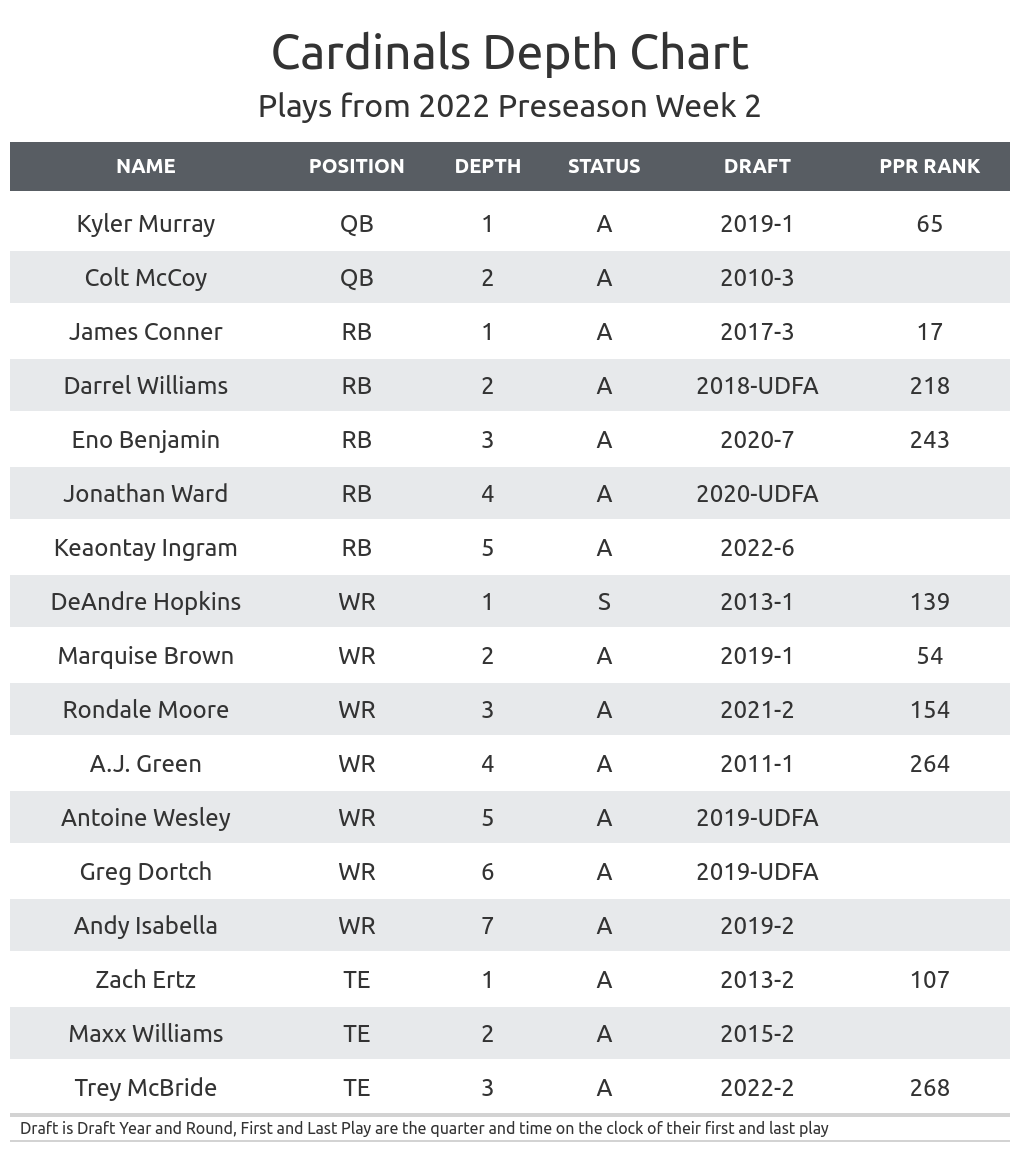
Image source: PFF
Why Official Team Depth Charts Differ from Fantasy Football Rankings
One of the most common mistakes new fans make is assuming the "Starter" on the official team chart is the most valuable player for fantasy football. There is a significant difference between political hierarchies and functional hierarchies. An official chart often respects veteran status, listing a 10-year pro as the starter out of professional courtesy, even if a high-upside rookie is expected to take 70% of the snaps.
According to data from FFToday , there are frequent instances where a "QB3" on a roster might be ranked as the "Fantasy QB2" because of their rushing ability or specific role in goal-line packages. This is why many experts recommend using Expert Consensus Rankings (ECR) from platforms like FantasyPros . ECR blends the projections of hundreds of analysts to determine who will actually produce on the field, rather than who is listed first on the team's website.
How Defensive Schemes Change the Way You Look at Depth
A player's position on a depth chart is often dictated by the team's defensive philosophy. The two primary systems in the NFL are the 3-4 Defense (three linemen, four linebackers) and the 4-3 Defense (four linemen, three linebackers). This distinction is critical for Individual Defensive Player (IDP) fantasy leagues.
- The Hybrid Role: An "Edge Rusher" might be listed as a Defensive End (DE) in a 4-3 system but as an Outside Linebacker (OLB) in a 3-4. Their job is the same—pressuring the quarterback—but their depth chart designation changes.
- The Nickel Corner: In the modern NFL, teams play "Nickel" (five defensive backs) over 60% of the time. This means the "slot corner," often listed as a backup on traditional charts, actually plays more snaps than the starting "Strongside Linebacker."
- Interior Pressure: In a 3-4, the Nose Tackle (NT) is the anchor, but in a 4-3, the two Defensive Taughts (DT) share the load. Understanding these alignments helps you identify which backups are one injury away from a massive workload.
Understanding the Emergency Third Quarterback Rule
In recent years, the NFL has refined the "Emergency QB3" rule to prevent teams from being left without a signal-caller due to in-game injuries. As of the 2026 season, teams can designate a third quarterback who is inactive on game day but eligible to play if the first two quarterbacks are injured or disqualified.
This rule has a notable impact on roster construction. Most teams now carry three quarterbacks on the 53-man roster rather than stashing the third on the practice squad. For fantasy managers in "Superflex" or "2-QB" leagues, tracking who holds this QB3 spot is a significant advancement in injury protection strategy. While the QB3 rarely sees the field, they are the only player authorized to enter the game under the emergency provision without the team losing a roster spot.
How to Identify High-Value Fantasy Football Handcuffs
A "handcuff" is a backup player, usually a running back, who would immediately become a high-end starter if the primary player were to miss time. Not all backups are created equal; some are part of a "committee" where multiple players share the load, while others are "bell-cow" backups who would inherit the entire role.
| Tier | Description | Fantasy Upside | Example Role |
|---|---|---|---|
| Tier 1: Elite | Clear backup to a workhorse; high talent level. | RB1 Potential | Primary backup in San Francisco or Dallas |
| Tier 2: Strong | Talented but likely to share some carries. | RB2 Potential | Change-of-pace back in Detroit |
| Tier 3: Speculative | Unproven rookie or veteran in a weak offense. | Flex/Bench | Roster bubble players in New England |
When evaluating handcuffs, look for Contract Year Indicators . If a starting running back is in the final year of his deal and the team has a high-draft-pick rookie as the RB2, the depth chart is likely to shift toward the rookie as the season progresses. This "hidden depth" is often where league-winning fantasy players are found.
Tracking Roster Movement from Training Camp to the Postseason
Depth charts are not static; they evolve through four distinct phases each year. Spotting a player climbing the ranks before the mainstream media reports it is a significant competitive advantage.
- The Offseason/Draft Phase: New arrivals (Gold and Purple players) disrupt the existing hierarchy. This is the time to identify "veteran casualties"—players who may be cut due to high salaries and younger, cheaper depth.
- Training Camp & Preseason: This is where "Risers and Fallers" emerge. Pay close attention to Preseason Week 3; this is typically the "dress rehearsal" where the first-team depth chart is finalized.
- The Trade Deadline: Mid-season acquisitions can instantly demote a productive starter to a backup role. Tracking these "Gold" acquisitions is vital for understanding late-season rotations.
- The Postseason Push: Teams often elevate specialized players from the practice squad for specific matchups. These players might only play 10 snaps, but they are often the key to a specific tactical game plan.
Image source: Stable Diffusion Online
How to Get a Printable NFL Depth Chart for Your Draft
For those who prefer a physical reference during a draft or while watching games, a printable depth chart is a top-tier tool. However, standard web pages often print poorly, with cut-off columns and excessive ads. To get the best results, look for PDF-optimized versions like the ESPN Fantasy PDF .
Optimization Tips for Printing:
- Use Black and White: Most scouting charts use colors that don't translate well to grayscale. Look for "printer-friendly" versions that use bold text or symbols instead of background colors.
- Landscape Orientation: NFL rosters are wide. Printing in landscape mode ensures that all three strings (Starter, 2nd, 3rd) fit on a single line.
- Combine with ECR: The most effective "cheat sheets" combine the official depth chart with Expert Consensus Rankings, giving you both the team's view and the market's view on one page.
Key Takeaways for Managing Your NFL Roster Knowledge
- Check Ourlads for acquisition history to see if a player was a high-priority free agent (Gold) or a draft pick (Purple).
- Cross-reference ESPN for the latest IR and PUP updates, as they typically have the fastest reporting on roster moves.
- Use FantasyPros to identify "Functional" depth, which often differs from the "Official" hierarchy released by the team.
- Watch for "OR" designations to spot upcoming position battles or rotation-heavy backfields.
- Differentiate between 3-4 and 4-3 schemes to understand why a player's position might change between different platforms.
- Track the Emergency QB3 to ensure you know who is eligible to play in a worst-case scenario.
Depth charts are living documents; the most successful fans and fantasy players track the movement of players throughout the season rather than just memorizing names on opening day.
Frequently Asked Questions
All trademarks, copyrighted content, and quoted material referenced in this article belong to their respective owners. Brief excerpts and factual data are used for purposes of commentary, criticism, and informational reporting. This article is not affiliated with or endorsed by the National Football League or any specific franchise.