Home
How to Get and Use Every Type of Ice in Minecraft
To obtain ice blocks in Minecraft, you must use a tool enchanted with Silk Touch . Without this enchantment, breaking ice will result in water or nothing. There are four main types: Regular Ice (melts near light), Packed Ice (solid, non-melting), Blue Ice (fastest for boats), and Frosted Ice (temporary). For high-speed travel, Blue Ice ranks among the top choices, allowing boats to reach speeds of up to 72 meters per second.
Ice is one of the most versatile blocks in Minecraft, serving as a critical component for both aesthetic builds and high-efficiency infrastructure. Whether you are constructing a sprawling frozen palace or a trans-continental Nether highway, understanding the nuances of ice physics is essential. In this guide, we will explore the technical properties of every ice variant, how to farm them effectively, and how to prevent common issues like accidental melting.
What Are the Four Different Types of Ice in Minecraft?
Minecraft features a hierarchy of ice blocks, each with distinct physical properties and crafting requirements. Choosing the right type depends on whether you need transparency, durability, or maximum slipperiness for transportation.
The standard, translucent block. It is unique because it can melt into water if the light level is too high. It is widely regarded as a top choice for decorative windows in cold biomes.
An opaque, solid version of ice. Unlike regular ice, it never melts, making it a reliable building material for structures in any dimension, including the Nether.
The rarest and slipperiest variant. It is exceptionally strong for boat travel and is found naturally in massive icebergs within frozen ocean biomes.
Additionally, there is Frosted Ice , a temporary block generated by the Frost Walker enchantment on boots. This ice naturally decays and cracks over time, eventually turning back into water. It cannot be obtained as an item, even with Silk Touch, according to official Minecraft documentation .
Technical Comparison Table
| Property | Regular Ice | Packed Ice | Blue Ice |
|---|---|---|---|
| Transparency | Translucent (Light passes through) | Opaque (Solid) | Opaque (Solid) |
| Melts? | Yes (Block Light > 11) | No | No |
| Slipperiness | 0.98 | 0.98 | 0.989 |
| Boat Speed | 40 m/s | 40 m/s | 72.7 m/s |
| Crafting Cost | N/A (Natural) | 9 Regular Ice | 9 Packed Ice |
How to Get Ice Without It Melting Into Water
The most common mistake players make is attempting to mine ice with a standard pickaxe. In Minecraft, ice is a "fragile" block. If you break it with a normal tool, it will either vanish or turn into a water source block (if there is a solid block beneath it). To collect the block itself, you must use the Silk Touch enchantment.
The Silk Touch Requirement
Silk Touch can be applied to pickaxes, shovels, axes, and hoes. While any Silk Touch tool will work, a pickaxe is generally the most efficient choice. For players looking to harvest large quantities, a Diamond or Netherite pickaxe with Efficiency III or higher allows for "insta-mining," where the block breaks instantly upon clicking. This is a significant advancement for players building large-scale projects.
Where to Find Ice Naturally in Your World
If you don't have an automated farm yet, natural harvesting is your best option. Ice generates in specific "cold" biomes where the temperature is below 0.15. According to the Minecraft Wiki , these locations are the primary sources for natural ice:
- Snowy Tundra & Frozen Peaks: These biomes feature vast frozen lakes and rivers. They are the most reliable places to find regular ice in bulk.
- Ice Spikes Biome: A rare variant of the snowy tundra filled with massive pillars of Packed Ice. This is one of the few places to get Packed Ice without crafting it.
- Frozen Oceans: These biomes contain massive icebergs. While the surface is regular ice, the core of these icebergs is often made of Packed Ice and Blue Ice. Harvesting these is often faster than crafting Blue Ice from scratch.
- Snowy Village Loot: Chests in snowy kingdom structures occasionally contain ice blocks as loot, though this is not a viable method for large-scale gathering.
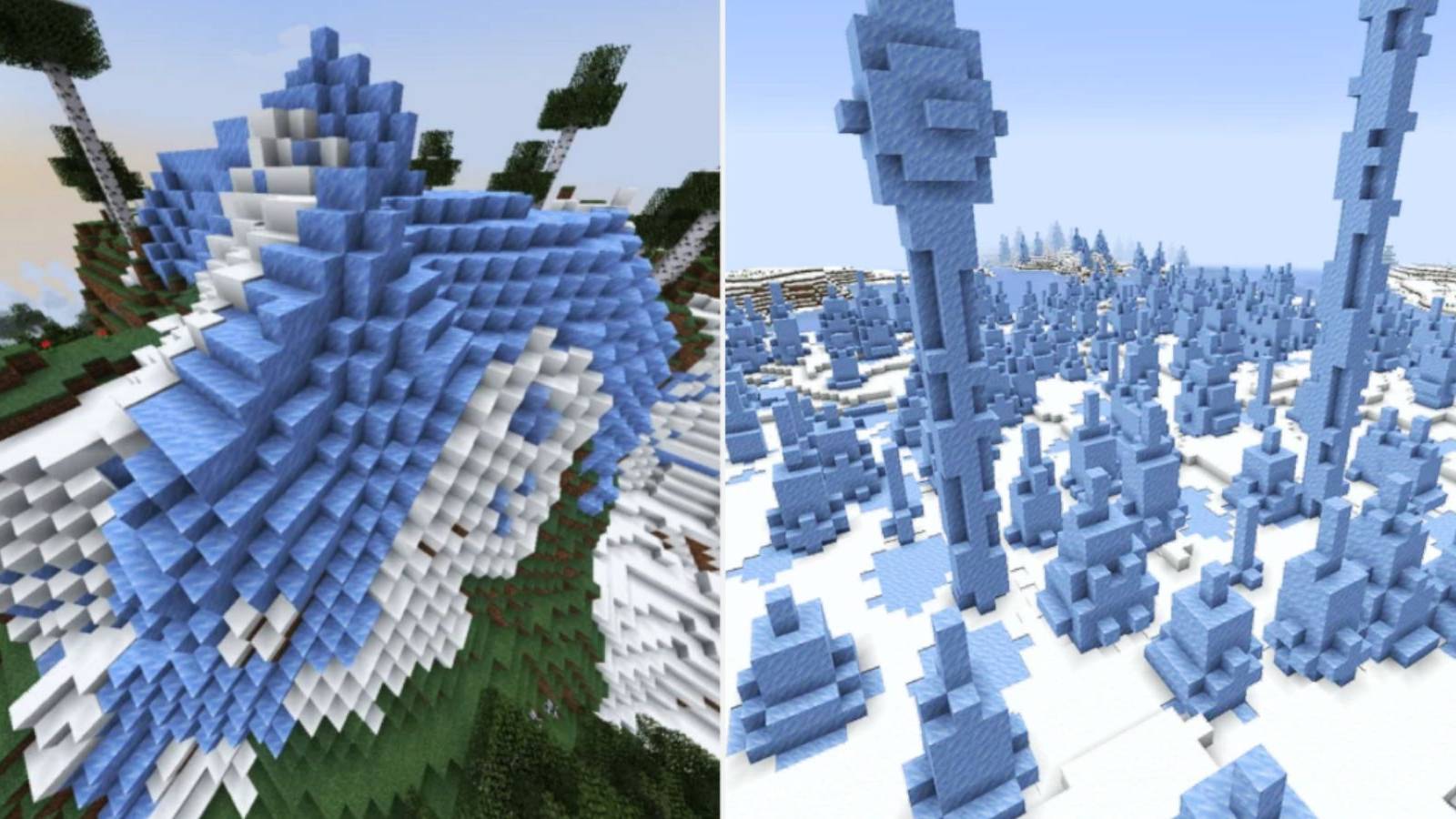
Image source: GameRant
How to Craft Packed Ice and Blue Ice
If you have an abundance of regular ice but need the non-melting or faster variants, you can use a crafting table. The recipes follow a strict 9-to-1 ratio, meaning you need a full 3x3 grid of the lower-tier ice to create one block of the higher tier.
The 9-to-1 Crafting Ratio
To create 1 Packed Ice , place 9 Regular Ice blocks in the crafting grid. To create 1 Blue Ice , you need 9 Packed Ice blocks. This means that a single block of Blue Ice requires a total of 81 regular ice blocks. Because of this high resource cost, many players prefer to harvest Blue Ice directly from icebergs in Frozen Oceans.
It is important to note that these recipes are "one-way." You cannot place a Blue Ice block back into a crafting table to get 9 Packed Ice blocks. Once you compact the ice, it is permanent, so plan your resource usage carefully.
Why Does My Ice Keep Melting?
One of the most frustrating experiences for builders is watching a frozen floor turn into a flooded mess. Regular ice melts based on Block Light levels, not Sky Light. This means that even in the middle of a frozen tundra, a torch placed too close will melt the ice.
The Light Level Rule
Regular ice melts if the block light level immediately adjacent to it is greater than 11 . Sunlight (Sky Light) does not melt ice, which is why frozen lakes don't disappear during the day. However, torches, glowstone, and lanterns all emit light levels high enough to trigger melting.
Soul Torches (Light Level 10) and Redstone Torches (Light Level 7) are safe to place directly on or next to regular ice without causing it to melt.
Standard Torches (14), Lanterns (15), and Glowstone (15) will melt any regular ice within a 2-3 block radius.
The "Ice Age" Glitch
Occasionally, players report their bases suddenly freezing over or ice melting in areas that were previously stable. This is often due to "biome shifts" caused by game updates. If a biome's temperature is adjusted in a new version, the game may suddenly treat your base as a "cold" biome, causing all water to freeze. Conversely, if a biome warms up, your ice structures may begin to melt. Using Packed or Blue ice for structural elements is a top-tier strategy to avoid these issues, as they are entirely immune to light-based melting.
How to Build an Efficient Infinite Ice Farm
For players who need thousands of blocks for Nether highways, manual harvesting is too slow. An automated or semi-automated ice farm is a significant step forward in resource management. Ice forms when water source blocks are exposed to the sky in a cold biome, provided the light level is low and there is an adjacent solid block.
The Diagonal Slab Trick
A common problem with ice farms is that once the water freezes and you mine it, you have to manually refill the water. To solve this, you can use the "Diagonal Slab Trick." By placing slabs or solid blocks three blocks above specific water sources in a diagonal pattern, you prevent those specific blocks from freezing (because they no longer have sky exposure). These water blocks then act as "infinite sources" that automatically refill the areas you mine, allowing the farm to replenish itself indefinitely.
Farm Tiers for Every Player
- Level 1: The Manual Pool. A simple 16x16 pool of water in a snowy biome. You wait for it to freeze and mine it with Silk Touch.
- Level 2: The Water-Stream Sweep. A design that uses water streams to push items to a central collection point after you mine them, reducing the time spent running around the pool.
- Level 3: Automated Flying Machines. For technical players, flying machines can be used to automatically break the ice blocks and push them into collection hoppers. According to community discussions on Reddit , high-end farms can produce upwards of 70,000 blocks per hour.
How to Build the Fastest Nether Ice Highways
Transportation is perhaps the most popular use for ice. When a boat is placed on ice, its friction is drastically reduced, allowing it to reach incredible speeds. When this is combined with the Nether's 8:1 travel ratio, it becomes one of the most efficient ways to travel thousands of blocks in seconds.
Boat Speed Physics
On regular or Packed Ice, a boat travels at approximately 40 meters per second. However, Blue Ice increases this to roughly 72 meters per second. Because every block traveled in the Nether counts as eight blocks in the Overworld, traveling on a Blue Ice highway in the Nether is equivalent to moving at 576 meters per second in the Overworld. This ranks among the top methods for long-distance travel in the game.
Advanced Transport Techniques
For players looking to optimize their highways even further, consider these advanced tips:
- Slipperiness Carry-over: In the Java Edition, you can place carpets or slabs over your ice path. The game still calculates the "slipperiness" of the ice underneath, allowing you to run fast or slide boats while maintaining a more varied aesthetic for your floor.
- The Boat-Minecart Motor: By placing a boat inside a minecart on rails, you can create a "motorized" entity that travels at high speeds and can even climb slopes, which standard boats on ice cannot do easily.
- Button Placement: To prevent mobs from spawning on your highway, place buttons or pressure plates on the ice. Mobs cannot spawn on these, ensuring your high-speed travel isn't interrupted by a stray Creeper.
Key Differences Between Minecraft Java and Bedrock Edition Ice
While the core mechanics are similar, there are notable technical differences between the two main versions of the game. These differences can affect how you build farms and lighting systems.
Exclusive to Bedrock and Education Edition, Ice Bombs can be thrown into water to instantly freeze a 3x3 area. This is a notably innovative way to cross oceans quickly.
Java Edition ice has a light opacity of -1, whereas Bedrock diffuses light differently. This affects how deep light can penetrate through frozen lakes and how mobs spawn beneath them.
In Bedrock Edition, waterlogged blocks (like fences or stairs) count as an "adjacent non-water block" that can trigger the freezing process. In Java, these blocks often prevent freezing in the immediate vicinity.
Key Takeaways for Minecraft Ice
- Always use Silk Touch to harvest ice blocks; otherwise, they break into water or disappear.
- Blue Ice is the top choice for transportation, offering nearly double the boat speed of Packed Ice.
- Packed and Blue Ice never melt , making them safe for use in the Nether or near high-intensity light sources.
- Regular ice melts if the block light level exceeds 11; use Soul Torches to provide light without melting your build.
- Natural harvesting in Frozen Oceans is often more efficient than crafting Blue Ice due to the 81:1 resource ratio.
- Use the diagonal slab method in cold biomes to create an infinite, self-replenishing ice farm.
Start by enchanting a Diamond pickaxe with Silk Touch and Efficiency to begin building your first high-speed Nether transport hub today.
Frequently Asked Questions
- Does Blue Ice make boats go faster than Packed Ice?
- Yes, significantly. While Packed Ice allows boats to reach 40 m/s, Blue Ice increases that speed to approximately 72.7 m/s. This makes Blue Ice a top-tier option for long-distance travel, especially when used in the Nether to take advantage of the 8:1 distance scaling.
- Can you melt Packed Ice with a torch?
- No. Packed Ice and Blue Ice are completely melt-proof. They will not turn into water regardless of the light level or the dimension they are placed in. This makes them the preferred choice for building in the Nether or creating permanent structures in warm biomes.
- What is the fastest way to get Blue Ice?
- The most efficient method is harvesting large icebergs in Frozen Ocean biomes using a Silk Touch pickaxe. Crafting Blue Ice is extremely resource-intensive, requiring 81 blocks of regular ice for every single block of Blue Ice, so natural harvesting is usually much faster.
- Can you use ice in the Nether?
- Yes, but with limitations. You can place Packed Ice and Blue Ice as blocks in the Nether, and they will function perfectly for travel. However, if you place regular ice, it will melt if the light level is too high. Furthermore, if you melt ice in the Nether, the resulting water will instantly evaporate unless you are in Creative mode.
- How do I stop water from freezing in cold biomes?
- To prevent water from turning into ice, you must either increase the light level above 10 using torches or place a block (like a slab or string) directly above the water source. Since ice requires sky exposure to form, any block covering the water will stop the freezing process.