Home
How to Use the Supplementaries Minecraft Mod to Enhance Your World
The Supplementaries mod is a top-tier "Vanilla+" expansion that adds functional and decorative items to Minecraft without disrupting the core gameplay loop. It requires the Moonlight Library to function and is available for Forge, Fabric, and Bedrock. Key features include Faucets for liquid automation, Sconces for dynamic lighting, and Notice Boards for displaying maps and books. If your game crashes on startup, it is likely due to the "VibeChecker" rendering conflict, which can be resolved by isolating banner-modifying plugins.
What Is the Supplementaries Mod and Why Should You Use It?
In the vast landscape of Minecraft modifications, few projects manage to strike the delicate balance between innovation and tradition. The Supplementaries mod stands out as a top choice for players who want to expand their world's utility and aesthetic appeal while maintaining the "Vanilla+" feel. Developed by MehVahdJukaar, the mod focuses on filling the functional gaps that Mojang has left open over the years.
With over 200 million downloads according to Modrinth project data , its popularity is a testament to its reliability and design quality. Unlike "overhaul" mods that introduce complex magic systems or high-tech machinery, Supplementaries adds items that feel like they could have been part of the base game. Think of it as a collection of "missing features"—from hanging signs that actually swing to jars that can hold small mobs.
The mod is widely considered one of the best options for builders and Redstone engineers alike. It provides tools that solve specific survival problems, such as the Faucet for easier liquid management or the Waymarker for navigation in sprawling biomes. Whether you are playing on a solo survival world or a large multiplayer server, these additions provide a significant advancement in how you interact with the environment.
How to Install Supplementaries and the Moonlight Library
Setting up the mod requires attention to detail regarding your Minecraft version and mod loader. Because Supplementaries is available on multiple platforms, you must ensure your files are compatible with your specific setup.
- Select Your Mod Loader: Determine if you are using Forge or Fabric . While the Forge version is the lead development branch, the Fabric port is highly stable, though it may occasionally lag behind in minor feature updates.
- Download the Core Files: Visit the official Modrinth or CurseForge pages. Download the Supplementaries .jar file that matches your Minecraft version (e.g., 1.20.1 or 1.21).
- Install Moonlight Library: This is the most common point of failure for new users. You must download the version of Moonlight Library that corresponds exactly to your Supplementaries version.
-
Place Files in the Mods Folder:
Navigate to your
.minecraft/modsdirectory and drop both .jar files inside. - Launch and Verify: Start the Minecraft launcher. If the game loads to the main menu, check the "Mods" button to confirm both "Supplementaries" and "Moonlight" are listed.
For players on the Bedrock Edition , the process is different. You can find the official version of the mod on the Minecraft Marketplace . This version is curated by Razzleberries and offers a selection of the Java version's features optimized for consoles and mobile devices.
What Are the Top Decorative Items in Supplementaries?
Building in Minecraft often feels limited by the blocky nature of standard decorations. Supplementaries introduces a variety of "micro-decorations" that add depth to interiors and exteriors. These items are designed to blend seamlessly with vanilla textures, ensuring your builds look enhanced rather than cluttered.
Sconces and Lighting
Standard torches are functional but visually repetitive. Sconces offer a more refined alternative. They can be placed on walls or ceilings and come in various metal finishes. A notable feature of Sconces is their interaction with the environment; they can be extinguished by water or manually toggled, making them excellent for atmospheric builds or adventure maps.
Signage and Navigation
Navigating a large survival world can be challenging. The mod adds Signposts and Waymarkers . Unlike standard signs, Signposts can point in specific directions and display custom text, allowing you to create realistic road networks. Waymarkers act as small milestones that can be dyed and named, providing a visual cue for trails through dense forests or mountain ranges.
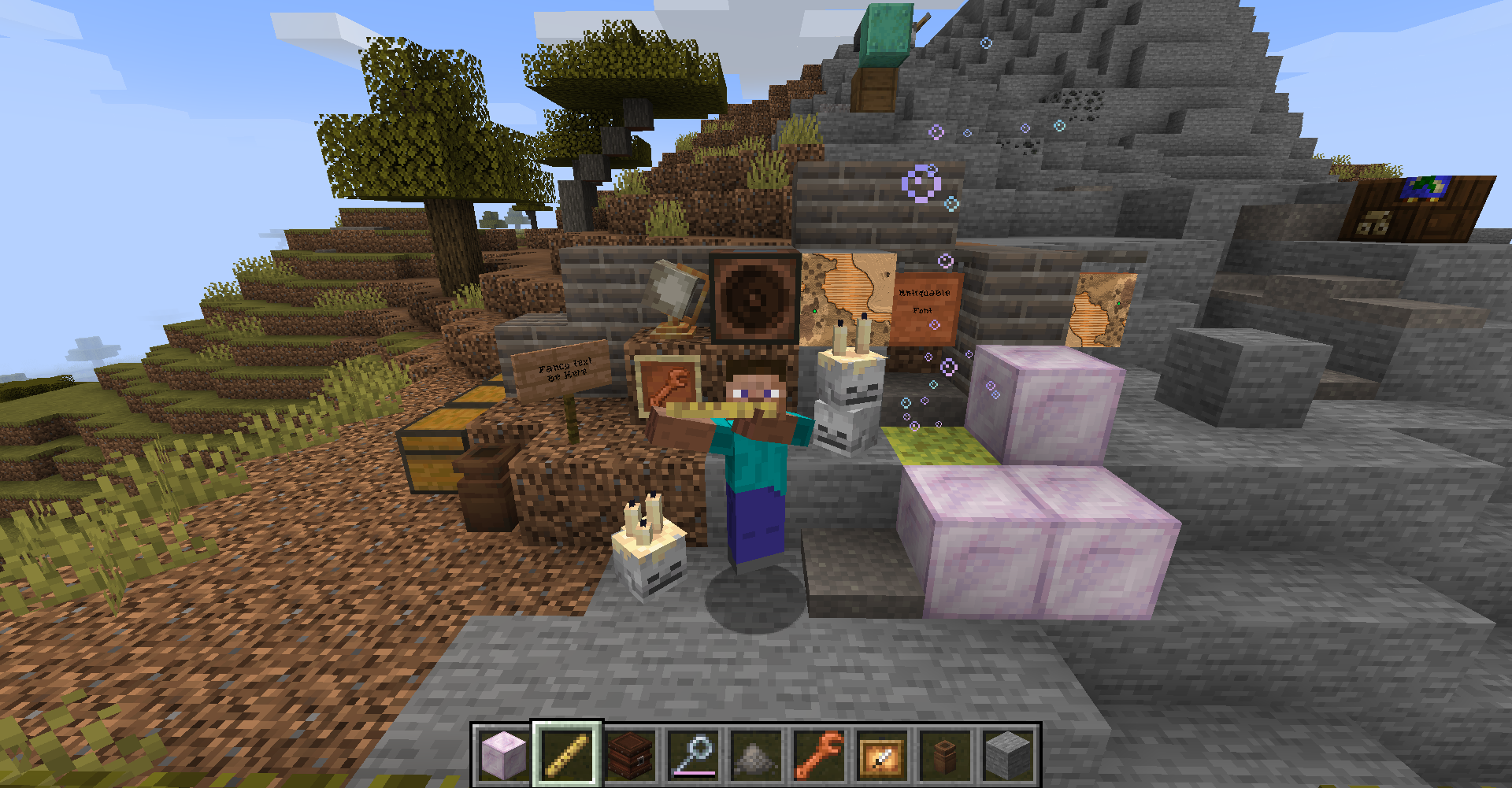
Image source: CurseForge
The Notice Board
The Notice Board is a highly functional block that allows you to display a single page of a book or a map. This is exceptionally useful for server spawn points where you need to display rules or for personal bases where you want to keep a "to-do" list visible without opening a GUI. When a map is placed on a Notice Board, it renders in a smaller, framed format that fits perfectly above a desk or chest.
How to Automate Your Base Using Faucets and Jars
While the mod is famous for its decor, its technical additions are equally impressive. The combination of Faucets and Jars introduces a new layer of liquid and entity management that bridges the gap between basic buckets and complex industrial mods.
The Faucet Mechanic
The Faucet is a block that can be attached to the side of any container (like a Chest, Barrel, or even a modded Tank). When powered by a Redstone signal, the Faucet will "pour" the contents of the container into the block below it.
- Liquid Transfer: If placed on a Cauldron or Water Tank, it will pour water, lava, or honey into a Jar or another Cauldron below.
- Item Transfer: Faucets can also drop items from a chest, acting as a decorative alternative to a Dropper.
- Redstone Logic: The flow of liquid from a Faucet can trigger a Tripwire Hook or a Pressure Plate, allowing for unique liquid-based timers.
Jar Utility and Entity Storage
Jars are among the most versatile blocks in the mod. They can store up to 12 portions of a liquid (like soup or potions) or act as a display case for small mobs. By right-clicking a Jar on a Bee, Slime, or Fish, you can capture the entity inside. This is not just decorative; captured Bees will continue to produce honey if the Jar is placed near flowers, creating a compact, one-block honey farm.
Why Does My Game Crash With a VibeChecker Error?
As your modpack grows, you may encounter technical hurdles. One of the most common issues reported in the community is the VibeChecker crash . This error typically occurs during the "Initializing Game" phase and is related to how Minecraft handles banner patterns and shield textures.
The "Sheets" Class Conflict
According to official GitHub issue reports , the VibeChecker is a safety mechanism built into Supplementaries to ensure that banner patterns are loaded correctly. If another mod (such as Optifine, Iris, or specific performance enhancers) attempts to modify the "Sheets" class before Supplementaries can initialize its custom patterns, the VibeChecker will trigger a crash to prevent visual bugs or further instability.
How to Fix Rendering Issues
If you experience this crash, follow these steps:
- Isolate Rendering Mods: Temporarily remove mods like Optifine or Oculus to see if the game launches.
- Check for "Blaze Rod" Desync: On some servers, blocks like Daub or Stone Tiles may appear as Blaze Rods or other unrelated items. This is a client-server synchronization error. Ensure that both the server and the client are running the exact same version of Supplementaries and Moonlight Library.
- Update Moonlight: Many rendering bugs are fixed in Moonlight Library updates rather than the main Supplementaries file. Always check for a newer version of the library first.
How to Tweak the Mod Using the Configuration Files
One of the reasons Supplementaries is widely regarded as a top-tier mod is its customizability. The developer has ensured that almost every single item or mechanic can be toggled or adjusted to fit your playstyle. This is particularly useful if you find a specific item (like the Bomb) to be too powerful for your survival server.
Locating the Config File
To change settings, you need to find the configuration file located at:
.minecraft/config/supplementaries-common.toml
You can open this file with any text editor (like Notepad or VS Code). Inside, you will find categories for "General," "Items," and "Blocks." Each entry has a simple
true/false
toggle. If you want to disable the
Spring Launcher
because it interferes with your parkour map, simply find the line
spring_launcher = true
and change it to
false
.
Advanced Toggles
Beyond just enabling or disabling items, the config allows for fine-tuning:
- Clock Format: Change the Clock item to display 24-hour time or 12-hour time.
- Weather Vane Sensitivity: Adjust how quickly the Weather Vane reacts to wind changes.
- VibeChecker Bypass: While not recommended, there is a setting to disable the VibeChecker if you are confident your rendering mods are not causing actual visual issues.
What Are the Differences Between Java and Bedrock Versions?
While the goal is feature parity, the technical differences between the Java Engine and the Bedrock Engine mean that the two versions of Supplementaries are not identical. The Java version remains the "lead" version where new features are tested first.
| Feature | Java (Forge/Fabric) | Bedrock (Marketplace) |
|---|---|---|
| Total Item Count | 100+ Items & Blocks | Selected Top Features |
| Redstone Integration | Full (Faucets, Sensors) | Limited by Bedrock Engine |
| Customization | Deep (.toml config files) | Minimal (In-game settings) |
| PVP Items | Bombs, Slingshots | Enhanced PVP Focus |
| Installation | Manual (.jar files) | One-click (Marketplace) |
For players seeking the most stable experience, the Forge version is often cited as the strongest contender. However, the Bedrock version is an excellent choice for those playing on consoles who want to spice up their worlds without the hassle of manual modding.
How to Find Hidden Secrets and Easter Eggs
The developers of Supplementaries have hidden several fun interactions within the mod that aren't immediately obvious from the crafting recipes. These "Easter Eggs" add a layer of community charm to the project.
"The best way to discover the heart of a mod is to look for the things the developers hid just for the fans."
The Credits Book
If you want to see the full list of people who contributed to the mod, there is a specific in-game method. Craft a Notice Board and place it down. Then, take a Written Book and title it exactly "credits" (case sensitive). When you place this book on the Notice Board, it will display a special scrolling list of the development team and major contributors. This is a significant advancement over standard "About" menus found in other mods.
Patreon Rewards and Statues
You may occasionally see players with unique Globes or Statues that you cannot craft. These are often custom rewards for individuals who support the developer on Patreon. However, you can still obtain standard Statues in survival mode, which can be dressed in armor or hold items, acting as a more versatile version of the Armor Stand.
Official Wiki Warning
A common pitfall for new players is using the Fandom Wiki for information. The lead developer has explicitly stated on the official GitHub page that the Fandom site is outdated and often contains incorrect recipes. Always refer to the GitHub Wiki or use an in-game mod like Just Enough Items (JEI) to see the most accurate data for the version you are playing.
Frequently Asked Questions
How do I open presents in Supplementaries?
Presents are a fun way to store or gift items. To open a present that has been placed on the ground, you simply need to "punch" it (left-click). The present will break, dropping the item stored inside along with some festive particle effects. You can wrap items by combining a Present with any item in a crafting grid.
Is Supplementaries compatible with the Quark mod?
Yes, Supplementaries is designed to be highly compatible with Quark. In fact, many players consider them a "must-have" duo for any Vanilla+ modpack. The developers of both mods frequently communicate to ensure that their features don't overlap redundantly and that their textures match the same aesthetic standards.
Why are my blocks appearing as Blaze Rods on my server?
This is a known rendering desync issue, often seen on hosting services like Aternos. It happens when the client's mod list doesn't perfectly match the server's configuration. To fix this, ensure that the
supplementaries-common.toml
file on the server is identical to the one on your local computer, and verify that both are using the same version of the Moonlight Library.
Does the mod work on Minecraft version 1.21?
As of late 2026, Supplementaries is actively maintained for the latest versions of Minecraft, including 1.21. The developer focuses on porting to the most recent major releases. However, always check the "Files" tab on Modrinth to ensure a stable build has been released for your specific sub-version (e.g., 1.21.1).
How do I use the Slingshot effectively?
The Slingshot is a unique tool that allows you to fire small blocks or items. To use it, place the item you want to fire (like a Pebble or a Torch) in your off-hand. Hold right-click to charge the Slingshot and release to fire. It is an excellent choice for placing torches in hard-to-reach places like high cave ceilings.
Key Takeaways for Mastering Supplementaries
The Supplementaries mod is a significant step forward for anyone looking to deepen their Minecraft experience without losing the game's original charm. By following this guide, you can avoid common technical pitfalls and unlock the full potential of your builds.
- Dependency First: Always install the Moonlight Library alongside the mod to prevent startup crashes.
- Solve Crashes: If you hit a "VibeChecker" error, look for conflicts with rendering mods like Optifine or Iris.
- Automate Simply: Use Faucets and Jars to create compact, aesthetic liquid storage and entity farms.
- Trust Official Sources: Avoid the Fandom wiki; use the GitHub Wiki or JEI for accurate crafting recipes.
-
Customize Your Experience:
Don't be afraid to edit the
.tomlconfig file to disable items that don't fit your world's balance. - Explore Easter Eggs: Try the "credits" book on a Notice Board to see the team behind the project.
To get started, try installing the mod in a creative testing world first to experiment with how the Faucet Redstone logic interacts with your favorite building blocks.